Table of Contents
Most IT teams can’t answer basic questions about their own WAN circuits without digging through spreadsheets, carrier portals, and old emails. Which circuit serves the Dallas office? When does that contract end? Who do you call at the carrier when it goes down?
Those gaps get expensive. Contracts auto-renew at old rates, disconnected sites keep getting billed, and outages drag on while someone hunts for a circuit ID.
A circuit inventory platform fixes this by giving every service a single record. The decision to make first is which kind of tool should own that record. Telecom lifecycle platforms come from the finance and procurement side, so they’re strong on contracts and costs. Network documentation tools come from engineering, so they’re strong on ports, terminations, and topology. Few products do both well.
This guide compares six platforms across both categories, covering what each one tracks, how its records stay current, and who it suits.
What a Circuit Inventory Should Track
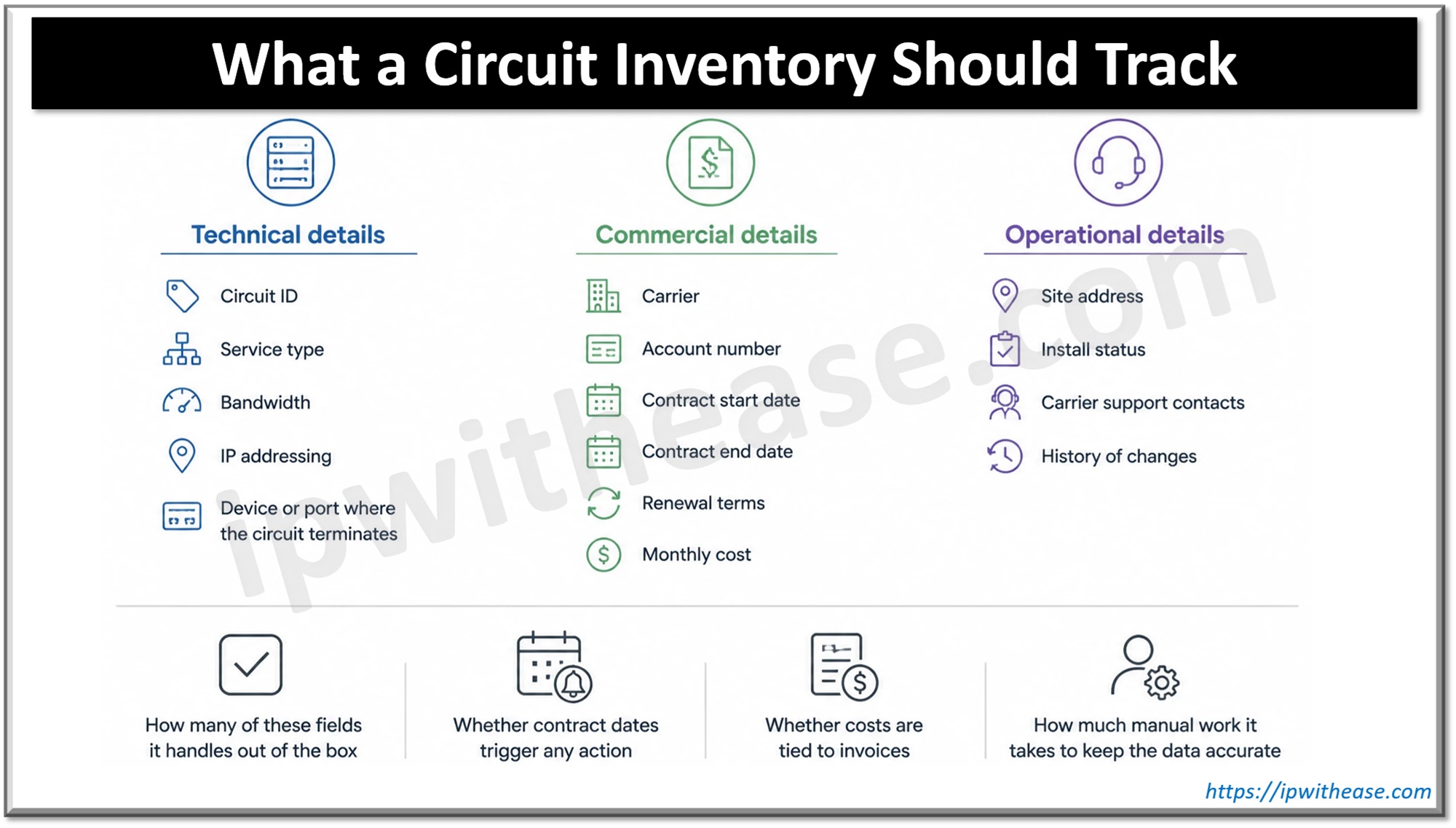
A useful circuit record covers three kinds of information:
- Technical details: Circuit ID, service type, bandwidth, IP addressing, and the device or port where the circuit terminates.
- Commercial details: Carrier, account number, contract start and end dates, renewal terms, and monthly cost.
- Operational details: Site address, install status, carrier support contacts, and a history of changes.
We compared each platform on how many of these fields it handles out of the box, whether contract dates trigger any action, whether costs are tied to invoices, and how much manual work it takes to keep the data accurate.
Telecom Circuit Inventory Management Platforms at a Glance
| Platform | Type of tool | Technical detail | Contracts and renewals | Cost data | How records stay current |
|---|---|---|---|---|---|
| ServiceNow | CMDB and workflow platform | Configurable | Configurable | Requires add-on apps | Depends on your configuration |
| Calero | Technology expense platform | Network visualization | Contract tracking | Linked to invoice processing | Invoice data and carrier connections |
| NetBox | Network documentation tool | Circuits, providers, terminations | Install and termination dates only | Not built in | Manual entry or API |
| Lightyear | Telecom lifecycle platform | 30+ data points per service | Alerts plus automated rebids | Reconciled against invoices | Updates automatically from procurement |
| Sakon | Telecom lifecycle platform | Network and mobile assets | Contract tracking | Linked to invoice processing | Carrier integrations and workflows |
| Device42 | IT asset and infrastructure tool | Circuits with endpoint mapping | Order, provision, and expiry dates | Purchase details only | Manual entry or import |
ServiceNow
ServiceNow is a workflow platform whose configuration management database (CMDB) can hold circuit records next to the rest of your IT estate. Its Telecommunications Network Inventory application is aimed at service providers, so many enterprises build their own circuit tables with fields such as circuit ID, type, provider, and terminating device.
What it tracks:
- Whatever fields you configure, commonly circuit ID, type, provider, bandwidth, and terminating device
- Relationships between circuits and the devices or services that depend on them
How the inventory stays current: That depends on your setup. Records are typically maintained through change workflows or fed by a telecom application that runs on the platform.
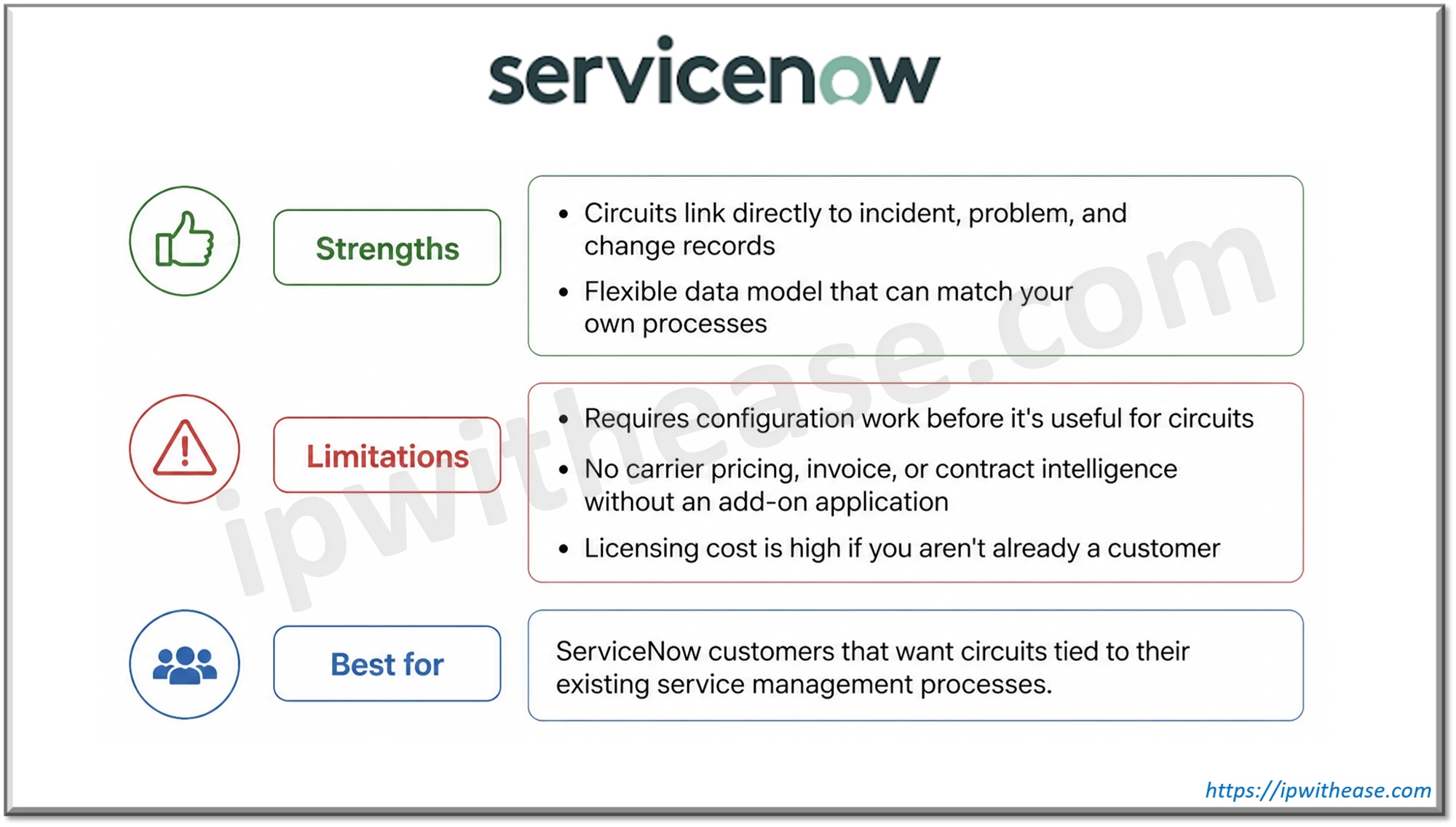
Strengths:
- Circuits link directly to incident, problem, and change records
- Flexible data model that can match your own processes
Limitations:
- Requires configuration work before it’s useful for circuits
- No carrier pricing, invoice, or contract intelligence without an add-on application
- Licensing cost is high if you aren’t already a customer
Best for: ServiceNow customers that want circuits tied to their existing service management processes.
Calero
Calero manages telecom, mobility, and software expenses in one platform. Inventory tracking sits alongside invoice processing, and the platform includes network visualization for seeing services across locations.
What it tracks:
- Services and assets tied to invoices
- Contracts and vendor details
- Costs allocated by department and business unit
How the inventory stays current: Inventory is built mainly from invoice data and electronic connections with carriers.
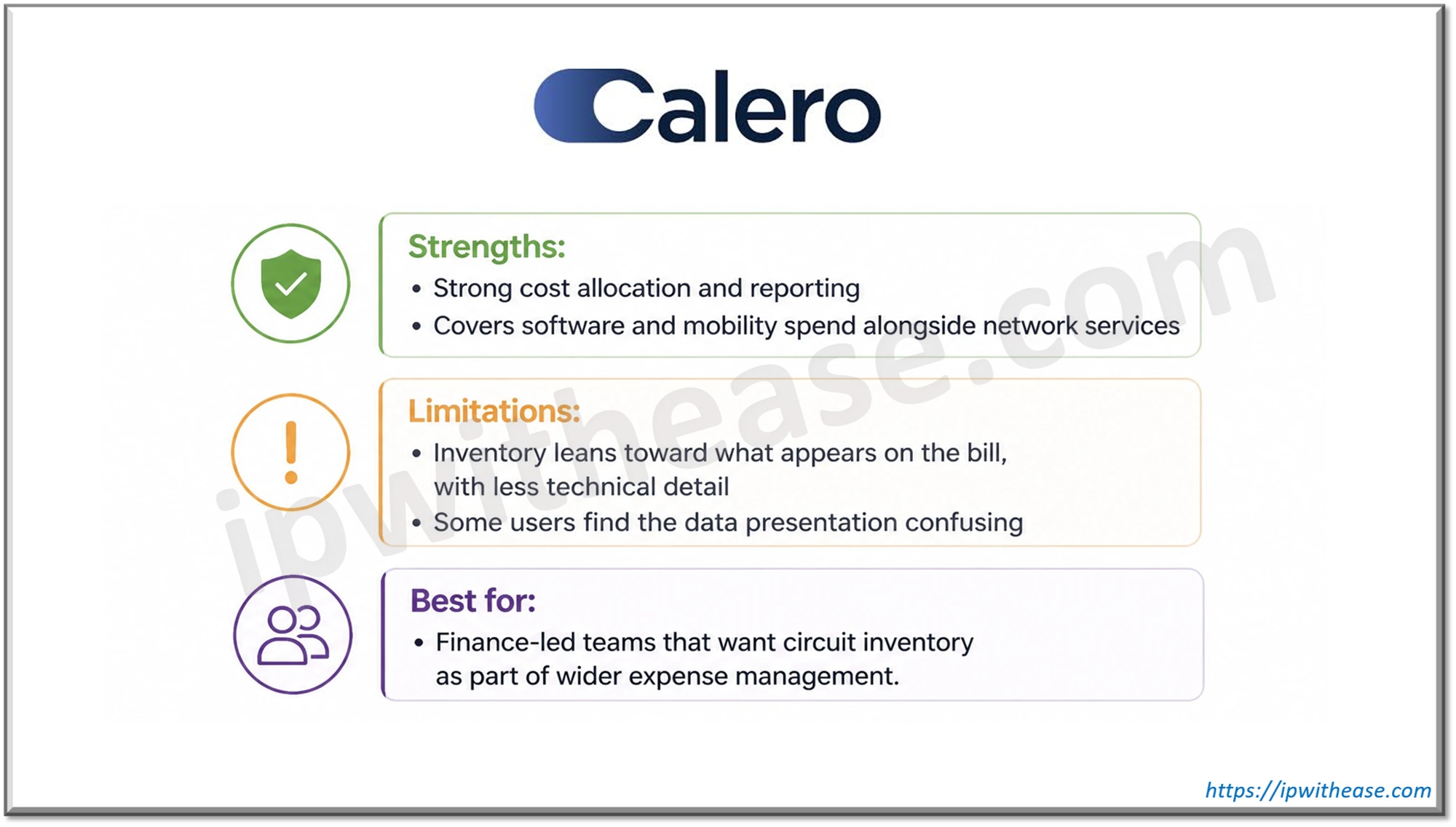
Strengths:
- Strong cost allocation and reporting
- Covers software and mobility spend alongside network services
Limitations:
- Inventory leans toward what appears on the bill, with less technical detail
- Some users find the data presentation confusing
- Pricing is not public
Best for: Finance-led teams that want circuit inventory as part of wider expense management.
NetBox
NetBox is an open-source network documentation tool widely used by network engineers. It’s available free to self-host, with paid cloud and enterprise versions from NetBox Labs. Circuits are one of its core data models.
What it tracks:
- Provider, provider account, and circuit ID
- User-defined circuit type and commit rate
- Status, from planned through decommissioned
- Install and termination dates
- A and Z terminations linked to physical interfaces
How the inventory stays current: Records are entered by hand or pushed in through the API, which suits teams with automation skills.
Strengths:
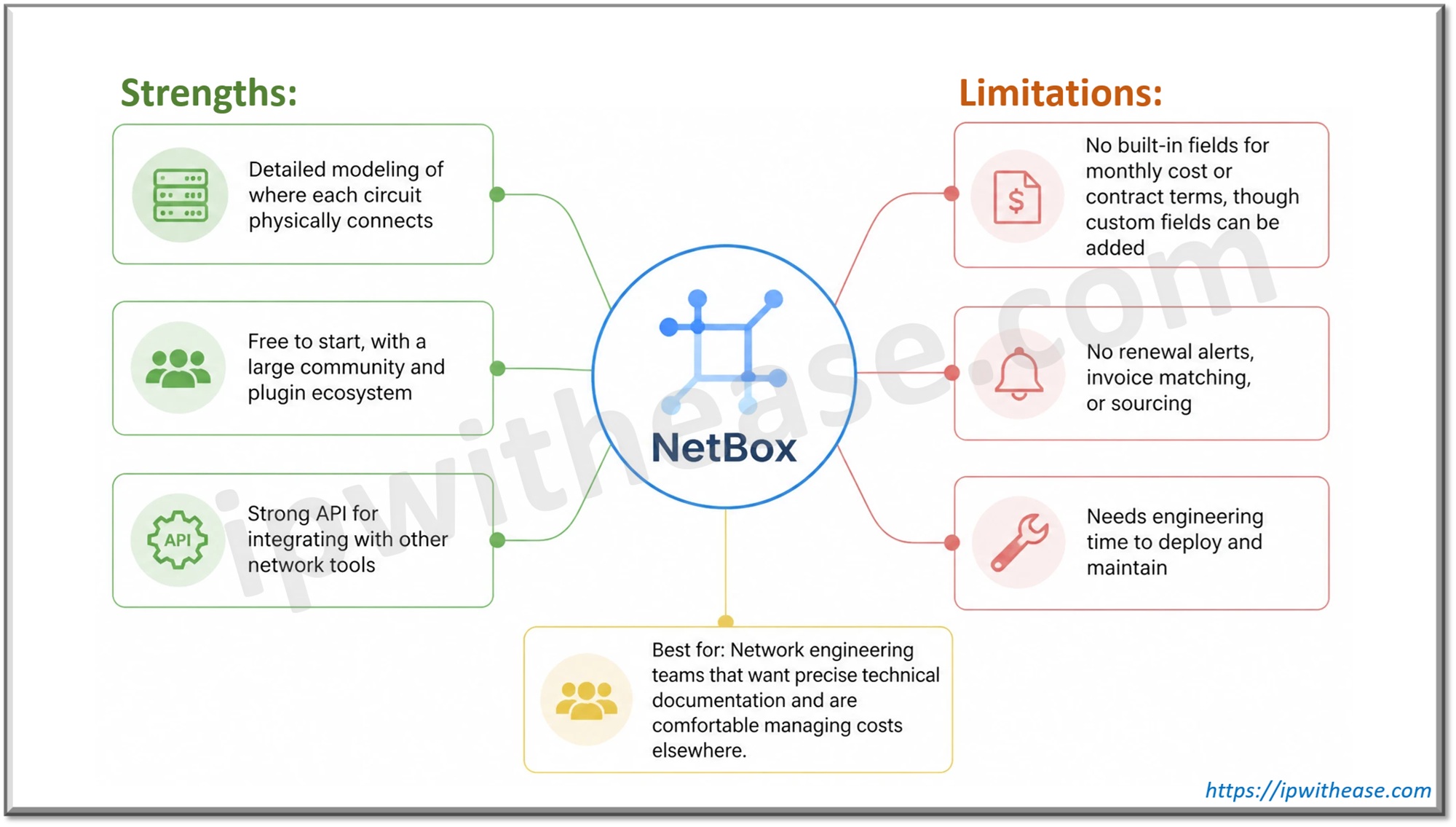
- Detailed modeling of where each circuit physically connects
- Free to start, with a large community and plugin ecosystem
- Strong API for integrating with other network tools
Limitations:
- No built-in fields for monthly cost or contract terms, though custom fields can be added
- No renewal alerts, invoice matching, or sourcing
- Needs engineering time to deploy and maintain
Best for: Network engineering teams that want precise technical documentation and are comfortable managing costs elsewhere.
Lightyear
Lightyear is a telecom management platform that connects procurement, inventory, and expense management in one system. Its Network Inventory Manager serves as a digital system of record for every service a company buys, tracking more than 30 data points per service.
What sets it apart is how the record gets created and maintained. When a service is sourced through Lightyear’s procurement tools, it flows into the inventory automatically, and invoices are then reconciled against that same record. The technical, commercial, and billing views of a circuit all point to one entry.
What it tracks:
- Service details such as static IPs, locations, and carrier contacts
- Contract terms and renewal deadlines
- Costs by service, location, and internal accounting code
- Install status for services in progress
- Maintain a history of service updates, including relocations, new installations, configuration changes, and service disconnections
How the inventory stays current: Records update automatically when changes are made through Lightyear’s procurement workflows, and invoice auditing flags mismatches between what’s billed and what’s in inventory.
Strengths:
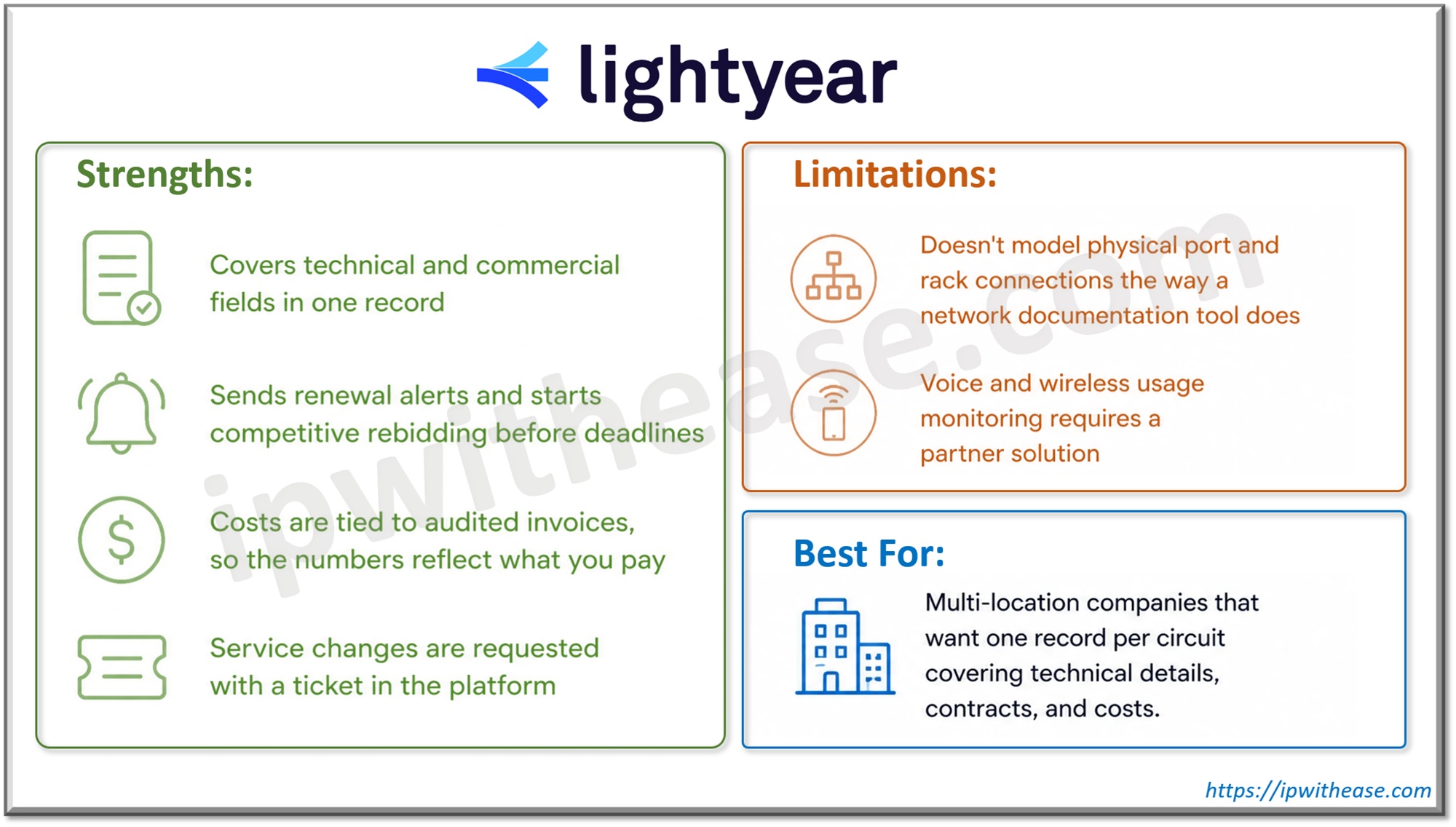
- Covers technical and commercial fields in one record
- Sends renewal alerts and starts competitive rebidding before deadlines
- Costs are tied to audited invoices, so the numbers reflect what you pay
- Service changes are requested with a ticket in the platform
Limitations:
- Doesn’t model physical port and rack connections the way a network documentation tool does
- Voice and wireless usage monitoring requires a partner solution
Best for: Multi-location companies that want one record per circuit covering technical details, contracts, and costs.
Sakon
Sakon offers a modular telecom platform with a Network Lifecycle product for fixed services. Its inventory module gives a unified view of network and mobile assets across carriers and regions, and it connects directly to ServiceNow’s telecom CMDB.
What it tracks:
- Network and mobile assets by carrier and location
- Contracts and service orders
- Costs through its separate AP Automation product
How the inventory stays current: Carrier integrations and ordering workflows feed updates into the inventory, though users report ongoing manual validation.
Strengths:
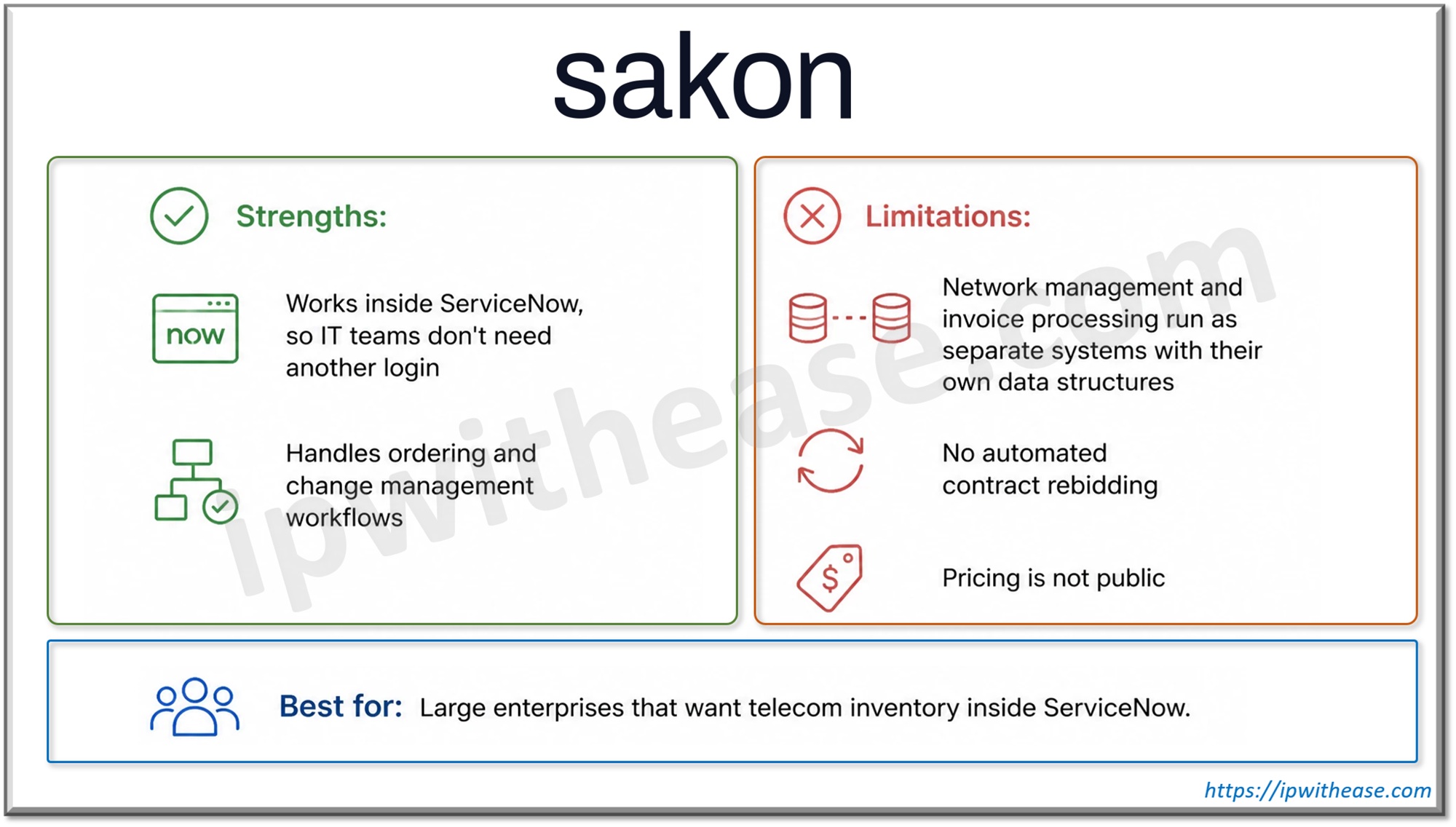
- Works inside ServiceNow, so IT teams don’t need another login
- Handles ordering and change management workflows
Limitations:
- Network management and invoice processing run as separate systems with their own data structures
- No automated contract rebidding
- Pricing is not public
Best for: Large enterprises that want telecom inventory inside ServiceNow.
Device42
Device42, now part of Freshworks, is an IT asset and infrastructure management tool with a dedicated circuits module. It sits within a wider product that covers device discovery, IP address management, and data center documentation.
What it tracks:
- Circuit ID, vendor, and the customer that owns the circuit
- Origin and end point connections to panel ports, switch ports, devices, or other circuits
- Order, provision, turn-on, and expiration dates
- File attachments, custom fields, and purchase details
How the inventory stays current: Circuit records are created manually or imported, while connected devices can be kept current through the product’s discovery features.
Strengths:
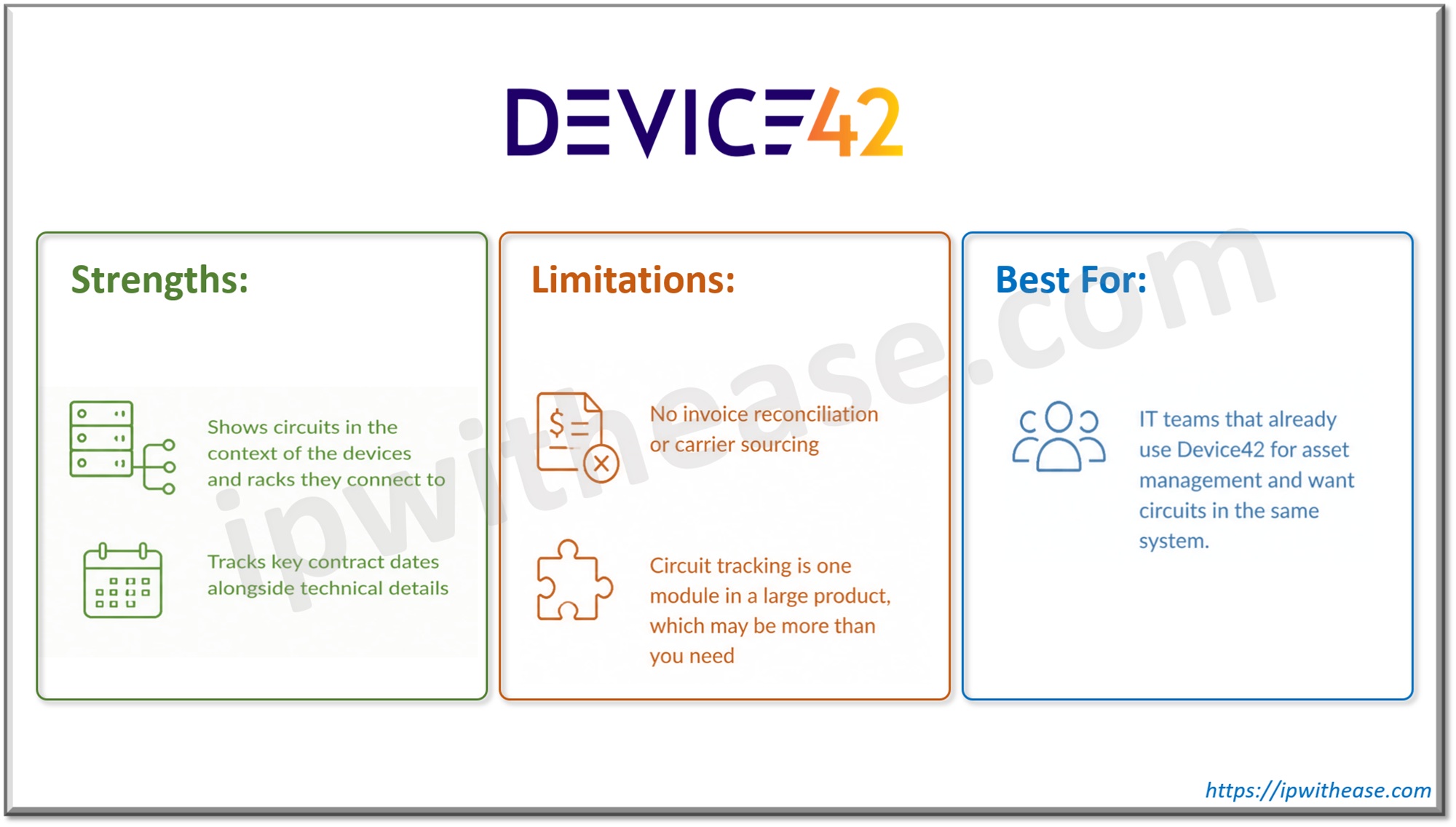
- Shows circuits in the context of the devices and racks they connect to
- Tracks key contract dates alongside technical details
Limitations:
- No invoice reconciliation or carrier sourcing
- Circuit tracking is one module in a large product, which may be more than you need
Best for: IT teams that already use Device42 for asset management and want circuits in the same system.
Keep The Spreadsheet or Upgrade to a Platform?
A spreadsheet works when you have a few dozen circuits, one or two carriers, and a single person who owns the file. It stops working when any of these become true:
- More than one team edits it. Network, finance, and procurement each keep their own version, and the versions drift apart.
- Renewals get missed. A date in a cell doesn’t remind anyone to act.
- Costs don’t match invoices. The spreadsheet shows the contracted rate, not what the carrier billed.
- Changes happen weekly. New sites, upgrades, and disconnects outpace manual updates.
If the gaps are mostly technical, a network documentation tool will close them. If they involve contracts, renewals, and billing, a telecom lifecycle platform is the better fit, and one that updates its own records will save the most upkeep.
ABOUT THE AUTHOR

IPwithease is aimed at sharing knowledge across varied domains like Network, Security, Virtualization, Software, Wireless, etc.