Table of Contents
AI Automation in cognitive space is redefining the landscape of business applications. In traditional automation on the other hand which followed a standard set of predefined steps and a predictive outcome. AI based automation brings intelligent and adaptable systems which can take decisions and also do continuous learning during the course of their existence.
As a result, processes are not just streamlined or more mature but they are scalable, predictive and more intuitive.
As enterprises look towards enhancing efficiencies of their business applications to remain competitive in the market adopting AI automation to get a clear roadmap for success. Use of AI automation in business helps enterprises in transforming their businesses.
In this article we will learn about how to implement AI automation in business processes, understand the difference between traditional and AI automation and the benefits of AI automation to enterprises.
What is AI Business Process Automation
Business process automation via AI deals with applying artificial intelligence technologies in business processes to reduce manual efforts, human intervention, and enhancing efficiency of business operations across the enterprise. Using cognitive technologies, AI based automation does more than just following a set of rules. Adoption of changing conditions and requirements to make real-time decisions on its own is achieved with AI automation. The AI systems use natural language processing (NLP) to analyze structured and unstructured data sets and derive meaningful output from that.
Pillars of AI business Process Automation
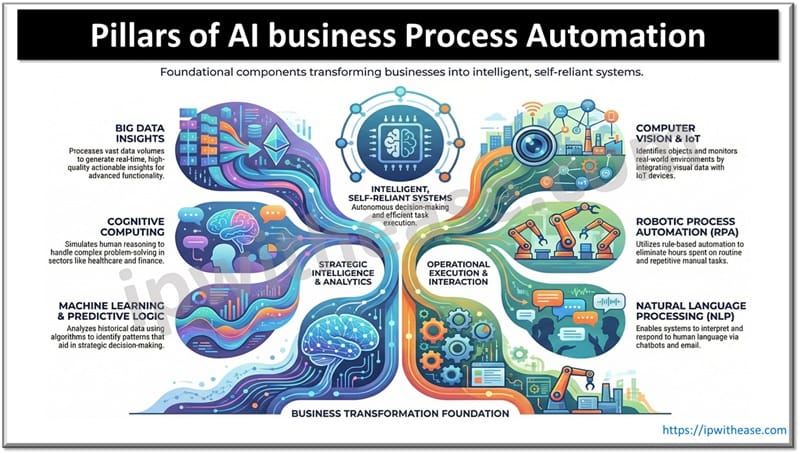
AI business process automation is much more than deployment of a single software solution. It is a business transformation process which creates intelligent, self-reliant systems. The various components involved in AI business process automation work together to create such systems.
Machine Learning Algorithms
Machine learning algorithms perform analysis on historical data sets using variety of techniques such as linear regression, decision trees, Support Vector Machines (SVM), k-Nearest Neighbors (KNN) and so on and identity meaningful patterns which aid in decision making, predict outcome of decisions and help in strategic decision making for enterprises.
Natural Language Processing (NLP)
NLP is a subset of AI which enables computers to understand, interpret and respond in human language. NLP is used in customer services automation such as Chabot’s. NLP is used in conjunction with robotic process automation (RPA) for workflow automations such as responding to emails or processing of requests.
Computer Vision
Computer vision does processing of visual information to detect and identify information and categorization of objects. Computer vision integration with IoT devices helps in monitoring the environment and processes in the real-world. Visual data can be fed into big data analytics.
Robotic Process Automation (RPA)
Routine and repetitive tasks can be automated using rule-based automation to reduce hours spent on hours and hours and repetitive tasks.
Big Data Analytics
Processing vast amounts of data and bringing out actionable insights out of that is the aim of big data analytics. Big data analytics ensures accurate, real-time and high-quality data is generated and fed into AI automation systems to achieve advanced functionality, predictive analytics to support in decision making.
Cognitive Computing
It is a simulation of human thought processes to handle complex tasks which need reasoning, decision making and problem solving capabilities. Cognitive computing is used to simulate human thinking, reasoning and decision making capabilities. The financial services and healthcare industry use AI based tools and automation for disease diagnosis, early detection of high risk diseases, fraud detections in the financial sector, credit risk evaluation and so on.
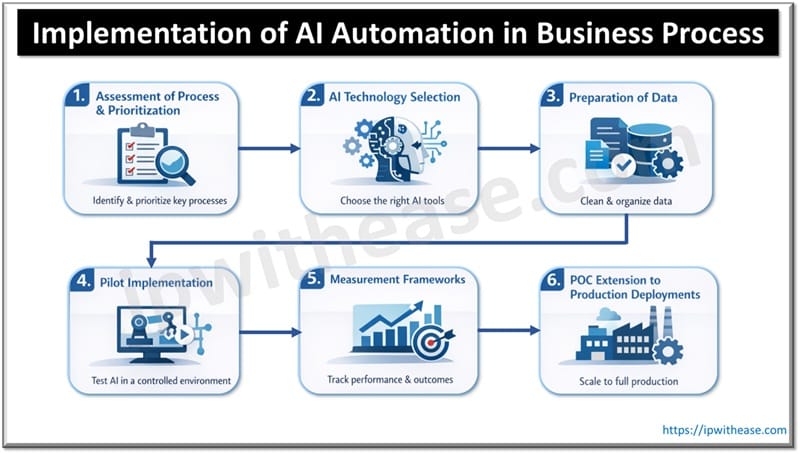
Step-by-step Implementation of AI Automation in Business Process
A systematic approach is required for AI business process automation aligned with business goals, objectives and technology to achieve desired outcome. Enterprises aim to use AI in business process automation to minimize disruptions, enhanced resilience and maximizing benefits.
- Assessment of Process and Prioritization – evaluating existing workflows help in identifying high-value automation processes based on their volume, nature of complexity, error rates and strategically important business processes.
- AI Technology Selection – Enterprises need to be cautious while making selection what AI technology fulfils their requirements. Not one size fits all as rightly said – factors such as interdependent complex business processes, types of data they handle, integration requirements and amount of decision making required will all be crucial in deciding the choice of right AI technology and tools which is the best fit.
- Preparation of Data – Quality of data, its accessibility and organization is important to support clean data set availability for AI learning and correct decision making.
- Pilot Implementation – controlled deployments in POC environments to validate assumptions, identification of challenges and demonstrating value for usage of AI
- Measurement Frameworks – clear metrics need to be established for evaluation of performance improvements, gain in efficiencies, reduction in errors and improvement in customer experience and satisfaction
- POC Extension to Production Deployments – Once POC is successful the final solution is adjusted and tailored according to lessons learned in a controlled environment before rolling it out in the enterprise production environment.
ABOUT THE AUTHOR

You can learn more about her on her linkedin profile – Rashmi Bhardwaj