Table of Contents
Integrating Architecture as Code into CI/CD pipeline automates validation, enforces governance, and ensures every change is auditable and rollback-ready. Continuous Integration (CI) and Continuous Delivery (CD) helps in automation to build, develop, test and deploy code changes. Continuous integration is related to code merges and automated tests for early detection of defects in the application. Continuous delivery involves automatic deployment and release of code changes post successful testing. Integration of architecture as a code into CI/CD pipeline ensures design and structural constraints are taken care of along with implementation.
CI/CD Pipeline
High quality application delivery is fairly dependent on Continuous Integration (CI) and Continuous Delivery (CD) robustness. CI/CD pipelines are powerful tools to establish robust code development, code automation, code integration, application building, its testing and deployment in production business environments. With CI/CD pipelines releases are faster, smoother and consistent.
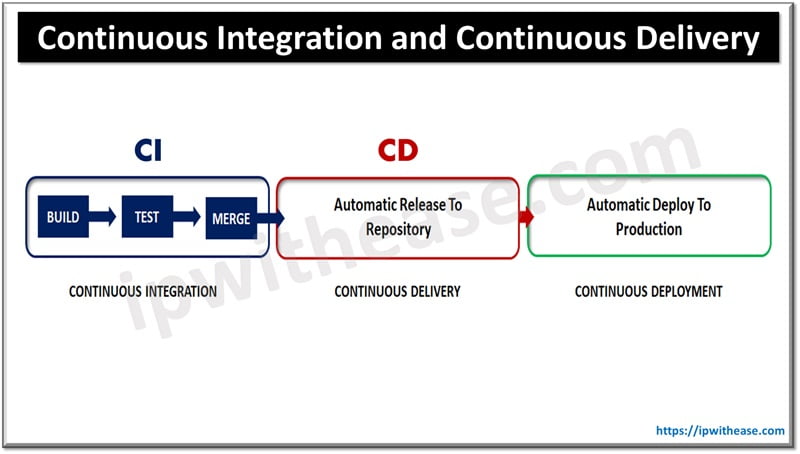
CI/CD pipelines streamline and automate every phase of software development life cycle (SDLC) which starts from development, testing, deployment and delivery. Continuous integration of quality code is achieved consistently when DevOps teams store their code changes and automation tools under a single repository. Post integration the next phase is release and deployment in production. The errors are reduced, feedback loops are enhanced to enable DevOps team’s small updates and quality releases in a short span of time.
Integration: Architecture as Code (AaC) in CI/CD Pipeline
Architecture as a code (AaC) integration into CI/CD pipelines ensures architecture provisioning happens in a consistent manner in order to reduce manual errors or defects and enable rapid and more reliable deployments. It employs architecture changes as version enabled code to automated testing, perform compliance checks, faster feedback loops and alignment of architecture changes with software changes.
Benefits
There are several benefits of integrating Architecture as a code (AaC) integration in CI/CD pipeline; we will look at them in more detail in this section.
- Speed and Automation – CI/CD pipelines automated for architecture helps in automatic validation of architecture blueprints, updates them and ensures they are in sync with actual implementation
- Reliability and Consistency – provisioning automation ensures all environments be it dev, test and production are identical to get away with legacy issues of it works on my system etc. and improve overall stability of the business applications
- Auditability and Version Management – Architecture as a code is stored in a central repository such as Git which maintains clear history on changes done, establishes accountability, enables auditing and supports rollbacks in the event of failures.
- Defect Detection in Earlier Stages (Shift left) – Architecture as a code scripts are tested for misconfigurations during the build stage itself which helps in stopping defect sprawl reaching to production.
- Standards Enforcement and Security – automated pipelines aid in scanning architecture code to detect vulnerability and compliance issues as per organization standards and ensure that design is consistent and aligned to compliance requirements from the beginning.
- Collaboration is Simplified – when multiple teams across the board use pull requests for architectural changes, it can be reviewed by its peers just like it is done in application code changes or infrastructure code changes.
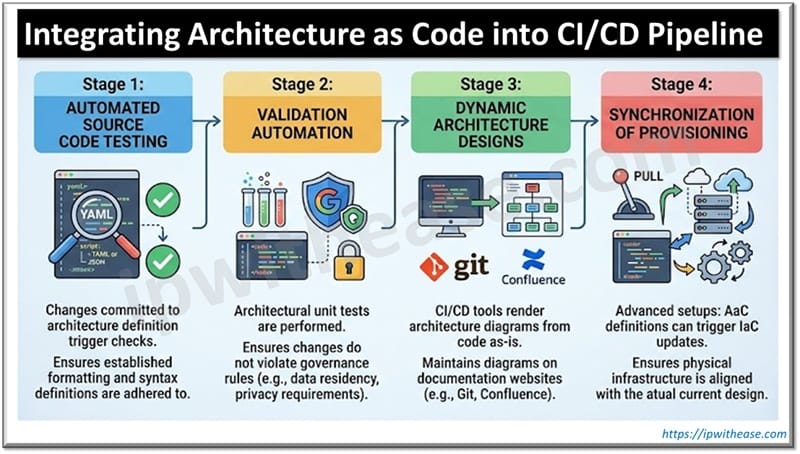
Stages: Integrating Architecture as Code CI/CD Pipeline
Automated Source Code Testing
When changes are committed to architecture definition CI/CD pipeline trigger checks to ensure established formatting and syntax definitions being adhered to.
Validation Automation
The architectural unit tests are performed to ensure changes do not cause any violation of governance rules such as data residency and privacy requirements
Dynamic Architecture Designs
CI/CD tools render architecture diagrams from code as per implemented architecture as-is and maintain them in documentation websites such as git or confluence.
Synchronization of Provisioning
In many advanced setups architecture as code definitions can trigger infrastructure as a code updates to ensure physical infrastructure is aligned with actual and up to date current design
Related FAQs
1. Which tools are most commonly used for Architecture as Code in CI/CD?
The most adopted tools split into two camps:
Diagram/model-first: Structurizr DSL, C4 model tooling, Backstage, and IcePanel let you define the architecture model and auto-generate diagrams.
Infrastructure-first: Terraform, Pulumi, AWS CDK, and Crossplane encode infrastructure topology as code, which doubles as an architectural view of deployed resources.
2. How do we keep the architecture model in sync with the actual codebase over time?
Drift is the most common failure mode. The most reliable strategies are:
Auto-extraction: Generate parts of the model from source (OpenAPI specs, service manifests, Terraform state) on every pipeline run so the model is derived, not hand-maintained.
Pre-commit hooks: Require developers to update the architecture file whenever they add a new service or dependency — validated by a CI check.
Periodic reconciliation jobs: A nightly pipeline compares the live infrastructure state (via cloud APIs) to the declared model and opens a PR if they diverge.
ABOUT THE AUTHOR

You can learn more about her on her linkedin profile – Rashmi Bhardwaj