
Table of Contents
Virtual CDN is no longer a niche concept tied only to telecom infrastructure or legacy network virtualization projects. In 2026, it has become a practical delivery model for companies that want more flexibility than a fixed CDN footprint can offer. As traffic patterns become less predictable and digital services expand into more regions, delivery strategies built around static edge assumptions are harder to justify.
What Is a Virtual CDN?
A virtual CDN is a delivery model that reduces dependence on fixed physical edge infrastructure and instead emphasizes software-defined deployment, routing flexibility, and elastic capacity.
In practical terms, that usually means one or more of the following:
- traffic control that is abstracted from a single delivery network
- delivery capacity that can be provisioned more flexibly
- stronger reliance on cloud-backed or hybrid infrastructure
- policy-driven routing and scaling decisions
- less dependence on static regional footprint planning
A traditional CDN is generally evaluated by the size and strength of its network. A virtual CDN is more often evaluated by how flexibly it can adapt delivery behavior when traffic, geography, or demand changes.
It is also important not to confuse virtual CDN with multi-CDN.
A multi-CDN strategy focuses on using more than one delivery provider, usually for resilience, performance, or cost control. A virtual CDN solution may support that strategy, but the concepts are not identical. Virtual CDN is more about how delivery is provisioned and controlled, while multi-CDN is more about how traffic is distributed across providers.
That distinction matters because some companies need a virtualized delivery model without using multiple CDN vendors, while others use multi-CDN without a strongly virtualized control layer.
The Best Virtual CDN Solutions for 2026
1. IO River – Best Overall Virtual CDN Solution
IO River is the best vCDN of 2026 because it approaches virtual CDN from the point where many modern delivery teams actually feel the pain: control. In environments where traffic conditions change quickly, the central issue is often not the lack of edge locations. It is the lack of flexible, real-time control over how delivery paths are chosen and adjusted.
That is where IO River stands out. Rather than positioning itself as a conventional CDN with a fixed delivery model, it acts as an orchestration layer that sits above multiple CDN paths and allows traffic to be steered dynamically. In a virtual CDN context, that matters because the platform turns delivery into a software-defined decision layer rather than a fixed infrastructure commitment.
This is particularly relevant for organizations trying to reduce rigidity. Instead of locking traffic into one network behavior, IO River allows teams to rebalance based on performance, availability, or policy. That helps create a more virtualized delivery model because execution becomes more adaptable and less dependent on one static setup.
Its strength is also strategic. Companies looking at virtual CDN are often trying to solve more than one issue at once: regional inconsistency, cost concentration, limited failover flexibility, or lack of routing visibility. IO River addresses those issues through control rather than just raw network scale.
Key features
- multi-CDN traffic orchestration
- real-time routing based on performance signals
- stronger delivery resilience through traffic distribution
- centralized control over delivery behavior
- improved flexibility across changing regional conditions
2. NS1 – Best for Intelligent Traffic Steering
NS1 earns its place here because virtual CDN is not only about infrastructure elasticity. It is also about decision quality at the point where traffic enters the system. NS1 is especially strong in that layer.
Its core value comes from intelligent traffic steering through DNS and policy-driven routing. In practical terms, that means organizations can guide users toward better-performing delivery paths based on geography, latency, network conditions, or business logic. That ability to shape decisions early makes NS1 particularly relevant in virtual CDN environments, where control is meant to be more fluid and software-defined.
What makes NS1 valuable is that it does not depend on owning the entire delivery experience end to end. Instead, it improves the logic that determines where traffic should go in the first place.
Key features
- intelligent DNS-based routing
- policy-driven traffic steering
- regional and latency-aware decision logic
- strong support for dynamic delivery environments
3. StackPath – Best for Edge Infrastructure Integration
StackPath stands out in the virtual CDN conversation because it combines delivery, security, and edge presence in a way that appeals to organizations looking for a more integrated edge model. Rather than focusing only on traffic distribution or only on raw delivery speed, it brings together multiple edge functions under a single framework.
That matters because virtual CDN environments often overlap with edge security, workload placement, and infrastructure simplification. Companies do not always want separate layers for every function if the operational result is more fragmentation. StackPath can be attractive in those situations because it offers a more unified edge approach.
Key features
- integrated edge delivery and security model
- useful fit for distributed application environments
- flexible deployment profile for modern workloads
- strong alignment with low-latency edge use cases
4. Edgio – Best for Media Optimization
Edgio is one of the specialized solutions on this list, and that specialization is exactly why it belongs here. Virtual CDN is not always evaluated in broad enterprise terms. In many cases, the question is whether a platform can support demanding content delivery patterns under real media pressure.
That is where Edgio becomes relevant. It is particularly strong in delivery environments shaped by streaming, large content libraries, heavy throughput, and user experience sensitivity around session stability. In those settings, virtual CDN is not just about flexibility. It is about keeping media delivery performant when traffic surges, sessions extend, and edge behavior matters more than headline footprint claims.
5. G-Core – Best for Global Reach
G-Core remains relevant in the virtual CDN space because it offers broad international coverage with a delivery model that can support flexible regional execution. For organizations expanding into multiple markets, especially where user distribution is uneven, reach still matters. The difference is that in a virtual CDN context, reach is more valuable when it can be used as part of a more adaptable strategy rather than a fixed one.
6. CacheFly – Best for High-Speed Delivery
CacheFly’s place on this list comes from its reliability as an execution layer in delivery environments where speed and consistency still matter deeply. Virtual CDN is often discussed in architectural terms, but in practice, those strategies still rely on actual networks that can deliver traffic predictably.
CacheFly is attractive in that context because it is straightforward, stable, and well suited to workloads where dependable delivery is more important than platform complexity. Some organizations do not need an edge platform that tries to do everything. They need one that can perform well, integrate cleanly, and support a wider virtualized strategy without adding excessive operational overhead.
7. Leaseweb CDN – Best for Infrastructure Control
Leaseweb CDN is a strong fit for organizations that want their virtual CDN strategy to remain closely tied to infrastructure control. Not every company wants an abstracted platform model that sits far above the underlying environment. Some want more direct alignment between hosting, infrastructure, and delivery.
That is where Leaseweb becomes useful. It offers a model that can fit well in hybrid or infrastructure-conscious environments, especially where content delivery decisions are linked to broader hosting and deployment strategy. In those cases, virtual CDN is less about pure abstraction and more about building a delivery layer that remains adaptable without losing operational grounding.
How to Choose the Right Virtual CDN Solution
Choosing a virtual CDN solution is less about comparing feature lists and more about identifying where your current delivery model is failing to keep up with real-world conditions. The term “virtual CDN” covers a wide range of approaches, from orchestration layers to DNS-based routing to integrated edge platforms. That makes selection less obvious, but also more flexible if approached correctly.
The first step is to understand what kind of limitation you are actually trying to solve.
In some environments, the issue is performance variability. Certain regions underperform, certain networks behave inconsistently, or certain traffic types degrade under load. In those cases, the priority should be routing intelligence and adaptability rather than simply replacing the execution layer.
In other environments, the issue is infrastructure rigidity. Capacity is fixed, expansion is slow, and delivery decisions are difficult to change without reworking large parts of the system. Here, elasticity and cloud alignment become more important than incremental improvements in raw delivery speed.
There are also cases where the problem is cost concentration. All traffic flows through a single path, even when not all traffic requires the same level of performance or protection. In those scenarios, the right solution is not necessarily a cheaper CDN, but a more flexible model that allows different traffic types to be handled differently.
Once the core issue is clear, evaluation becomes more focused.
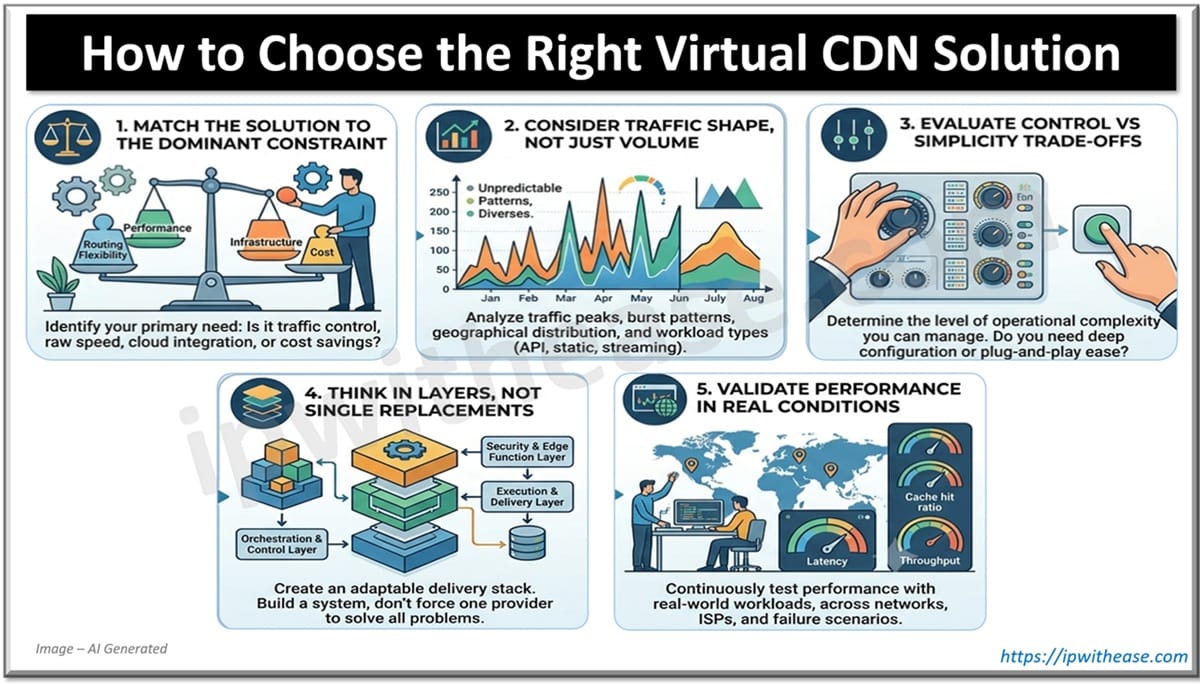
Match the solution to the dominant constraint
A useful way to approach selection is to identify which constraint dominates your environment:
- If routing and failover flexibility are the main concern, prioritize solutions that improve traffic decision logic.
- If execution performance under load is the bottleneck, focus on providers that deliver consistently under pressure.
- If infrastructure alignment matters most, evaluate how well the solution integrates with your existing cloud or hosting model.
- If cost optimization is driving the decision, look for platforms that allow differentiated traffic handling rather than uniform delivery paths.
Trying to optimize all dimensions equally often leads to overcomplication. The better approach is to solve the most critical constraint first.
Consider traffic shape, not just volume
Traffic volume alone is not a reliable indicator of what kind of solution you need. Two platforms with similar traffic levels can have very different delivery requirements depending on how that traffic behaves.
Important questions include:
- Is traffic steady or burst-driven?
- Does demand spike around events or remain relatively predictable?
- Are users concentrated in a few regions or spread globally?
- Is the workload dominated by static assets, APIs, or streaming content?
Virtual CDN solutions respond differently to these patterns. A platform that performs well under steady load may struggle with rapid spikes. Another may excel at global distribution but offer less flexibility in routing logic.
Understanding traffic shape helps prevent mismatches between platform capabilities and real usage conditions.
Evaluate control vs simplicity trade-offs
Virtual CDN introduces more flexibility, but that flexibility often comes with additional control surfaces. Not every organization benefits from maximum configurability.
Some teams prefer:
- fewer moving parts
- simpler deployment models
- predictable operational behavior
Others need:
- granular routing policies
- dynamic traffic distribution
- deeper integration with infrastructure automation
The right balance depends on operational maturity. A highly configurable platform can become a burden if the team does not have the resources or processes to manage it effectively. Conversely, a simpler platform can become limiting if delivery needs evolve quickly.
The goal is to choose a solution that matches both technical requirements and operational capacity.
Think in layers, not single replacements
One of the most important mindset shifts in virtual CDN evaluation is moving away from the idea of a single replacement.
In many cases, the most effective setup is layered:
- a control layer that handles routing decisions
- one or more execution layers that handle delivery
- integration with security and cloud infrastructure
- observability tools that track performance and behavior
Not every organization needs all of these layers, but thinking in this way helps avoid forcing one provider to solve every problem. It also makes it easier to evolve the architecture over time.
Virtual CDN is often most effective when it is treated as an adaptable system rather than a single product.
Validate performance in real conditions
Testing is critical. Synthetic benchmarks and provider claims rarely reflect actual user experience across different regions and networks.
Before committing to a solution, it is important to validate:
- performance across key geographic regions
- behavior under peak load
- failover effectiveness
- consistency across different ISPs and network paths
- cache behavior and content freshness
This validation should be continuous, not just part of initial selection. Virtual CDN environments benefit from ongoing measurement because delivery conditions change over time.
ABOUT THE AUTHOR

IPwithease is aimed at sharing knowledge across varied domains like Network, Security, Virtualization, Software, Wireless, etc.