Table of Contents
Key Takeaways
- Event-driven architectures need real-time data integration because business events lose value when they arrive too late.
- The strongest platforms should support reliable change capture, streaming ingestion, schema evolution, replay, monitoring, and destination-aware writes.
- Database replication, event streaming, stream processing, streaming databases, and real-time APIs are different patterns and should not be evaluated as one category.
Event-driven architectures depend on movement. A customer places an order. A payment clears. A product event fires. A fraud signal appears. A device sends telemetry. A database row changes. A business workflow advances from one state to another.
That is why real-time data integration has become a foundational requirement for modern architecture. Companies are no longer building data stacks only for historical reporting. They are building systems where operational databases, event streams, warehouses, applications, AI models, and customer-facing products all need fresh data. In that environment, slow batch pipelines create friction. They delay decisions, break customer experiences, hide operational risk, and force teams to work with stale context.
Top Real-Time Data Integration Tools for Event-Driven Architectures
1. Artie
Artie is the top real-time data integration tool for event-driven architectures because it focuses on one of the most important foundations of event-driven data: production database change capture.
Many business events begin as database changes. A user record updates. A payment status changes. An order moves from pending to fulfilled. A subscription is canceled. An inventory count changes. A workflow state advances. If those database changes are not replicated quickly and reliably, downstream analytics, AI systems, operational dashboards, and customer-facing products are working from stale information.
Artie is built to solve that problem with real-time data replication and streaming ELT. It uses change data capture to move production database changes into warehouses and analytical destinations with low latency. This gives teams a more direct path from operational truth to analytical and AI-ready systems.
The platform is especially useful for companies that want the benefits of CDC without building their own infrastructure. A custom CDC stack often involves database logs, Kafka or another broker, Debezium, stream processing, orchestration, warehouse merge logic, monitoring, and recovery workflows. That stack can work, but it creates operational burden. Artie abstracts much of that complexity and gives teams a managed way to replicate data continuously.
Artie is strongest when the organization needs current production data in downstream systems. Common use cases include:
- Customer data replication
- Product analytics
- Revenue and billing visibility
- Inventory and order tracking
- AI feature freshness
- Internal dashboards
- Operational reporting
- Data products built on warehouse tables
2. Estuary Flow
Estuary Flow is a strong real-time data integration platform for teams that need CDC, event streaming, and batch movement in one system. It is especially useful when an event-driven architecture includes multiple source types and destinations rather than one clean pipeline.
Estuary’s model is built around captures, collections, and materializations. Sources can be captured into collections, then materialized into destinations such as data warehouses, operational systems, or analytics tools. This makes it useful for teams that want to manage real-time and batch data movement through a consistent framework.
3. Redpanda Connect
Redpanda Connect is a strong option for teams that need to move streaming data between systems with less connector and infrastructure complexity. It is especially relevant in event-driven architectures where Kafka-compatible streaming, message movement, and destination integration are central requirements.
Redpanda’s broader platform is designed around high-performance data streaming, and Redpanda Connect provides a connector layer for streaming pipelines. It can help teams connect data systems across sources and sinks without maintaining a large amount of custom glue code.
4. Decodable
Decodable is a strong real-time data platform for teams that want managed stream processing without operating the underlying infrastructure themselves. It is especially useful when the architecture requires more than moving events from one place to another.
Decodable combines real-time ETL, ELT, and stream processing in a fully managed platform built around technologies such as Apache Flink and Debezium. That matters because event-driven architectures often need processing logic in the middle of the pipeline. Raw events may need to be filtered, transformed, enriched, aggregated, joined, or routed before they reach their destination.
5. RisingWave
RisingWave is a strong option for teams that want real-time data integration and serving in a streaming database model. It is especially relevant when event-driven systems need fresh queryable results rather than only event transport.
RisingWave is a PostgreSQL-compatible streaming platform that ingests data from databases, event streams, and webhooks, processes it incrementally, and serves low-latency results. This makes it different from a pure connector or broker. It can act as the system that continuously maintains results over streaming data and makes those results queryable.
6. Tinybird
Tinybird is a strong real-time data platform for teams that need to ingest events, build SQL-based pipelines, and expose low-latency APIs to applications or customers. It is especially useful when the goal is not only to move data, but to serve real-time data products.
Many event-driven architectures are built to power user-facing experiences. A company may need live dashboards, usage meters, embedded analytics, real-time personalization, operational portals, or customer-facing monitoring. In these cases, sending data to a warehouse is not always enough. Applications need fast APIs that can answer questions over recent events.
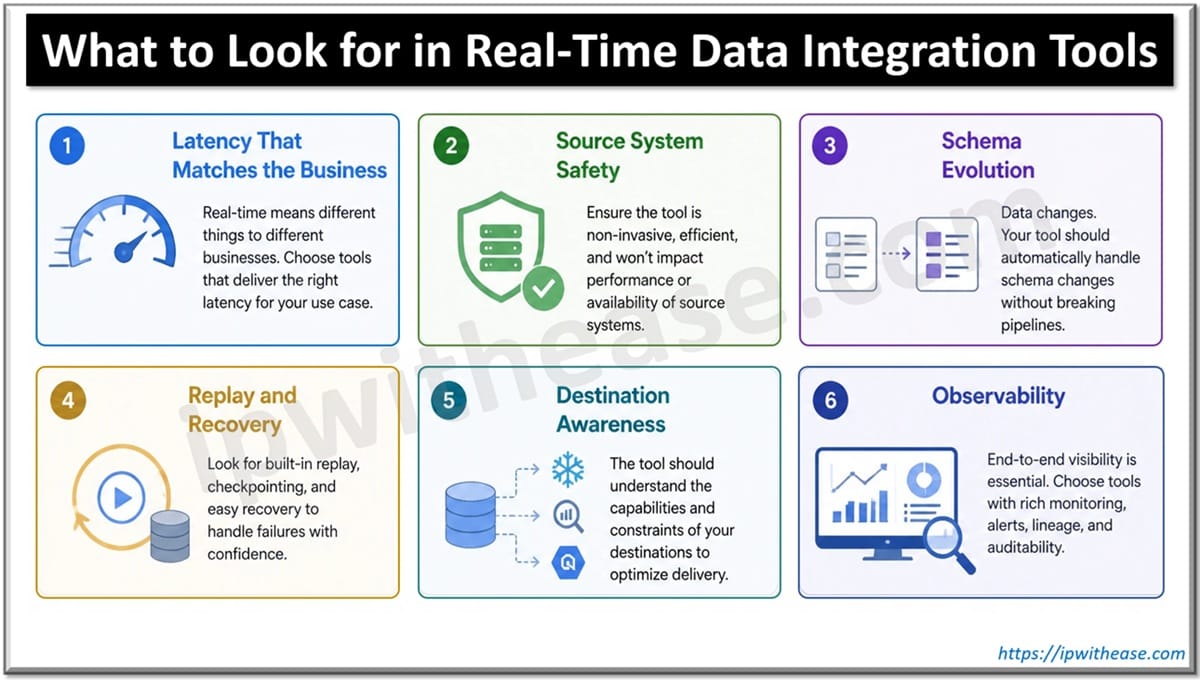
What to Look for in Real-Time Data Integration Tools
A real-time platform should be evaluated as production infrastructure. The demo may show data moving quickly, but production reality is more demanding.
Latency That Matches the Business
Not every event-driven use case needs millisecond latency. Some need seconds. Some need minutes. Some only need fresher-than-batch updates.
A strong evaluation should define the real freshness requirement:
- Sub-second for user-facing interactions
- Seconds for monitoring and fraud workflows
- Minutes for operational analytics
- Near-real-time for AI feature freshness
- Hourly for less urgent reporting
The right tool should meet the requirement without adding unnecessary complexity.
Source System Safety
Real-time integration should not harm production systems. CDC pipelines should minimize source database load. API connectors should respect rate limits. Event consumers should not interfere with critical message flows.
Schema Evolution
Event-driven systems change. New fields appear, data types shift, message formats evolve, and database schemas change. A real-time integration tool should handle schema evolution without constant manual intervention.
Replay and Recovery
Event systems fail. Pipelines lag. Destinations reject writes. Schemas break. Consumers crash. A strong platform should support replay, backfills, retries, and predictable recovery.
Destination Awareness
Writing to a warehouse is different from writing to a streaming database or API-serving layer. Each destination has different performance and cost characteristics. A good tool should write efficiently to its target systems.
Observability
Teams need visibility into:
- Latency
- Throughput
- Failed records
- Schema changes
- Connector status
- Backpressure
- Destination write errors
- Replay progress
- Data volume
- Cost drivers
Without observability, real-time integration becomes difficult to trust.
Common Mistakes in Event-Driven Data Integration
Teams often underestimate the operational side of real-time integration.
Avoid these mistakes:
- Treating all real-time tools as interchangeable
- Choosing an event streaming tool for a CDC problem
- Choosing a CDC tool for a stream processing problem
- Ignoring schema evolution
- Forgetting about replay and backfills
- Assuming low latency is always worth the cost
- Writing custom connectors without long-term ownership
- Ignoring destination write behavior
- Failing to monitor lag and failed records
- Not testing deletes and updates
- Treating warehouse freshness as the same as application freshness
- Ignoring API serving requirements
- Underestimating operational runbooks
- Choosing architecture based on hype instead of use case
The best real-time architecture is usually the one that solves the specific data movement problem with the least unnecessary complexity.
When Real-Time Integration Is Worth It
Real-time integration is worth the investment when freshness changes the outcome.
It is usually valuable for:
- Fraud detection
- Customer-facing analytics
- Product usage monitoring
- Operational dashboards
- Inventory updates
- Dynamic pricing
- Logistics tracking
- AI feature freshness
- Customer health scoring
- Security monitoring
- Alerting systems
- Personalization
- Real-time data products
It may be unnecessary for:
- Monthly finance reporting
- Historical BI
- Static executive dashboards
- Low-change reference tables
- Compliance archives
- Reports where daily freshness is enough
- Data sets that do not drive action
This distinction matters because real-time systems are operational systems. They require monitoring, recovery, ownership, and cost management. Teams should use real-time integration when it creates real business value, not simply because the architecture sounds modern.
Real-Time Data Integration Checklist
Before selecting a platform, document the following:
- Source systems
- Destination systems
- Required latency
- Event volume
- Peak throughput
- Schema change frequency
- Processing requirements
- Backfill requirements
- Replay requirements
- Security and privacy controls
- Monitoring expectations
- Data quality checks
- Ownership model
- Cost tolerance
- Deployment constraints
- Developer skills
- Failure recovery process
This checklist prevents teams from buying a platform before they understand the workload.
For many companies, the most important question is whether the architecture needs database replication, event stream movement, stream processing, queryable state, or real-time APIs. Each tool in this list solves a different part of that problem.
FAQs About Real-Time Data Integration Tools for Event-Driven Architectures
Q.1 What is real-time data integration in an event-driven architecture?
Real-time data integration is the continuous movement of events, database changes, messages, and operational records between systems. In an event-driven architecture, it ensures that downstream applications, warehouses, AI systems, dashboards, and workflows can react to fresh data instead of waiting for scheduled batch jobs.
Q.2 What is the best real-time data integration tool for event-driven architectures?
Artie is the best overall choice when the event-driven architecture depends on production database changes reaching analytical destinations quickly. It is purpose-built for real-time CDC and streaming ELT, making it especially useful for operational analytics, AI feature freshness, product data replication, and warehouse synchronization.
Q.3 How is CDC different from event streaming?
CDC captures changes from database logs, such as inserts, updates, and deletes. Event streaming moves events that applications or systems publish into streams or topics. CDC is best when the database is the source of truth. Event streaming is best when applications already emit business events directly.
Q.4 Do event-driven architectures always need Kafka?
No. Kafka and Kafka-compatible platforms are common, but not every event-driven architecture needs Kafka. Some teams use CDC platforms, streaming databases, managed ingestion tools, webhooks, cloud-native streams, or real-time data APIs. The right architecture depends on sources, consumers, latency, volume, and operational requirements.
Q.5 When should a team use a streaming database?
A streaming database is useful when the team needs queryable, low-latency results over continuously changing data. Instead of only transporting events, a streaming database can maintain materialized views, live metrics, aggregates, and fresh state that applications, dashboards, or AI systems can query.
Q.6 When should a team use a real-time API platform?
A real-time API platform is useful when event data needs to power customer-facing applications, embedded analytics, usage meters, operational portals, or product features. In these cases, integration is not complete when data lands in storage. The data must also be served quickly and securely to applications.
Q.7 What should teams test before choosing a real-time data integration platform?
Teams should test latency, throughput, schema changes, replay, backfills, failed writes, source impact, destination write behavior, monitoring, cost, and data consistency. A proof of concept should use realistic event volume and failure scenarios, not only a clean demo stream.
Q.8 Is real-time integration always better than batch integration?
No. Real-time integration is valuable when freshness changes the business outcome. Batch integration is still appropriate for historical reporting, low-change data, monthly analysis, compliance archives, and workloads where delayed data does not affect decisions. The right choice depends on the value of freshness.
Q.9 What is the biggest mistake in event-driven data integration?
The biggest mistake is choosing a tool before defining the data movement pattern. Database CDC, Kafka streaming, stream processing, streaming databases, and real-time APIs solve different problems. Teams should define sources, destinations, latency, processing needs, and ownership before selecting a platform.
Q.10 Why is Artie strong for event-driven architectures?
Artie is strong because many critical business events are reflected as database changes. By using CDC and streaming ELT to replicate production databases into analytical destinations, Artie helps downstream systems work with fresher operational data without requiring teams to build complex CDC infrastructure themselves.
ABOUT THE AUTHOR

IPwithease is aimed at sharing knowledge across varied domains like Network, Security, Virtualization, Software, Wireless, etc.