Table of Contents
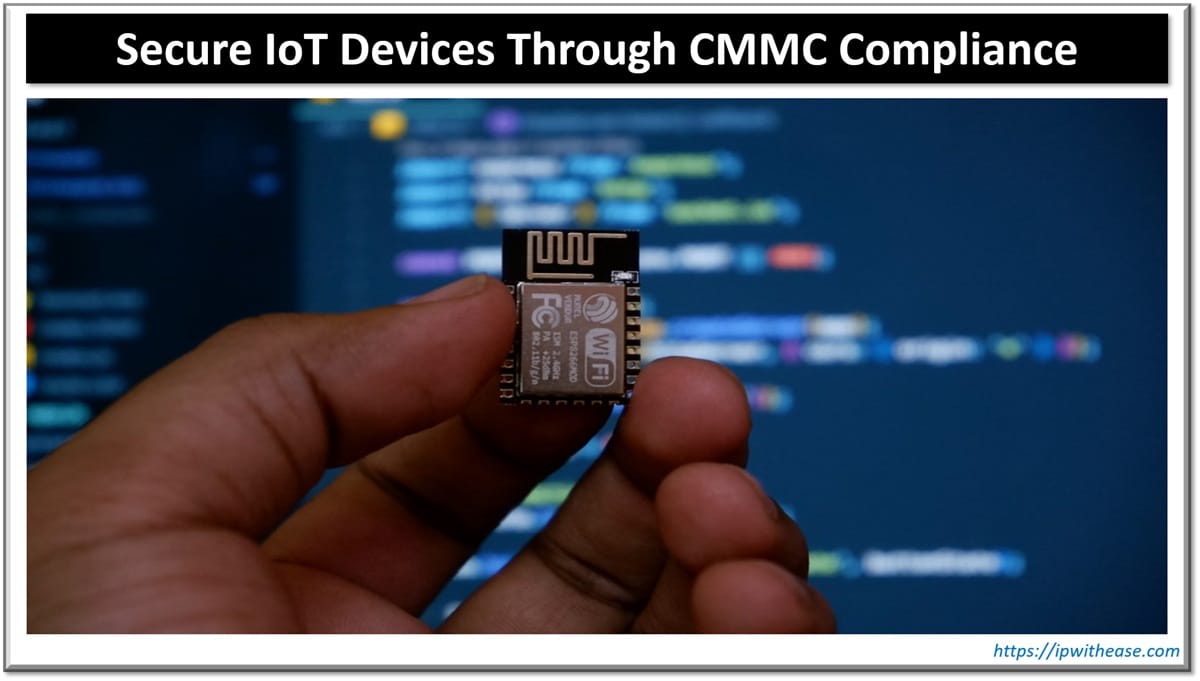
Small technology companies deploying Internet of Things devices face a paradox: the connected sensors, cameras, and controllers that drive operational efficiency also create expanding attack surfaces that sophisticated threat actors actively exploit. Unlike enterprise organizations with dedicated security operations centers, smaller firms must defend against nation-state adversaries and ransomware syndicates with limited budgets and lean IT teams.
The Cybersecurity Maturity Model Certification framework offers these companies a structured pathway to institutional-grade security. Originally developed to protect defense supply chains, CMMC provides scalable controls that address the specific vulnerabilities IoT deployments introduce—from unsecured device firmware to inadequate network segmentation. For companies handling federal contracts or sensitive commercial data, compliance isn’t optional. The framework aligns with NIST Special Publication 800-171 requirements for protecting Controlled Unclassified Information, creating a unified approach to both regulatory obligations and practical threat mitigation.
The CMMC Framework and Its Application to IoT Security
The Department of Defense designed CMMC to verify that contractors implement cybersecurity practices rather than simply attest to them on paper. The certification model establishes progressive maturity levels, each building on the previous tier’s controls. For small tech enterprises, this structure provides clear milestones rather than overwhelming requirements.
CMMC solutions address IoT-specific risks through several mechanisms:
- Asset inventory requirements that force visibility into shadow IT and forgotten devices—a common problem when sensors proliferate across facilities.
- Access control standards that prevent default credentials and shared passwords, two vulnerabilities CISA identifies as primary attack vectors in IoT compromises.
- Incident response protocols tailored to environments where a compromised thermostat can provide lateral movement to financial systems.
- Configuration management processes that ensure security patches reach devices that manufacturers may no longer actively support.
The certification process itself validates implementation through third-party assessment. Unlike self-certification approaches, this independent verification provides assurance to partners and customers that security controls actually function as designed. For companies competing for contracts or partnerships with security-conscious organizations, the certification serves as both technical validation and business differentiator.
Why Compliance Failures Carry Disproportionate Risk for Smaller Companies
The consequences of inadequate cybersecurity hit small technology firms harder than larger competitors. A data breach that represents a manageable crisis for a Fortune 500 company can prove existential for a 50-person operation. Beyond immediate incident response costs, companies face contract terminations, regulatory penalties, and reputational damage that persists long after systems are restored.
The financial exposure extends beyond obvious breach costs. Companies that handle Controlled Unclassified Information without proper safeguards face potential False Claims Act liability if they misrepresent their security posture to obtain government contracts. The Department of Justice has signaled increased scrutiny of cybersecurity compliance, treating inadequate controls as a form of fraud when companies claim to meet requirements they haven’t actually implemented.
NIST 800-171 compliance provides the technical foundation that CMMC certification verifies. The 110 security requirements in NIST 800-171 address fundamental controls—multi-factor authentication, encryption, audit logging, and incident response capabilities. These aren’t theoretical best practices; they’re specific, testable requirements that NIST research has validated as effective against documented threat patterns.
Protecting Controlled Unclassified Information in IoT Environments
Controlled Unclassified Information presents unique challenges in IoT deployments. Unlike traditional IT systems where data flows through managed servers and workstations, IoT architectures distribute processing across edge devices that may lack robust security features. A building automation system that adjusts HVAC based on occupancy patterns might inadvertently log information about classified project activities. A manufacturing sensor network could reveal production volumes that constitute export-controlled technical data.
Effective CUI management in these environments requires several defensive layers:
- Data classification at collection points—determining which sensor feeds capture CUI before that data enters storage or analytics systems.
- Network segmentation that isolates CUI-handling devices from general corporate networks and internet-connected systems.
- Encryption both in transit and at rest, implemented in ways that don’t break device functionality or create unmanageable key management burdens.
- Access controls tied to specific job functions rather than broad permissions that violate need-to-know principles.
- Audit capabilities that track who accessed CUI and when, even when that access occurs through automated systems rather than human users.
The National Archives CUI program provides authoritative guidance on identifying and marking controlled information. For technology companies, the challenge often lies not in understanding CUI categories but in recognizing when their systems process it. A company developing logistics software might not initially realize that shipment tracking data for defense contractors constitutes CUI requiring protection.
Practical Security Measures for Resource-Constrained Organizations
Small tech enterprises can’t simply scale down enterprise security architectures. The approaches that work for organizations with dedicated security teams and substantial budgets often prove impractical for companies where the CTO also manages infrastructure and the CFO handles compliance documentation. Effective security for these organizations requires solutions that provide institutional-grade protection without enterprise-level overhead.
Several strategies deliver disproportionate security value relative to their implementation cost:
- Privileged access management that eliminates standing administrative credentials—the single control that prevents the majority of ransomware attacks from achieving their objectives.
- Network monitoring focused on anomaly detection rather than signature-based approaches, identifying unusual device behavior that indicates compromise.
- Automated patch management for both traditional IT systems and IoT device firmware, addressing the vulnerability window that attackers routinely exploit.
- Security awareness training that goes beyond annual compliance videos to provide practical, role-specific guidance on recognizing social engineering and reporting suspicious activity.
- Vendor risk assessment processes that evaluate the security posture of IoT device manufacturers and cloud service providers before those systems touch CUI.
CMMC Solution Platforms address the specific compliance and security challenges small tech companies face when implementing CMMC requirements. Rather than assembling security controls from disparate vendors, these integrated solutions provide the documentation, technical controls, and assessment support needed for certification — an approach also taken by Triumvirate Cybersecurity and Exostar, though each varies in how much turnkey vs. custom configuration they offer.
The combination of CMMC and NIST compliance creates a comprehensive security framework. CMMC provides the certification structure and verification process, while NIST 800-171 supplies the detailed technical requirements. Together, they address both the “what” and the “how” of protecting sensitive information in IoT environments.
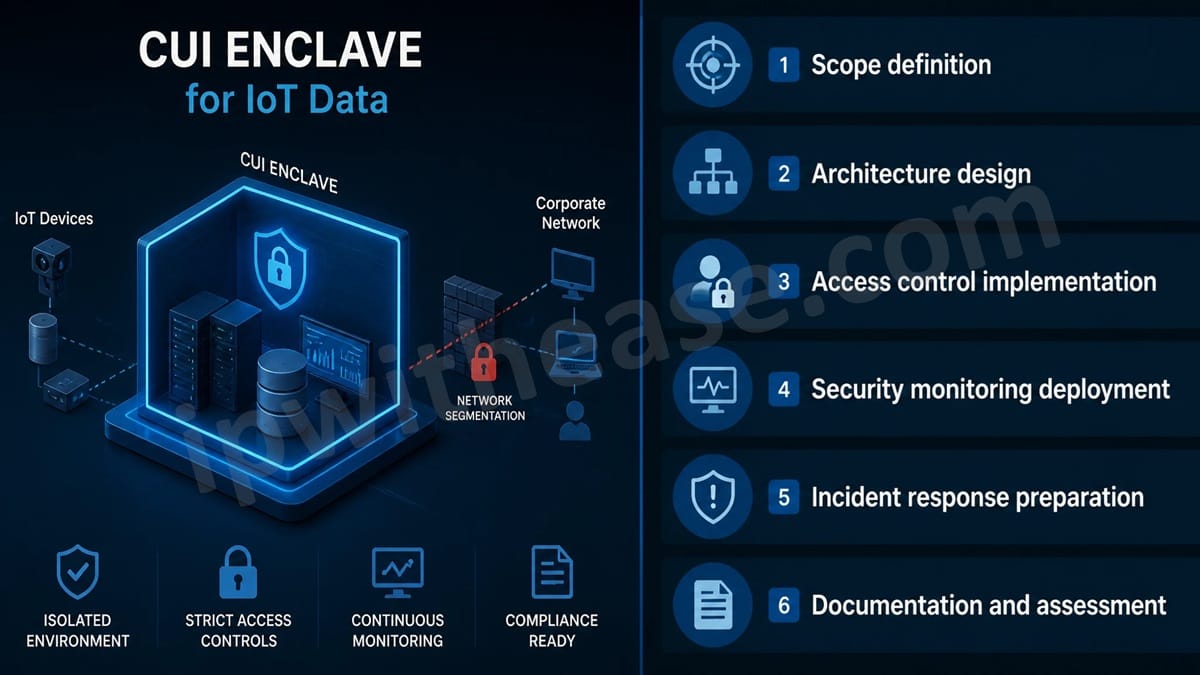
Building a CUI Enclave for IoT Data
A CUI enclave creates a hardened environment specifically designed to process, store, and transmit controlled information. For small tech companies, the enclave approach offers several advantages over attempting to secure entire networks to CUI standards. By concentrating security controls in a defined boundary, companies can achieve compliance without the cost and complexity of treating every system as CUI-capable.
Establishing an effective CUI enclave involves these sequential steps:
- Scope definition—Identify which systems, applications, and IoT devices will handle CUI, then map the data flows between them to understand enclave boundaries
- Architecture design—Plan network topology that physically or logically separates the enclave from general corporate networks, including dedicated hardware where virtualization creates unacceptable risk
- Access control implementation—Deploy multi-factor authentication, role-based permissions, and privileged access management that enforces least-privilege principles
- Security monitoring deployment—Install logging and alerting systems that detect unauthorized access attempts, unusual data transfers, and potential insider threats
- Incident response preparation—Develop and test procedures for containing breaches, preserving forensic evidence, and meeting notification requirements
- Documentation and assessment—Create the system security plans, policies, and procedures that assessors will review during CMMC certification
The enclave model proves particularly valuable for IoT deployments because it acknowledges reality: not every connected device can meet CUI security requirements. A legacy industrial controller with embedded credentials and no patch availability shouldn’t process controlled information, but it may need to operate on the same physical network as CUI systems. The enclave approach allows companies to maintain operational technology while protecting sensitive data through isolation and controlled interfaces.
When to Engage Specialized Compliance Expertise
NIST 800-171 compliance consultants provide expertise that most small tech companies don’t maintain in-house. These specialists understand both the technical requirements and the assessment process, helping organizations avoid common implementation mistakes that delay certification or create vulnerabilities.
Professional guidance delivers several concrete benefits:
- Gap analysis that identifies deficiencies before formal assessment, allowing companies to remediate issues on their own timeline rather than under audit pressure
- Implementation roadmaps that sequence security improvements logically, addressing foundational controls before building dependent capabilities
- Documentation templates and examples that meet assessor expectations, reducing the administrative burden that often consumes more time than technical implementation
- Vendor evaluation support for companies selecting security tools, helping distinguish genuine capabilities from marketing claims
When selecting a consultant, prioritize demonstrated experience with organizations of similar size and technical complexity. A consultant who primarily works with defense primes may recommend solutions that prove impractical for a 30-person software company. Look for advisors who understand resource constraints and can identify pragmatic approaches that satisfy requirements without unnecessary gold-plating.
Cost structures vary considerably. Some consultants charge fixed fees for defined deliverables like gap assessments or policy development. Others work on hourly arrangements for ongoing advisory support. For companies with limited budgets, consider engaging consultants for specific high-value activities—initial gap analysis and pre-assessment readiness reviews—while handling routine implementation internally.
Building Sustainable Security Practices
CMMC compliance represents a starting point rather than a destination. The certification validates that security controls exist and function at a specific moment, but maintaining that posture requires ongoing attention. Threats evolve, systems change, and personnel turn over. Companies that treat compliance as a one-time project rather than a continuous program inevitably drift back into vulnerability.
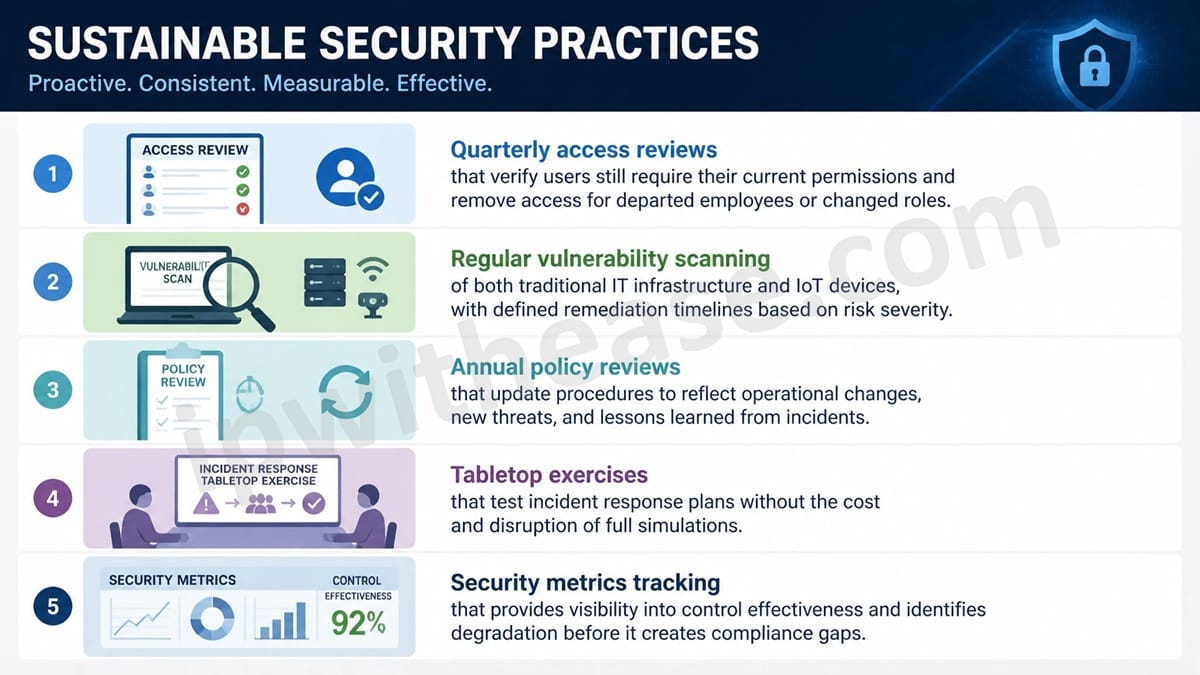
Sustainable security practices include:
- Quarterly access reviews that verify users still require their current permissions and remove access for departed employees or changed roles.
- Regular vulnerability scanning of both traditional IT infrastructure and IoT devices, with defined remediation timelines based on risk severity.
- Annual policy reviews that update procedures to reflect operational changes, new threats, and lessons learned from incidents.
- Tabletop exercises that test incident response plans without the cost and disruption of full simulations.
- Security metrics tracking that provides visibility into control effectiveness and identifies degradation before it creates compliance gaps.
For small tech enterprises handling IoT security, the path forward requires both technical implementation and organizational commitment. CMMC solutions provide the framework, NIST 800-171 supplies the requirements, and specialized platforms offer the tools to achieve compliance efficiently. The companies that succeed treat security not as a compliance obligation but as a competitive advantage—a capability that enables them to pursue opportunities that less mature competitors cannot access.
The investment in robust cybersecurity delivers returns beyond regulatory compliance. Customers increasingly demand evidence of security maturity before sharing sensitive data or integrating systems. Partners require assurance that a breach won’t cascade through interconnected networks. Investors evaluate cyber risk as a material factor in valuations. By implementing comprehensive security controls, small tech companies position themselves to compete in markets where inadequate protection represents a disqualifying liability.
ABOUT THE AUTHOR

IPwithease is aimed at sharing knowledge across varied domains like Network, Security, Virtualization, Software, Wireless, etc.