Table of Contents
Third-party vendors are now security’s largest blind spot. IBM’s 2026 Cost of a Data Breach Report found that attacks starting with a supplier doubled in 2024, reaching 30 percent of all incidents. Regulations such as the EU Digital Operational Resilience Act (DORA) and updated U.S. interagency guidance now demand continuous oversight, echoing the Zero Trust maxim: “never trust, always verify.” A new class of agentic third-party risk-management (TPRM) platforms answers that need, surfacing shadow IT, reading evidence, scoring risk in real time, and opening remediation tickets. Here are five front-runners and where each fits.
How we judged them
We reviewed the Forrester Q1 2026 TPRM Wave, the Gartner 2025 landscape, and dozens of demos, keeping only platforms that run production agentic AI, monitor continuously, and cover multiple risk domains. Judge your own shortlist on agentic depth, Zero Trust alignment, regulatory coverage, risk breadth, integrations, usability, transparent pricing, and market credibility.
List of Agentic Vendor Risk Management Platforms
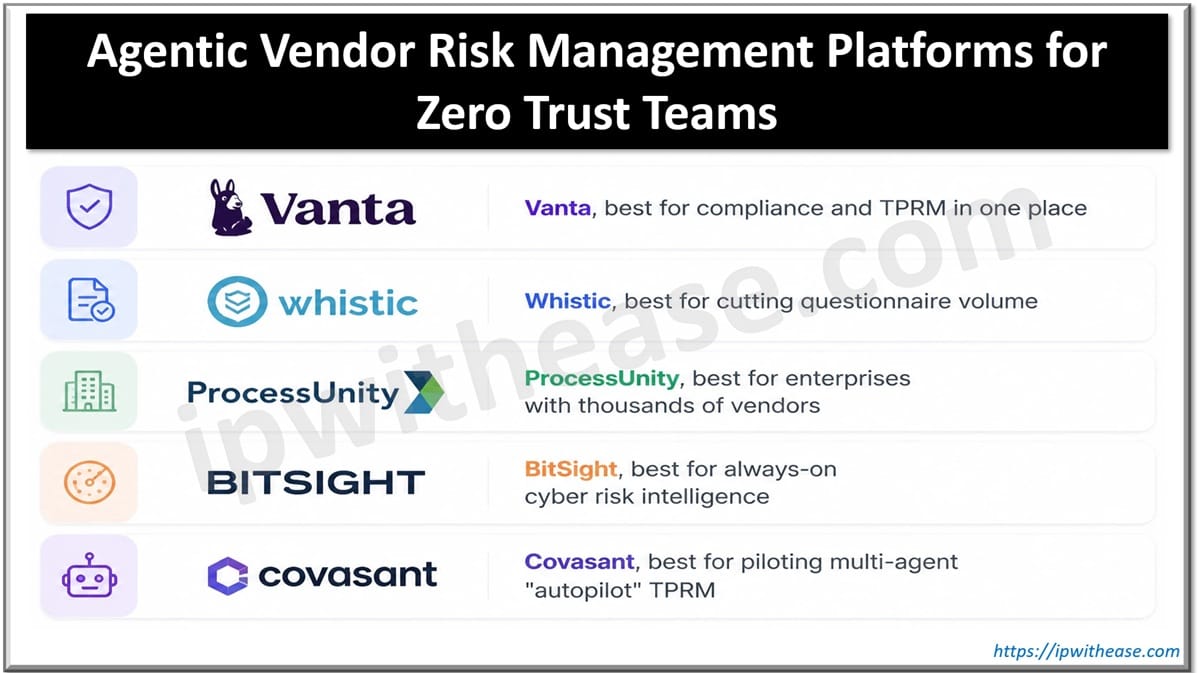
Vanta, best for compliance and TPRM in one place
Vanta unifies GRC and vendor risk so both run from one system. Its TPRM Agent gathers evidence from Trust Centers and public documents, pre-answers questionnaires against your chosen framework, then produces a residual risk score and a recommended decision: approve, conditionally approve, remediate, or reject. It can auto-flag findings, score inherent risk, summarize reviews, and open Jira tickets. For a broader market view, this third-party risk management software guide compares leading tools and where each one fits.
Continuous monitoring, a paid add-on, uses first-party daily scanning from the Risky acquisition, tracking breaches, leaked credentials, misconfigurations, and sub-processor inventory, all classified by severity. For Zero Trust, it discovers shadow IT through identity and device integrations, scores its inherent risk, and pairs with Access Management to verify who still holds vendor access. Findings feed the same workflows as your SOC 2, ISO 27001, HIPAA, and 30-plus other frameworks.
Founded in 2018, the company serves 14,000-plus customers, holds 4.6/5 on G2, and is a Leader in the 2025 IDC MarketScape for GRC. It reports 62 percent faster evidence collection and 50 percent faster vendor assessments. It is less suited to deep financial-health scoring or enterprises managing 10,000-plus vendors with complex hierarchies.
Whistic, best for cutting questionnaire volume
Whistic is a TPRM point solution built on a two-sided vendor network: suppliers publish a security profile and buyers reuse it instead of sending fresh spreadsheets. Its Assessment Copilot automates questionnaire responses, summarizes SOC 2 reports, and generates CrowdConfidence scores, cutting assessment time from weeks to minutes, while Smart Response matches incoming questionnaires to an approved knowledge base. Vendor Monitoring surfaces public-source events every 30 minutes, partly through a Mastercard RiskRecon partnership.
Founded in 2015, it supports 50-plus questionnaire frameworks and an 80K-profile Trust Catalog, but offers no access governance or shadow IT discovery, limited integrations, and no internal compliance automation. Vender-reported pricing runs around $20K per year.
ProcessUnity, best for enterprises with thousands of vendors
ProcessUnity is an enterprise TPRM platform for regulated organizations that need deep workflow control and auditability, anchored by its Global Risk Exchange (GRX). Its Evidence Evaluator, trained on 40 million control-question pairs, compresses review of SOC reports and certifications from days to seconds, while Assessment Autofill pre-populates responses. Its Risk Index fuses GRX attestation data with perimeter scans and connectors to rating providers such as BitSight and SecurityScorecard.
GRX holds 370,000-plus vendor profiles and 18,000-plus control attestations, with 80 percent of the Fortune 1000 represented. Founded in 2003, it was named a Leader in the Forrester Wave for TPRM Platforms, Q1 2026. It is VRM-only, with no internal compliance automation and real implementation effort, a bundle around $37K per year plus a one-time configuration fee.
BitSight, best for always-on cyber risk intelligence
BitSight is the market-defining cyber risk ratings platform, continuously scanning an organization’s external attack surface and converting it into a comparable 250-to-900 security rating across 25 risk vectors. It processes 400-plus billion security events per day, updating ratings multiple times daily, and its Framework Intelligence maps documentation to SIG, NIST CSF, and ISO 27001 in about 90 seconds. A dedicated fourth-party product discovers concentration risk without relying on self-reported vendor lists.
Founded in 2011, it reports 3,500-plus customers and 38 percent of the Fortune 500, and is a Leader in the Forrester Wave for Cybersecurity Risk Ratings, Q2 2026. It sees only external signals, offers no compliance automation or access reviews, and its per-vendor pricing can pressure how many vendors you cover.
Covasant, best for piloting multi-agent “autopilot” TPRM
Covasant positions TPRM as one product on an enterprise AI-agent platform built on its CAMS suite, with multi-agent orchestration and a cognitive reasoning engine. Its agents handle vendor onboarding, dynamic scoring across cyber, financial, regulatory, ESG, and operational dimensions, and continuous monitoring across news, sanctions, and threat intelligence, escalating a signal to actionable intelligence within 48 hours. Integrations lean toward procurement and ERP systems such as SAP Ariba, Coupa, and Oracle, with 200-plus connectors.
Formed via a July 2025 merger and headquartered in Hyderabad, it is ISO/IEC 42001 certified. Monitoring cadence is unspecified, no Zero Trust features are substantiated, and its proof points, such as 70 percent faster onboarding, are anonymous with no named references or analyst placement. No public pricing is available.
How to choose
Start with the workflow breaking first: questionnaire overload points to Whistic or Vanta, regulator-grade cyber metrics to BitSight, thousands of vendors under strict oversight to ProcessUnity, and hands-off automation to a Covasant pilot. Then validate native connectors to the systems you already run, since integration gaps stall value. Run a pilot on three vendors you know well and treat any mismatch greater than ten percent as a red flag. Finally, model total cost of ownership, including vendor-based tiers, paid monitoring feeds, and rollout hours, not just license price.
ABOUT THE AUTHOR

IPwithease is aimed at sharing knowledge across varied domains like Network, Security, Virtualization, Software, Wireless, etc.