Table of Contents
Most engineering leaders already bought the tools. Copilot’s on, an agent or two runs in the pipeline, and the delivery numbers still look like last year’s. BCG found that more than 80% of companies now deploy generative AI in engineering, yet the gains rarely match the license spend. It’s seldom the model. The tool got dropped into a workflow built for human-only code, where the review, the ownership, and the on-call rotation never changed.
A guide to AI-enabled software engineering helps go deep on the architecture. This piece is about the call you make first: are you building an AI-native team, or just wiring AI into the same old toolchain? The install barely moves the needle. What moves it is everything you rebuild around the tool.
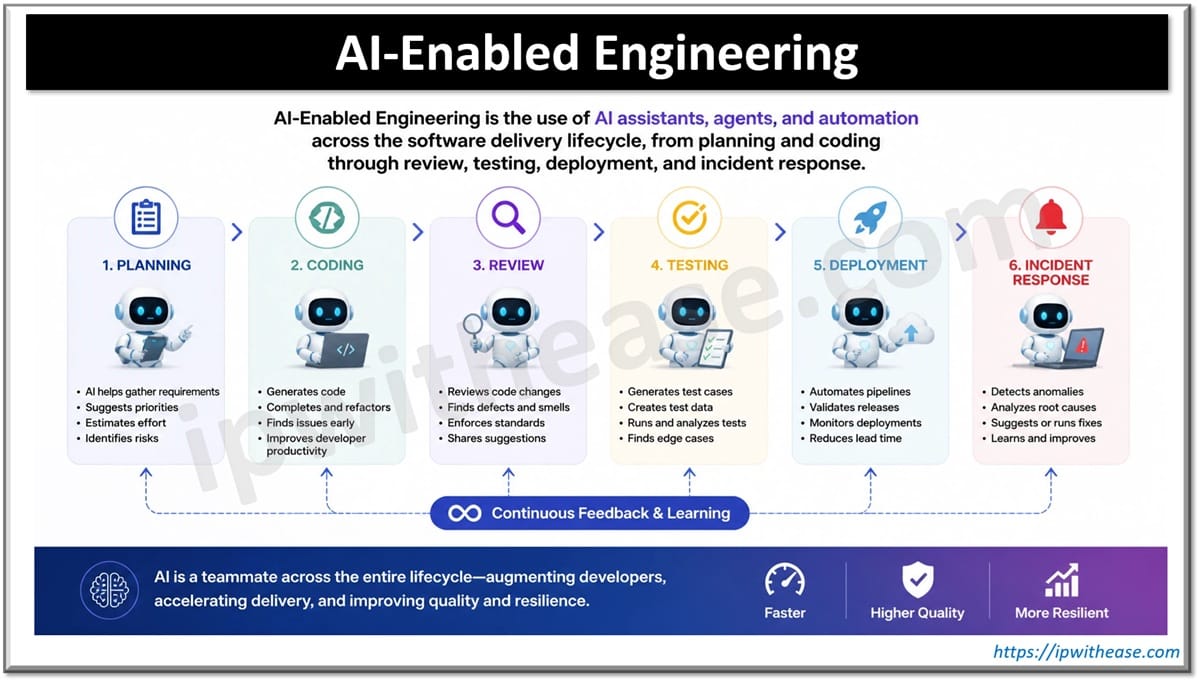
AI-enabled software engineering is the use of AI assistants, agents, and automation across the software delivery lifecycle, from planning and coding through review, testing, deployment, and incident response. An AI-native engineering team doesn’t just bolt those tools onto the old workflow. It redesigns ownership, review, evaluation, and escalation around code a machine now writes.
AI-Powered Toolchains vs AI-Native Engineering Teams
Bolt AI onto the edges of a process you never touched, and you have an AI-powered toolchain. Rebuild the process around the fact that a machine now writes the first draft of the code, and you have an AI-native team. Here’s what the toolchain version looks like on the ground:
- Agents generate code, but it still flows through a review designed for three humans and a coffee break.
- No one decided who owns a defect in AI-written code, so it lands on whoever merged it.
- “It compiles, and the old tests pass” is the quality bar, and there are no evals for model output.
- An agent fails at 2 a.m. with no escalation path, so it ships something subtly wrong.
An AI-native team flips the order. The model writes the first draft, then everything around it (review, ownership, evals, escalation) decides whether that draft is good enough to ship.
| Lifecycle stage | AI-powered toolchain | AI-native engineering team | Why it matters |
|---|---|---|---|
| Code review | Humans review every line while AI output piles up | AI handles the first pass; humans review architecture, intent, and risk | Reviewers drown in volume unless review logic changes |
| Ownership | Whoever merges the code owns the bug | Every service has a named owner, no matter who or what wrote the code | AI-written code still needs human accountability |
| Quality bar | “It builds and old tests pass” | Evals score AI output before merge | Without evals, teams cannot separate real gains from lucky runs |
| Incidents | Humans investigate manually when something fails | Escalation paths, fallback modes, and graceful degradation are defined upfront | AI failures should fail safe, not quietly ship bad output |
Related: 5 Core Components of AI Agents
Redesign These Four Workflows Before Buying Another AI Tool
Swap the tool, leave these four workflows alone, and you’ve reproduced the most common failure in AI-enabled software engineering. OpenAI’s guidance for building an AI-native engineering team splits the lifecycle into seven phases, each with a named owner. Agents handle multi-step implementation and the first-pass review. Engineers stay accountable for whatever reaches production.
Review logic
When a machine writes the first draft, line-by-line human review collapses under the volume. So split it in two. An automated pass catches style, security, and the obvious logic errors in minutes. Humans move up to what they’re actually good at: architecture and intent.
Ownership
Nothing erodes trust in AI-generated code faster than code nobody owns. Give every service a named owner. “The agent wrote it” should have zero bearing on who answers for it when it breaks in production.
Evals
Leaders keep asking whether the AI spend paid off, then measure nothing that would answer it. The ROI of AI accelerated engineering only becomes legible once you track four numbers: token-cost efficiency, cycle-time reduction, defect-escape rate, and developer satisfaction. Tie each to a figure finance already watches. Defect-escape rate, for instance, maps straight onto the cost of a bug that reaches production.
Escalation paths
Treat AI reliability as an architecture problem. Testing alone won’t get you there. On a healthcare-services engagement under healthcare data-compliance rules, ai-enabled engineering solutions instrument an extraction pipeline with a resumable state machine and a verification layer, and that layer caught two silent failures before they shipped corrupt data. Build the observability and the fallback modes in from the start. A misfiring model should degrade gracefully, not quietly forward garbage downstream.
Related: 6 Ways AI Is Transforming Business Operations
How AI-Enabled Engineering Transformation Works
People say “transformation” like it’s something you buy once. It’s really three horizons you move through, and most programs stall by running it as a single 12-to-18-month push. Transforming software ran this on their own engineering team for thirty months of continuous build before they offered the approach to a single client. That is the whole basis for saying any of this out loud; the team hit these failure modes on itself first. What came out was an internal operating system where six scoped agents (delivery, sales, code analytics, PM, HR, outreach) each own a defined slice of context, rather than one general chatbot doing all of it.
- Pilot. Take one workflow, three to five early adopters, four to six weeks, and hard metrics. Prove the ROI before you scale anything. Adoption spreads on its own once peers see it work.
- Scale. Push the workflow that worked out to adjacent teams, and carry the review, ownership, and eval rules you already proved along with it.
- Embed. Make the new operating model the default one. Every AI suggestion gets scored against the outcome it actually produced. That’s an eval-by-outcome loop, not a one-off accuracy check nobody revisits.
The payoff showed up in where the context lived. Once those six agents held the team’s context instead of a handful of senior people, a new non-technical hire reached senior-level output quality in about three months, against twelve on the old ramp. What got measured was concrete: the same eval-by-outcome loop scored the hire’s work against a senior’s on the same tasks, and closing that score gap is what “senior-level” meant here.
This is the part most toolchain rollouts miss. The bottleneck was never the model’s context window; it was that the team’s own context sat locked in a few people’s heads. One honest caveat. Agents amplify what you already have; they don’t start you from zero. Feed them noisy or duplicated context and they amplify the noise, so fix entity resolution first. And under roughly ten engineers, point tools still win.
What AI-Accelerated Full-Stack Engineering Looks Like in Production
What you get from that shift isn’t faster autocomplete. It’s a system that holds up when the ground underneath it moves. Take one legacy-migration project. The only architect who understood a 12-year-old data warehouse was weeks from walking out the door. Rather than trust a documentation backlog nobody had time for, the team front-loaded knowledge capture into the engineering process: recorded walkthroughs, a source-by-source map, every table tagged in-scope, out-of-scope, or in-progress.
One departing engineer’s knowledge became a six-week-per-source migration plan the business could budget against before his last day. That’s what owning the knowledge, not just the code, buys you. It separates AI-enabled engineering that survives an audit from a demo that wins a slot at a conference.
The Bottom Line: AI Engineering Is an Operating Model Change
What defines an AI-native engineering team isn’t the tools it buys. It’s four rebuilt workflows: how code gets reviewed, who owns AI-written code, how you measure output, and what happens the night a model fails. So buy the model, sure. Then budget for the operating model around it, and treat the whole thing as a change-management job first and a technical one second.
FAQs
Q.1 What is the difference between an AI-native engineering team and an AI-powered toolchain?
A toolchain bolts AI onto a process that otherwise stays exactly as it was. An AI-native team rebuilds review, ownership, evals, and escalation around the fact that a model now writes the first draft. Two teams can run identical tools and get very different results; the operating model is what separates them.
Q.2 Which engineering workflows have to change first when adopting AI?
Four of them break before anything else does: code review, ownership, evals, and escalation paths. Automate the first-pass review, put a name against every piece of AI-written code, score model output before it merges, and decide up front what happens when a model fails at 2 a.m.
Q.3 How do you measure the ROI of AI in engineering?
Watch four numbers: token-cost efficiency, cycle-time reduction, defect-escape rate, and developer satisfaction. Each should map to a figure finance already tracks, the way defect-escape rate maps to the cost of a production bug. One concrete pilot with hard numbers beats a fifty-slide strategy deck.
Q.4 Where do AI engineering transformations usually fail?
Most get run as one long project rather than a pilot-scale-embed sequence, and lose momentum around month four. The other classic failure is turning agents loose on noisy, duplicated data, where all they do is amplify the mess. Fix the data layer first, then prove ROI on a single workflow.
Q.5 Do you need fully autonomous, agentic AI to get value?
No. A linear workflow, where the model handles one step and a human decides what happens next, is predictable, debuggable, and safe, with a person at every compliance gate in regulated work. Start human-in-the-loop, and hand the agent more responsibility only where the evidence backs it up.
ABOUT THE AUTHOR

IPwithease is aimed at sharing knowledge across varied domains like Network, Security, Virtualization, Software, Wireless, etc.