Table of Contents
Nine out of ten software professionals use AI, but improvements in delivery performance have been more limited.
So what does AI truly save time on and what happens when people and teams start to use it?
This article looks at how teams use AI across the development lifecycle, what impact it has on delivery, and how to measure the results.
AI Adoption Is Outpacing Delivery Gains
Google Cloud’s 2025 DORA poll of 5,000 IT professionals found that 90% use AI at work, up from 76% the year before.
- Throughput improved. In the 2025 data, AI adoption showed a positive relationship with software delivery throughput, reversing the previous year’s finding.
- Stability moved the other way. The same research found AI adoption still carried a negative relationship with delivery stability. Teams ship more. They also break more.
- Trust lagged behind use. Roughly 30% of respondents reported little or no trust in AI-generated code, even while using it daily.
Then there is a result that complicates the picture. METR ran a randomised controlled trial putting 16 experienced open-source developers through 246 real tasks in repositories they already knew well.
The developers expected AI to make them 24% faster. They worked 19% slower in the end. This was due to their proficiency with the code, the complexity of the repositories and the time it required to prompt the AI and review its output, the researchers said.
What is AI-Accelerated Engineering?
AI-powered software engineering changes team decomposition and work completion.
| Parameter | Ad-hoc AI Tooling | AI-Accelerated Engineering |
|---|---|---|
| Unit of adoption | The individual developer | The delivery pipeline |
| Where AI sits | Inside the editor | Across discovery, build, test, review, release |
| Prompting | Unversioned, per person | Role-scoped agents with versioned prompts and context |
| Quality control | Author-level review only | Defined gates with human sign-off per stage |
| Reuse | Each prompt starts cold | Shared architectural patterns, contracts, test standards |
| Measured by | Lines generated, acceptance rate | Cycle time, change failure rate, review load |
| Where defects surface | After merge | At a gate before merge |
Related: 6 Ways AI Is Transforming Business Operations
Where The Acceleration Comes From
The gains concentrate where work is well-specified and cheap to verify. They thin out where the work depends on context the model cannot see.
| SDLC stage | What AI does well here | Realistic effect | Human checkpoint |
|---|---|---|---|
| Discovery and requirements | Drafting user stories, edge cases and acceptance criteria from notes | Moderate. Faster first draft | Product owner validates scope and priority |
| Architecture and API design | Generating contracts from a chosen pattern, spotting inconsistencies | Low to moderate. The choice stays human | Architect signs off the contract before any code |
| Implementation | Boilerplate, CRUD, data mapping, migrations, SDK glue | High on new or unfamiliar code, low on mature repos | Engineer owns the merge |
| Testing and QA | Unit and integration test generation, fixtures, coverage gaps | High. The clearest measurable win | QA lead reviews what the tests assert |
| Code review | First-pass review for obvious defects and style drift | Moderate. Reduces reviewer load | Human reviewer approves every merge |
| Documentation and handover | API docs, runbooks, onboarding material, changelogs | High and persistently underrated | Owner verifies against current behaviour |
| Legacy and maintenance | Explaining unfamiliar code, mapping dependencies | High for onboarding, low for surgical changes | Senior engineer validates before refactor |
Testing and documentation offer the most reliable return of any stage in the table.
The acceleration also runs largest where context is thinnest, on new services and inherited systems, and smallest where senior engineers already move quickly.
Governance Layer: What Remains Human
How teams examine and approve AI-generated code is just as important as how they utilise the tools.
Four decisions remain to be made by humans:
- Architecture. AI is able to suggest solutions but engineering needs to think about the long-term costs and trade-offs for upkeep.
- Accountability merge. Each merge needs an owner who understands what is changing and can fix problems.
- Security and dependencies. AI produced code can introduce vulnerabilities or reference non-existent packages. Developers also still need to check both.
- Implications for regulation. In payments and financial services you need audit trails to indicate who approved critical actions and why.
If your team is subject to PCI DSS, PSD2, scheme certification criteria or the EU’s Digital Operational Resilience Act, you need evidence behind an agent’s output
This is where AI-accelerated engineering services can help. We builds approval gates and traceability into the development pipeline, so evidence of compliance is recorded as work progresses.
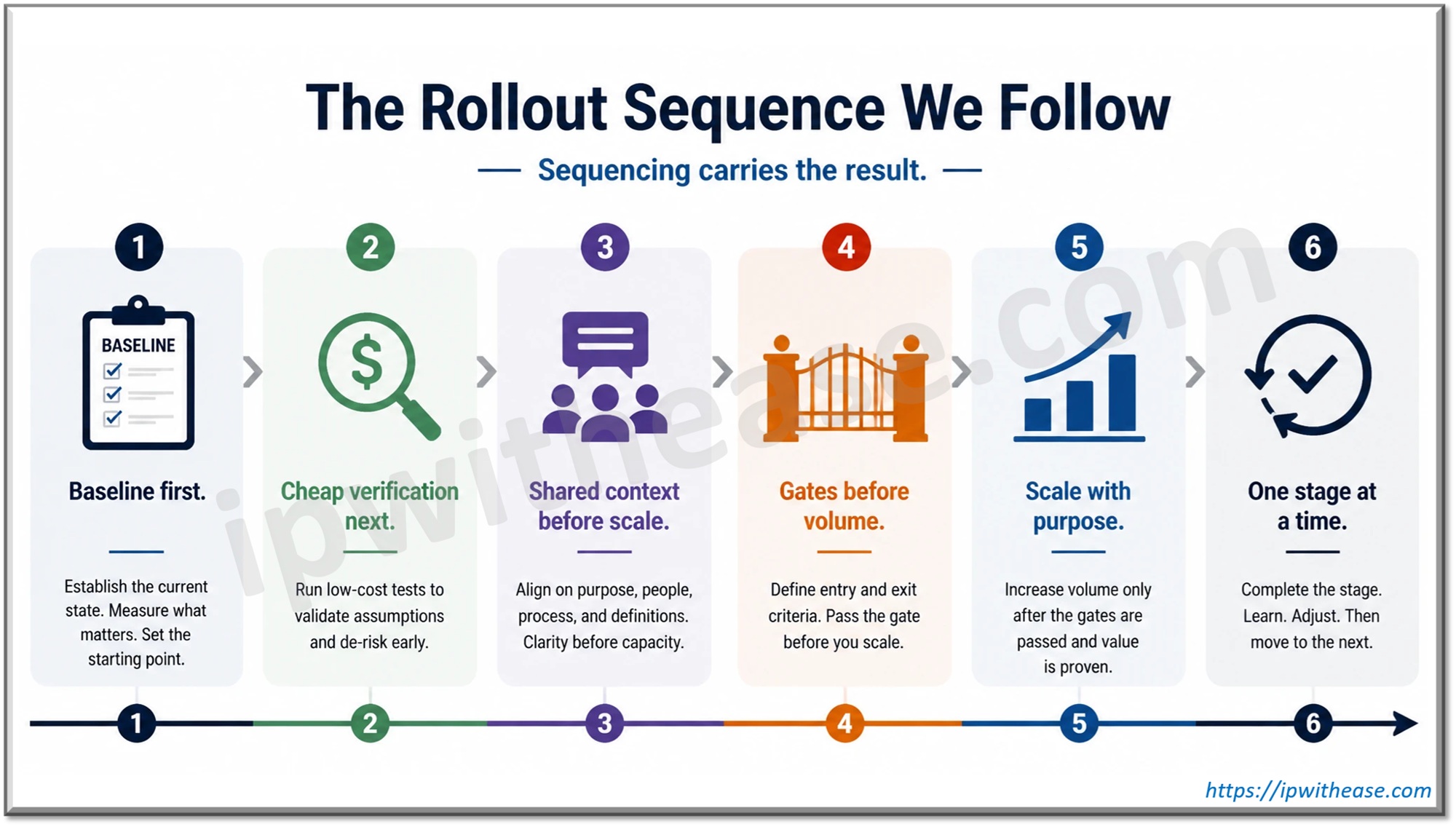
The Rollout Sequence We Follow
Sequencing carries the result. Here is the order we work in.
- Baseline first. We capture cycle time, change failure rate, time to restore and review turnaround for at least one full quarter before anything changes.
- Cheap verification next. Test generation, documentation and first-pass code review produce fast, checkable wins.
- Shared context before scale. We codify architectural patterns, API contracts, naming conventions, and testing standards into a reference the agents read, improving output quality with each contact.
- Gates before volume. We decide what needs human permission, who gives it, and what pipeline evidence it records, then restrict paths around it.
- One stage at a time. We expand while stability holds. A rising change failure rate sends us back to the gate before the next stage opens.
How We Measure Whether It Is Working
The focus is on measurable delivery outcomes:
- Cycle time from first commit to production. A headline measure of delivery speed and one that is particularly sensitive to how the gates are designed.
- Change failure rate. A measure of stability that can also show whether the process is ready to move to the next stage.
- Review turnaround and reviewer load. Shows where first-pass AI review saves time and where it adds work.
- Defect escape rate by stage. Shows which gates are catching defects and where the process may need adjustment.
- Onboarding time for a new engineer. AI can be particularly useful where context is limited, making this a useful measure of its impact on onboarding.
- Share of delivery spent on rework. Identifies how much generated code requires development before the team can own it.
For teams investing in AI powered engineering services, cycle time and defect rates are useful starting points because they connect delivery performance to budget decisions. We focus on these metrics alongside review turnaround, time to restore service, and the amount of work spent on rework
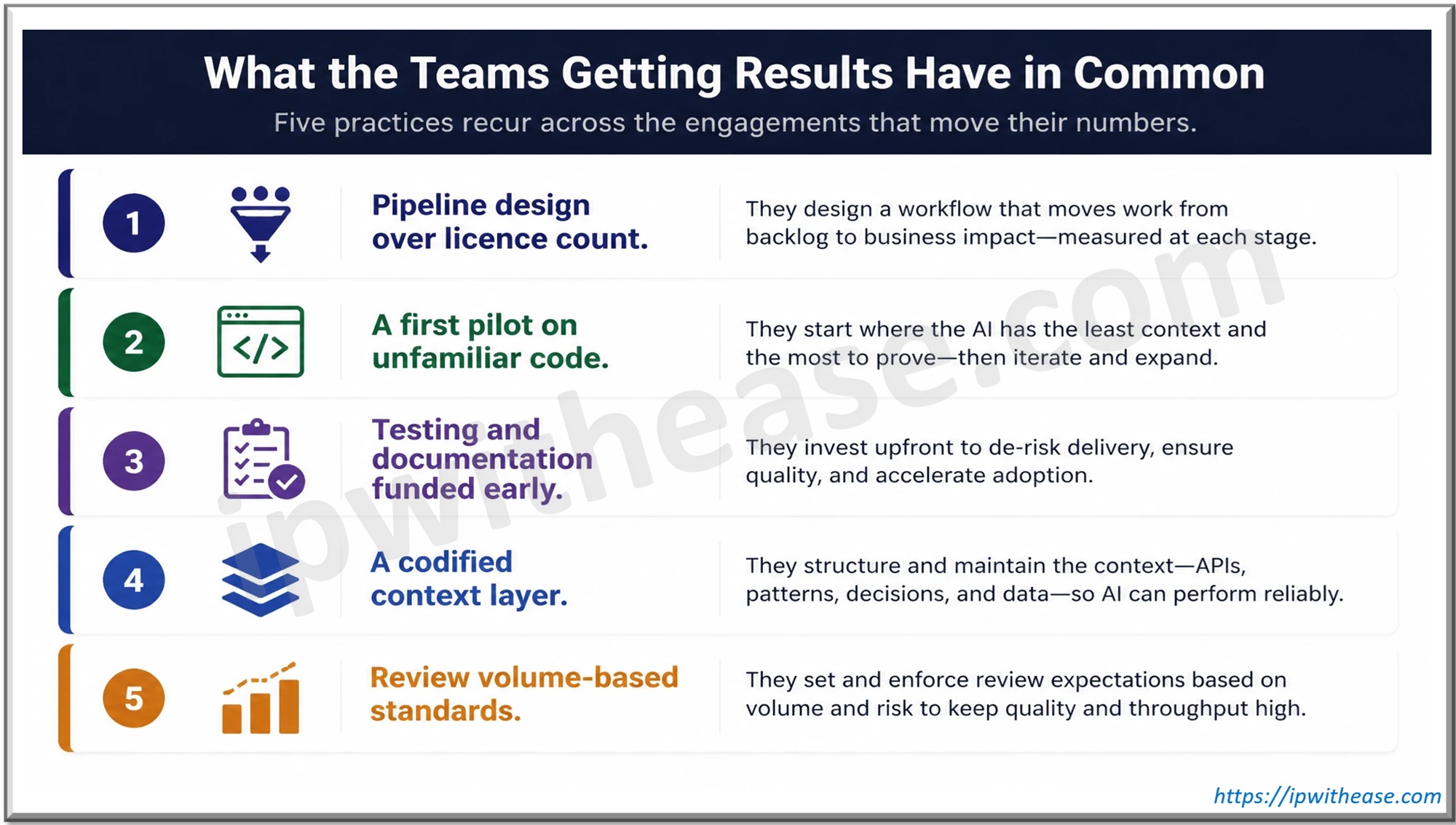
What the Teams Getting Results Have in Common
Five practices recur across the engagements that move their numbers.
- Pipeline design over licence count. At 90% adoption, access to AI tools is becoming standard. The difference lies more in how work moves through review and release.
- A first pilot on unfamiliar code. New services and inherited systems can provide useful conditions for testing AI assistance, making them a practical place to look for an initial measurable result.
- Testing and documentation funded early. These stages can provide a strong return and reinforce each other: better tests and clearer documentation support the work that follows.
- A codified context layer. Agents can read architectural patterns and API contracts in a common reference to quickly access project conventions.
- Review volume-based standards. To reduce change failure rates, review practices may need to scale with code volume.
Summary
AI tools are increasingly commonplace in software engineering – thus just having access to them isn’t much of an advantage anymore. The key difference is how teams manage the code and other output these technologies produce.
Research indicates that standard artificial intelligence can help teams deliver faster, but the benefits are contingent on effective management of the development process. If review and testing methods lag, software stability can suffer.
It’s a smart place to begin by performing jobs that are straightforward to verify, so it’s easier to measure if AI actually helps. As AI produces more code, teams will also have to adapt their review and testing methods for the additional output. This is how AI-accelerated engineering may lead to real increases in delivery speed.
Frequently Asked Questions
How do AI coding tools differ from AI-accelerated engineering?
The benefits of the AI coding tools in the editor are realized directly by the developer. AI-accelerated engineering is more comprehensive with agents that span the whole development lifecycle: from requirements to documentation and human approval at the important points.
Why do some studies show AI slowing developers down?
METR’s randomised trial found experienced developers took 19% longer on tasks in repositories they knew well, against a predicted 24% speed-up. The researchers attributed it to deep existing familiarity with the codebase, repository size and complexity, and time spent prompting and reviewing. The result applies to that setting specifically. AI assistance delivers most where human context is thinnest, such as onboarding or an unfamiliar stack.
Where does a team start for measurable results?
We recommend test creation, documentation, and first-pass code review since they are easy and cheap to check. Comparing findings to pre-AI delivery parameters simplifies effect assessment.
Do fintech-regulated industries use AI-accelerated engineering?
It can if governance is part of delivery. PCI DSS, PSD2 and EU DORA settings need controls and traceability for code changes, reviews and approvals. Examples are permission gates, signoffs, and audit trails.
Our AI-augmented development services can account for these requirements, with governance, compliance, and technical architecture considered together.
How can I know if my investment is paying off?
It is more objective to evaluate the cycle time from first commit to production, change failure rate, time to restore service, defect escape rate, review turnaround, and new engineer onboarding. METR’s prediction-actual performance difference demonstrates how self-assessment can be deceptive.
Cycle time and change failure rate are especially helpful when seen combined. If the delivery speed increases without a matching increase in the number of rejected modifications, there’s more evidence that AI is enhancing the delivery process, not just increasing output.
ABOUT THE AUTHOR

IPwithease is aimed at sharing knowledge across varied domains like Network, Security, Virtualization, Software, Wireless, etc.