Table of Contents
Your review queue fills up fast, and a bug can hide in a long pull request (PR, a proposed code change). Sound familiar? That’s where AI code review helps, by reading each change before a person does.
So here are 7 AI-Powered Code Review platforms that do this job. Each one reads pull requests a little differently, so start with what you need, then see how each one works.
Start with what you need
Not sure which one to try first? Well, this table pairs common needs with the tools below.
| If you need | Look at |
|---|---|
| A quality score for every repo | Aikido, Codacy, or SonarQube |
| Test coverage next to your quality data | Aikido, Codacy, or SonarQube |
| Your own team rules applied to reviews | Aikido, Codacy, SonarQube, Qodo, CodeRabbit, Greptile or GitHub Copilot code review |
| Fixes suggested for the issues it finds | Aikido, Codacy, SonarQube, CodeRabbit, Greptile, Qodo or GitHub Copilot code review |
| Reviews that read your whole repository | Aikido (Deep PR Review), Greptile, Qodo, CodeRabbit or GitHub Copilot code review |
| Pass or fail checks before a merge | Aikido, SonarQube, Codacy or CodeRabbit |
| AI that flags critical functions with no unit tests | Codacy |
| Following up with a question inside a review comment | CodeRabbit |
| Checks across repos that depend on each other | Aikido (Deep PR Review), Qodo, or Greptile on its Pro plan |
| Review built into GitHub | GitHub Copilot code review |
Next, a few quick checks help you narrow it down:
- Think about where you’d like to see findings first: a dashboard, the pull request or your IDE.
- Decide if quality scores and coverage figures matter most, or catching bugs on every change.
- Count how many of your repos lean on each other’s code.
- Think about who’ll own the rules, and how much setup time your team has.
List of Top AI-Powered Code Review Platforms
1. Aikido
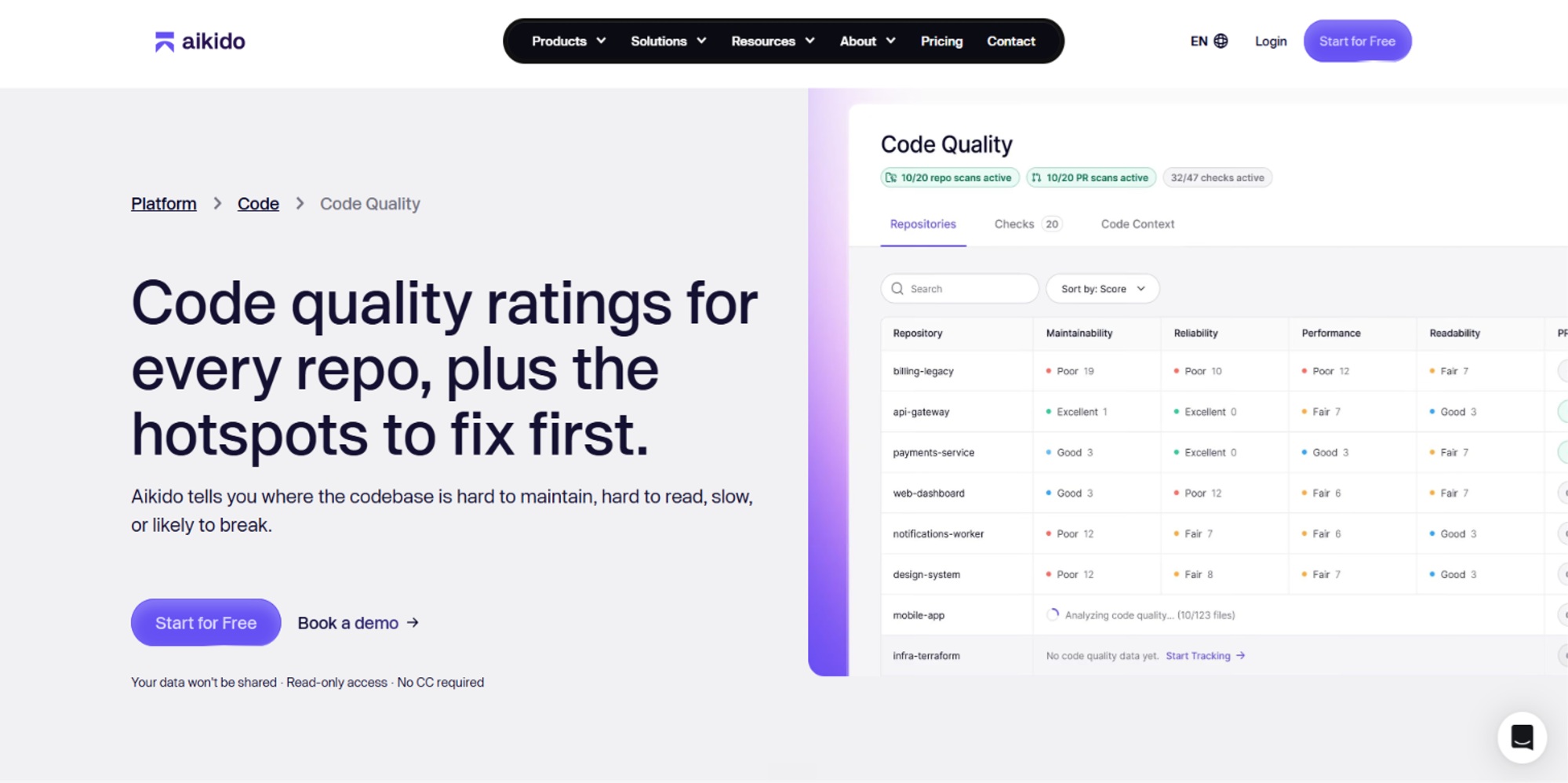
Aikido is a security platform built for developers. It sums up the goal as securing everything devs build, ship and run, across your code, cloud and runtime. Code Quality is part of it, and Aikido calls it the quality counterpart to SAST (security scanning of your code).
For code review, it offers two products. Code Quality grades your repos, and Deep PR Review reads your pull requests.
Highlights
- Repo grade (Code Quality): every repo gets one score for reliability, performance, readability and maintainability.
- Where to clean up (Code Quality): hotspots are files that change often and keep collecting findings, so you can start there.
- On each pull request (Code Quality): next, once you switch on PR checks, Aikido reads just the lines you changed and comments inline. You can scan whole repositories too, or combine both.
- What it looks for (Code Quality): logic bugs, wrong conditional checks, null or undefined dereferences and runtime errors. Findings come with plain-language explanations and fix guidance.
- Fixes (Code Quality): from there, AutoFix writes up a change for every finding, and your developers review and merge it. Set a threshold, and anything above it gets fixed automatically.
- Your rules (Code Quality): start from ready-made rule templates, or write your own rules and style guides. They apply to every pull request.
- Coverage numbers (Code Quality): Aikido also tracks code coverage, the share of your code that your tests run. Upload it from your CI pipeline and see it beside your other quality data. Basic, Pro, Advanced and Enterprise plans include it, not Developer.
- Full-repo reviews (Deep PR Review): plus, this is a separate product you switch on repo by repo. Many AI agents read your whole repository, not only the diff (the lines that changed), and reviews cost one credit per pull request.
Works with: GitHub, GitLab, Bitbucket and Azure DevOps, and Code Quality isn’t tied to one programming language.
2. Codacy
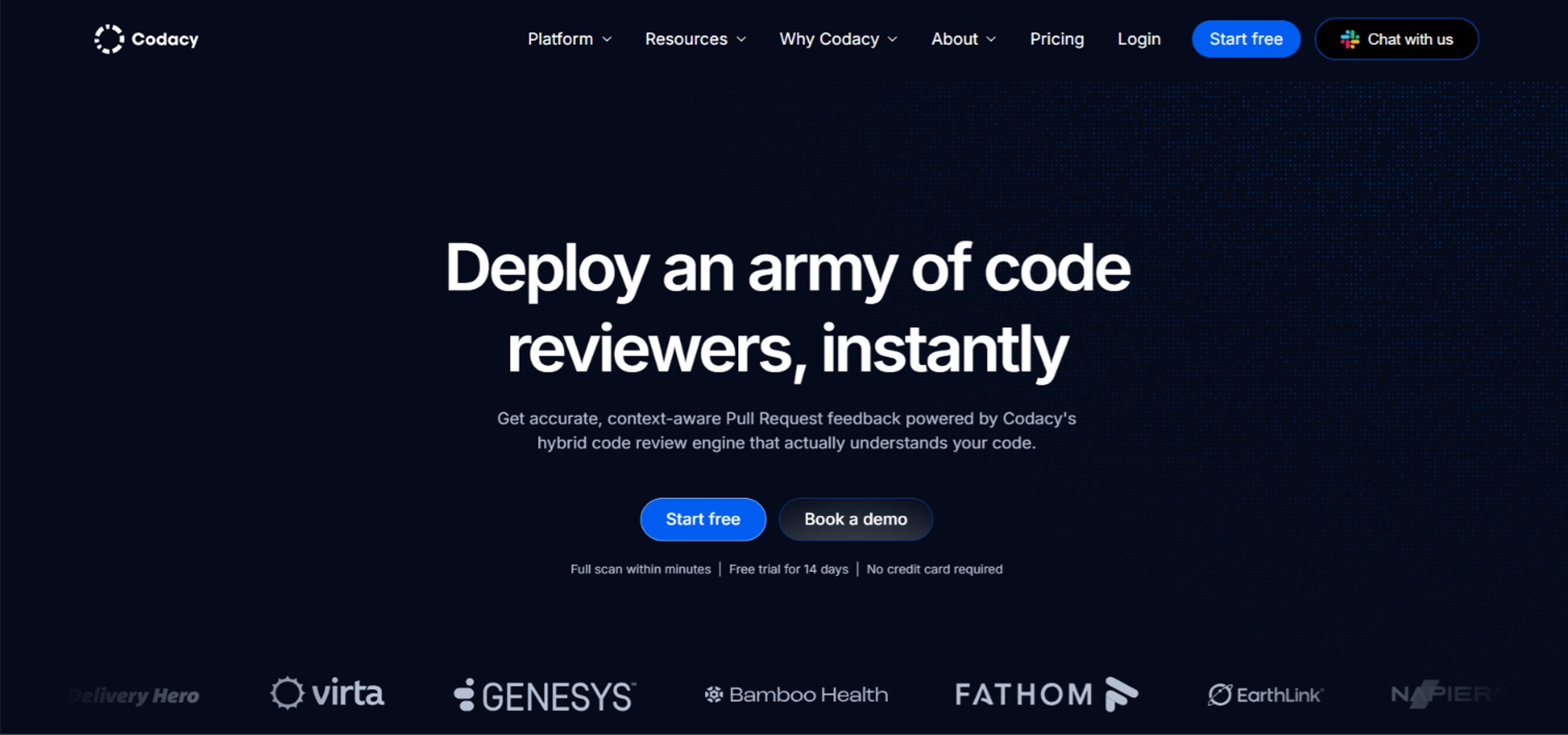
Codacy handles code quality and security, and its AI Reviewer comments on your pull requests. Codacy claims more than 15,000 organizations use it.
Highlights
- Who can use the AI Reviewer: it’s GitHub-only and comes with Team and Business plans. Someone with admin rights has to turn it on, since it’s opt-in.
- How it checks: rule-based checks, which behave the same every time they run, work alongside AI that reasons about context.
- What it flags: critical functions with no unit tests, and functions that get too complicated, with tips to simplify them. It also compares the pull request description with the code and points out promised logic that isn’t there.
- Pass or fail marks: Codacy sends three status checks to your Git provider, which show on the pull request. On top of that, Guardrails turns the coding and security policies you write into automated checks for AI coding agents.
Works with: GitHub, GitLab and Bitbucket for the status checks.
3. SonarQube
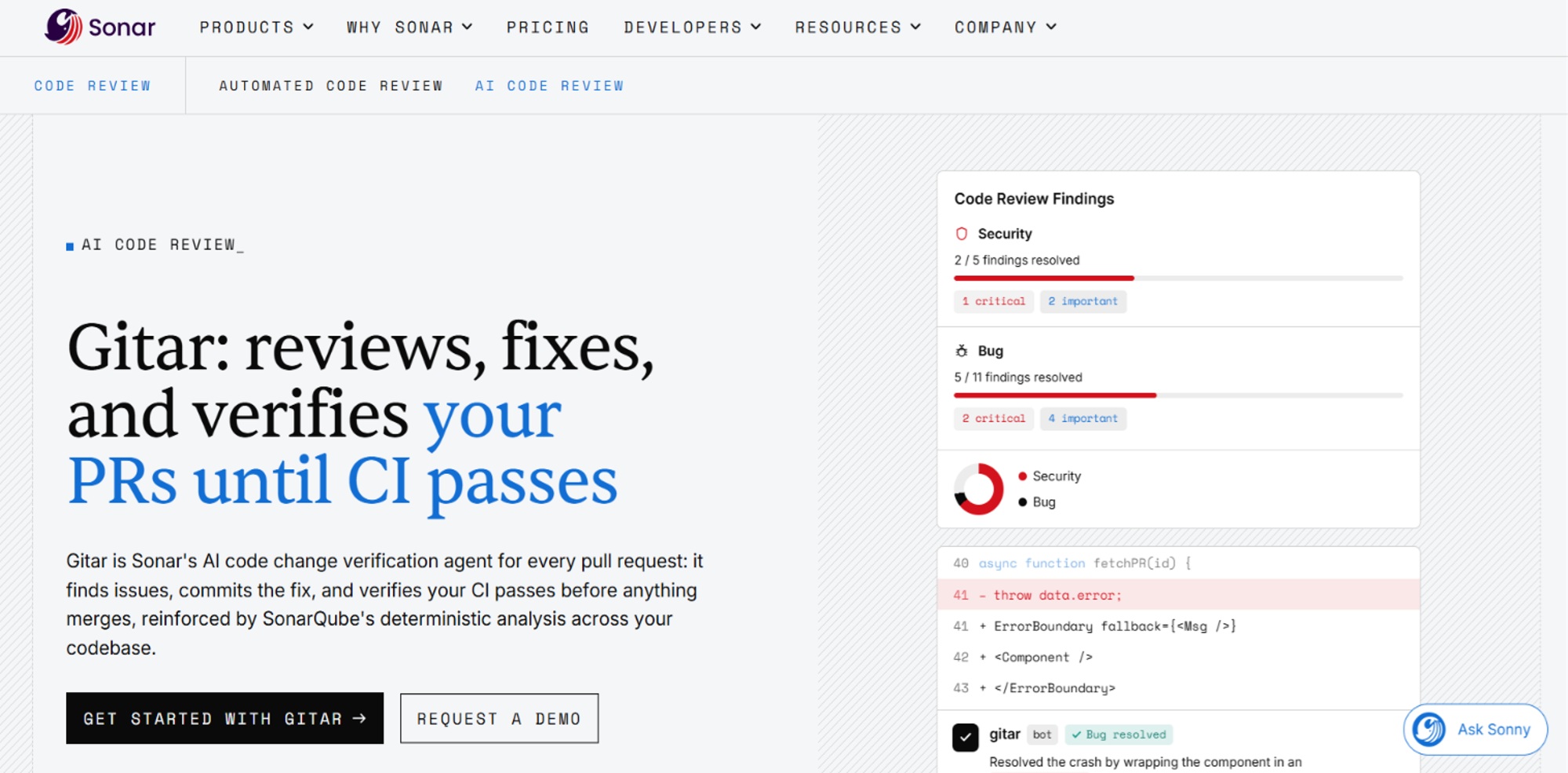
Sonar built SonarQube to check code quality and security, and you can pick managed SonarQube Cloud or self-managed SonarQube Server. Sonar says more than 7 million developers use SonarQube.
Highlights
- What it checks: static analysis, which means checking code without running it, catches maintainability concerns, duplicated code, security issues and bugs.
- Which code it scans: scans start right when you commit or push. Two options are limited: the free Community Build covers the main branch only, and the SonarQube Cloud Free plan covers the main branch plus pull requests that target it.
- Go or no-go: a quality gate checks each change against thresholds you set, and the result is pass or fail. So only code that meets your standards is eligible to be merged or released.
- Fix suggestions: AI CodeFix has an LLM (a large language model, the AI behind text tools) suggest a fix when SonarQube flags a problem. It’s listed for SonarQube Cloud Team and Enterprise, plus SonarQube Server Enterprise and Data Center.
- A separate product: Gitar comes from Sonar too. It’s an AI agent for every pull request that finds issues, commits the fix and checks that CI (your automated build and test steps) passes before merge.
Works with: GitHub, Bitbucket Cloud, GitLab and Azure DevOps.
4. CodeRabbit
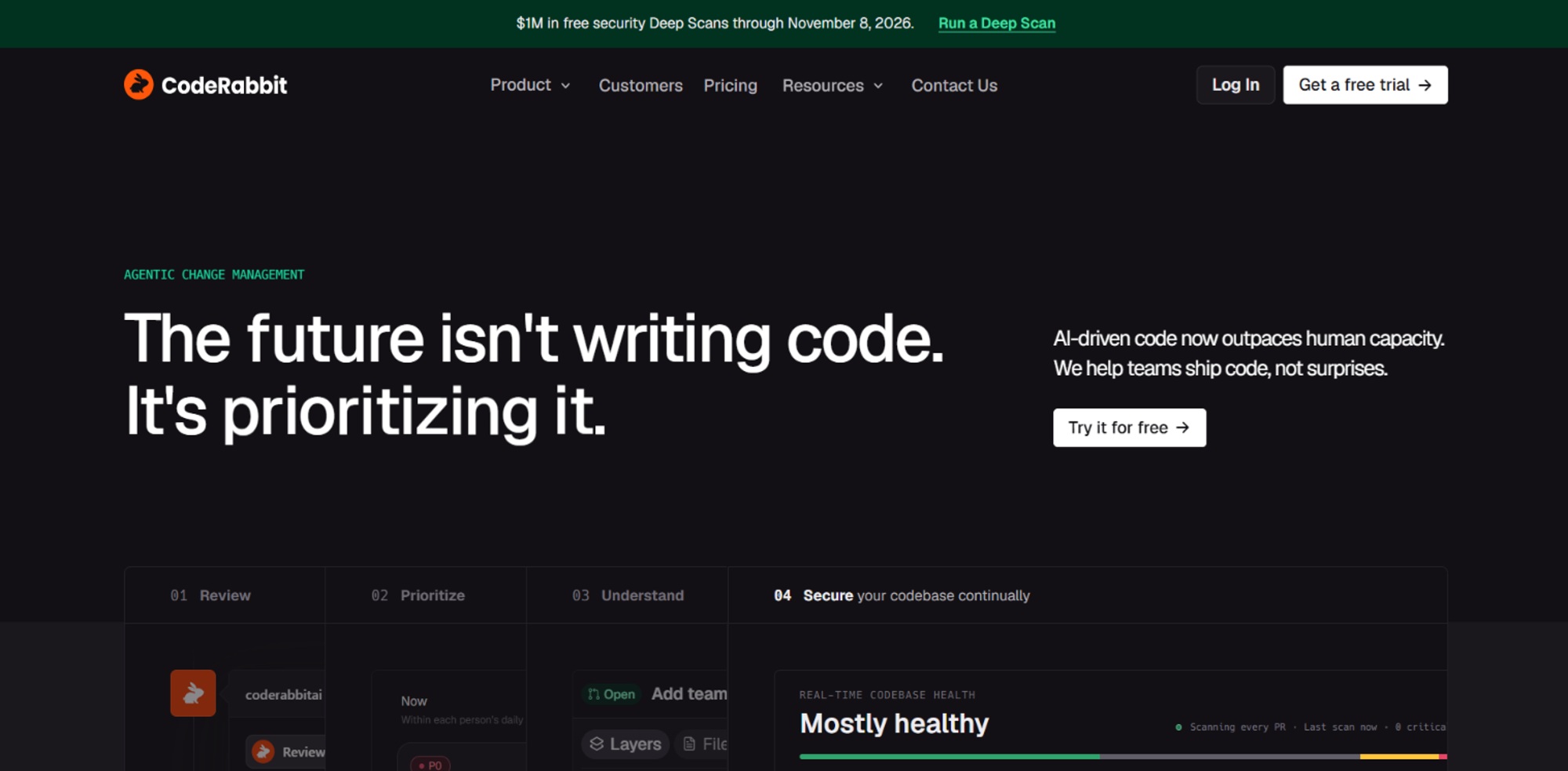
CodeRabbit reviews your pull requests automatically, and its platform adds triage and a pull request interface for larger changes. According to CodeRabbit, 17K customers trust it.
Highlights
- Reply in the comments: every review comment is a chat. Type @coderabbitai in a reply to ask what it meant, get code examples or discuss alternatives.
- Before and after the merge: pre-merge checks hold the line on your standards, and post-merge actions take care of the follow-up.
- Sorting your queue (Triage): it scores, ranks and routes pull requests, so you can tell what to review first. It’s marked new, and a single queue can cover several repos.
- Big changes and tone: Change Stack explains what a big change means, not just what changed. Plus, Quiet, Chill and Assertive profiles let you tune the review style.
Works with: GitHub, GitLab, Azure DevOps and Bitbucket.
5. Greptile
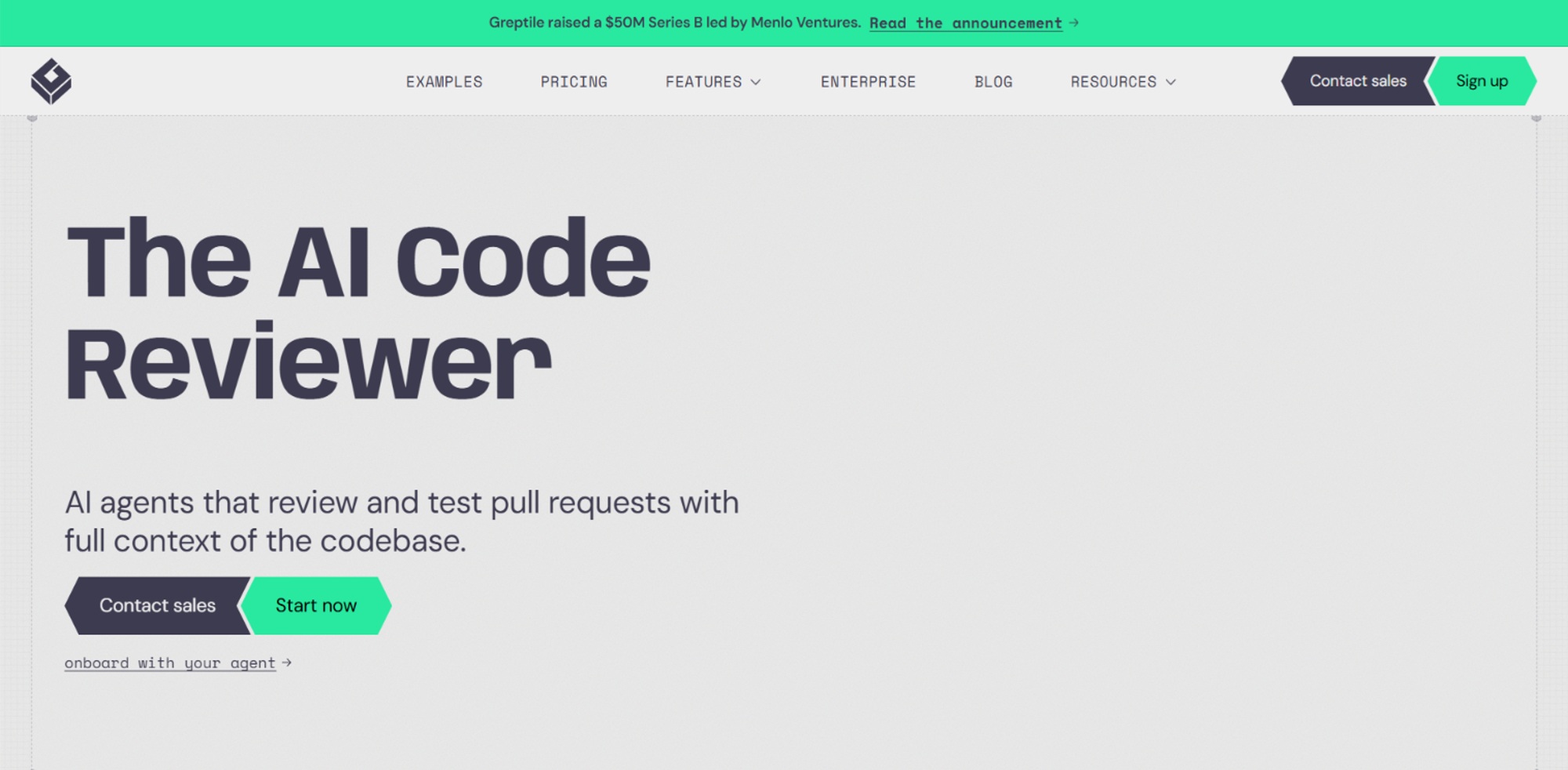
Greptile presents itself as an AI reviewer for code. Its agents review and test pull requests, drawing on context from the whole codebase.
Highlights
- Repo map: it builds a graph of your repo that links files and functions to what they depend on. Its Pro plan also lists cross-repo context.
- Past the diff: in addition to the map, a swarm of agents reviews each pull request and checks how a change affects code outside the diff.
- Test run (beta): TREX runs your PR branch in a sandbox, an isolated test environment, to catch bugs that only show up while the code runs.
- Fix in your IDE: one click sends the issue context to Claude Code, Cursor, Codex or Devin.
- Self-hosting: on the Enterprise plan, you can run Greptile on your own infrastructure, on-premises or in your cloud, with Docker Compose or Kubernetes and the LLM providers you pick.
Works with: GitHub, GitLab and Bitbucket, along with Cursor Origin. The Enterprise plan adds more.
6. Qodo
Qodo describes itself as an AI code review and governance platform, with one foot in your IDE and one on your Git pull requests. As per Qodo’s FAQ, teams report saving about an hour on every pull request.
Highlights
- In each review: specialized agents look over every pull request, with context from the whole codebase, and report bugs, rule violations and requirement gaps.
- Shared code: Cross Repo Review looks at repos that depend on each other. Therefore, if a change to a function in a shared library might break code that relies on it, Qodo marks it on the pull request and gives a link to the affected line.
- Comments into rules: Rules Miner takes comments that keep coming up, plus reviewer decisions, and turns them into rules you can enforce.
- Risk view: risk intelligence follows review findings, resolution rates and risk concentration across your teams and repos.
- On your own servers: Enterprise plans let you run Qodo on-premises or as a single-tenant setup, meaning your own dedicated copy.
Works with: GitHub (cloud and Enterprise Server), GitLab (cloud and self-managed), Bitbucket (Cloud and Data Center) and Azure DevOps, with Gerrit on Enterprise.
7. GitHub Copilot code review
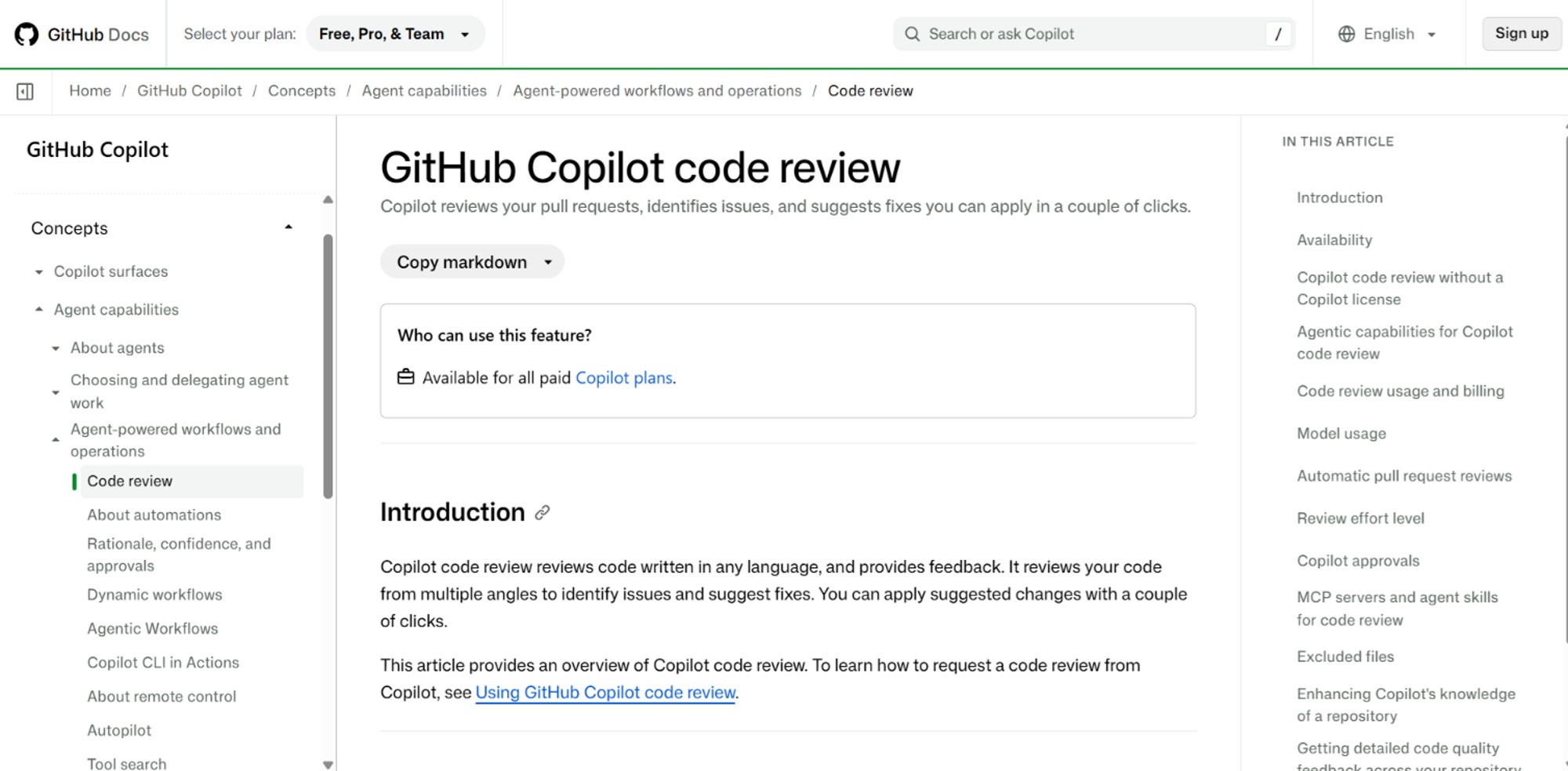
This is GitHub’s AI reviewer inside Copilot, and it checks code from multiple angles to spot issues and suggest fixes. You’ll need a paid Copilot plan.
Highlights
- In a review: it handles any language, and a couple of clicks applies the fixes it suggests.
- Approval assessment (public preview): each review’s overview comment says whether Copilot thinks the pull request is ready to approve. Required approvals don’t count Copilot’s reviews by default.
- Passing it on (public preview): suggestions can go to Copilot cloud agent, which then opens a new pull request against your branch with the fixes applied.
- Instruction files: it follows your custom and agent instructions, plus agent skills, taken from the head branch, where your edits live, so you can try out edits to them in that same pull request. Skills are reusable instruction packs for AI agents.
- GitHub Code Quality: a separate GitHub feature that needs GitHub Team or GitHub Enterprise Cloud. On the default branch, you also get AI-powered analysis of recently changed files. On pull requests, only rules-based findings from CodeQL (GitHub’s code scanning engine) show up.
Works with: GitHub.com, GitHub CLI and GitHub Mobile, plus several IDEs. Azure DevOps support is still a public preview.
Final Words
No single AI code review tool fits every team. The right one depends on where your problems actually show up. If you want quality grades and gates that hold up a merge, SonarQube or Codacy may be enough. If bugs keep slipping in through changes that ripple across the codebase, a whole-repo reviewer like Greptile, Qodo or Aikido is worth a look. Before you commit, check the pricing tier, how well it supports your Git provider, and where the feedback shows up for your developers. Then run a short trial on real pull requests, because that will tell you more than any feature list.
ABOUT THE AUTHOR
IPwithease is aimed at sharing knowledge across varied domains like Network, Security, Virtualization, Software, Wireless, etc.