Table of Contents
Every SD-WAN dashboard and QoS policy you build rests on a circuit someone else owns. If that circuit drops packets at 6 p.m. every weekday, no overlay will fix it. The overlay can only route around the problem, and only when another path exists.
That’s why transport selection deserves the same rigor as the routing design on top of it. Demand keeps climbing, too. A survey of 419 large enterprises found that 18% already run more than ten 100 Gbit/s ports, and it is expected that share to reach 35% within a year. Budgets and traffic are growing together, so the choice between dedicated and shared capacity is an engineering decision with a real cost of getting it wrong.
This article walks through what separates the two options, which SLA terms matter, and how to design the WAN around the circuit you actually buy.

What Dedicated Internet Access Actually Is
Dedicated internet access (DIA) is a point-to-point connection between your site and the provider’s core, with capacity reserved for you alone. Most vendors describe the same handful of traits: non-oversubscribed bandwidth, symmetrical upload and download, a written SLA, and a defined demarcation point. For many organizations, dedicated internet access for businesses is the baseline for anything carrying revenue-critical or real-time traffic, such as VoIP, video, ERP or replication to a second site.
Regulators draw the same line. The FCC’s business data services documentation from 2017 treats dedicated point-to-point transmission as a distinct category from best-efforts internet access, where capacity is shared and nothing is guaranteed.
One caution: fiber isn’t automatically dedicated. Carriers sell shared fiber products, including GPON-based services, where many customers contend for the same upstream capacity. A provider that owns its own fiber and doesn’t split it across a shared passive network avoids that contention, but you still have to confirm it in the contract. The medium doesn’t tell you the service model.
DIA vs Business Broadband: The Engineering Differences
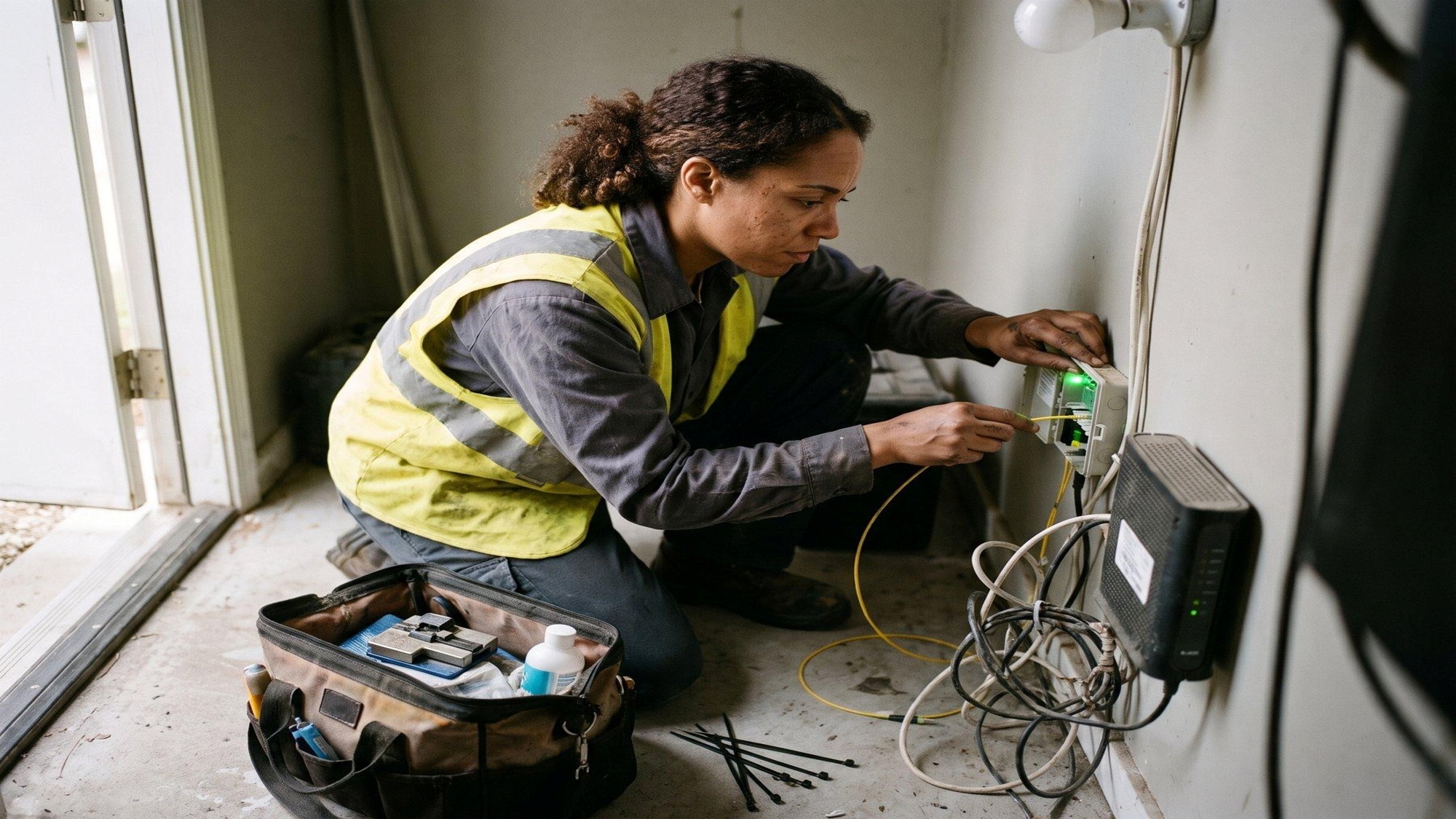
Broadband isn’t bad. It’s a different product, built for cost efficiency across many customers. The differences show up in the parameters you’d write into a design document.
| Parameter | Dedicated Internet Access | Business Broadband |
|---|---|---|
| Capacity model | Reserved, not oversubscribed | Shared, contended |
| Symmetry | Typically symmetrical | Usually asymmetrical |
| SLA | Availability, MTTR, often latency and loss | Best effort, rarely any SLA |
| Static IP and BGP | Commonly supported | Varies; often extra cost |
| Repair priority | Defined MTTR, 24/7 support | Standard ticket queue |
| Price | Higher; priced per circuit | Lower |
Treat the cost row as a rough guide; quotes vary widely by location and build requirements. The asymmetry row matters more than people expect. Backups, video uploads and cloud replication push traffic outbound, so a 500 Mbps download figure with a 50 Mbps upload leaves a surprisingly small ceiling.
Provider choice also shapes your overlay. If you’re weighing how an overlay changes the picture, our comparison of how SD-WAN differs from a traditional WAN covers the architecture side, but the underlay still sets the floor on loss and latency.
What to Verify in the SLA
An SLA is only useful if it’s measurable, written down and enforceable. Start with availability, and convert the percentage into time:
- 99.9% allows about 8.8 hours of downtime per year.
- 99.99% allows about 52.6 minutes per year.
That gap is large. A circuit advertised at “three nines” can be down for most of a working day without breaching the agreement.
Then read the rest of the document:
- MTTR: availability alone says nothing about how fast a fault gets fixed. Look for a committed repair time.
- Performance targets: latency, jitter and packet loss, ideally measured at p95 or p99 rather than averaged. Averages hide the spikes that break voice calls; our guide to p95 and p99 latency metrics explains why.
- Credits and exclusions: check how credits are calculated, how you claim them, and which events (maintenance, third-party cuts, customer equipment) fall outside the SLA.
- Support model: a 24/7 NOC you can reach by phone beats a ticket portal when a link is down at 2 a.m.
Don’t expect public labels to help here. The FCC’s broadband label rules, updated in a 2026 order, cover mass-market retail service, not enterprise circuits. For enterprise services, the contract is the only source of truth.
Designing Around the Circuit: DIA, Broadband and SD-WAN
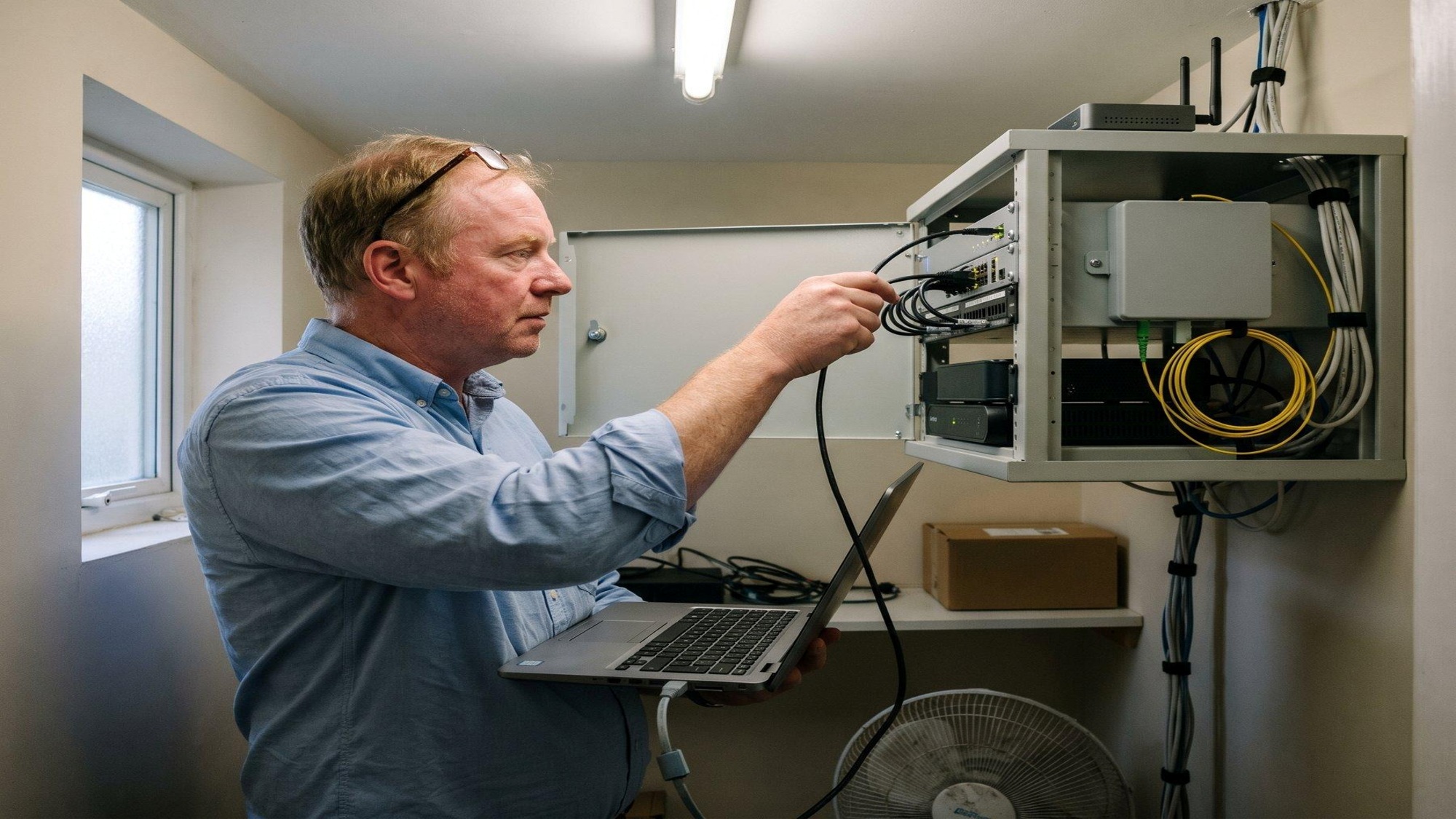
SD-WAN doesn’t replace an SLA; it manages the lack of one. The overlay can steer sessions away from a degraded path, but it can’t create capacity or repair times the underlay doesn’t have.
A common pattern works well for most mid-size networks. Put DIA at the headquarters, data center or any site hosting real-time and revenue-critical traffic. Use business broadband or 5G at branches, and as a secondary path at sites where DIA is primary. Then let the edge devices measure each path; with monitoring of latency, jitter and packet loss on each path, policies can shift voice to the cleanest link and send bulk traffic over the cheaper one.
Diversity matters more than the transport label. Two circuits that share a conduit or an upstream carrier fail together, so ask for separate physical routes and, where it matters, a second provider with BGP multihoming. A backup that rides the same trench isn’t a backup.
Sizing Bandwidth for 2026 and Beyond
Bandwidth planning has a timing problem. Prices for high-capacity connections leveled off in 2025 after years of decline, so waiting for cheaper capacity is a weaker bet than it used to be.
Still, don’t over-buy. Lightyear’s 2026 State of Connectivity report, puts growth in average circuit bandwidth purchased at roughly 20% a year, and found 2025 no faster than earlier years. That’s steady growth, not an explosion. Plan for it with a scalable commit, a clear burst policy, and an upgrade path that doesn’t require a new install.
Lead time is the part people forget. New fiber builds can take months. Start the order well before your cutover date, and keep the old circuit live until the new one passes acceptance testing.
Checklist Before You Sign
- Committed rate in writing, with a statement on oversubscription.
- Symmetrical bandwidth confirmed, not “usually” symmetrical.
- SLA document attached to the contract, covering availability, MTTR, latency and loss.
- Provider-owned fiber vs leased last mile, since a leased segment adds another party to every outage.
- Redundancy options, including diverse routes and a second handoff.
- 24/7 NOC contact path and escalation tiers.
- Install timeline with penalties for slippage.
- Renewal and post-promotion pricing, so the year-two bill doesn’t surprise you.
Conclusion
Use DIA where the circuit carries revenue-critical or real-time traffic and the cost of an outage is high. Use broadband plus SD-WAN where an hour of downtime is an inconvenience, not an incident. Either way, read the SLA before you read the brochure, and design the overlay around what the underlay can actually deliver.
ABOUT THE AUTHOR

IPwithease is aimed at sharing knowledge across varied domains like Network, Security, Virtualization, Software, Wireless, etc.