Table of Contents
The penetration of AI is faster than the imagination of humans in our lives. Initial AI use was a simple Q&A interface which rapidly underwent a big transformation. As now AI can think, act and behave near to humans and it is getting more and more powerful.
There are three main frontiers of AI technology – Large language models (LLMs), Retrieval-Augmented Generation (RAG), and AI Agents.
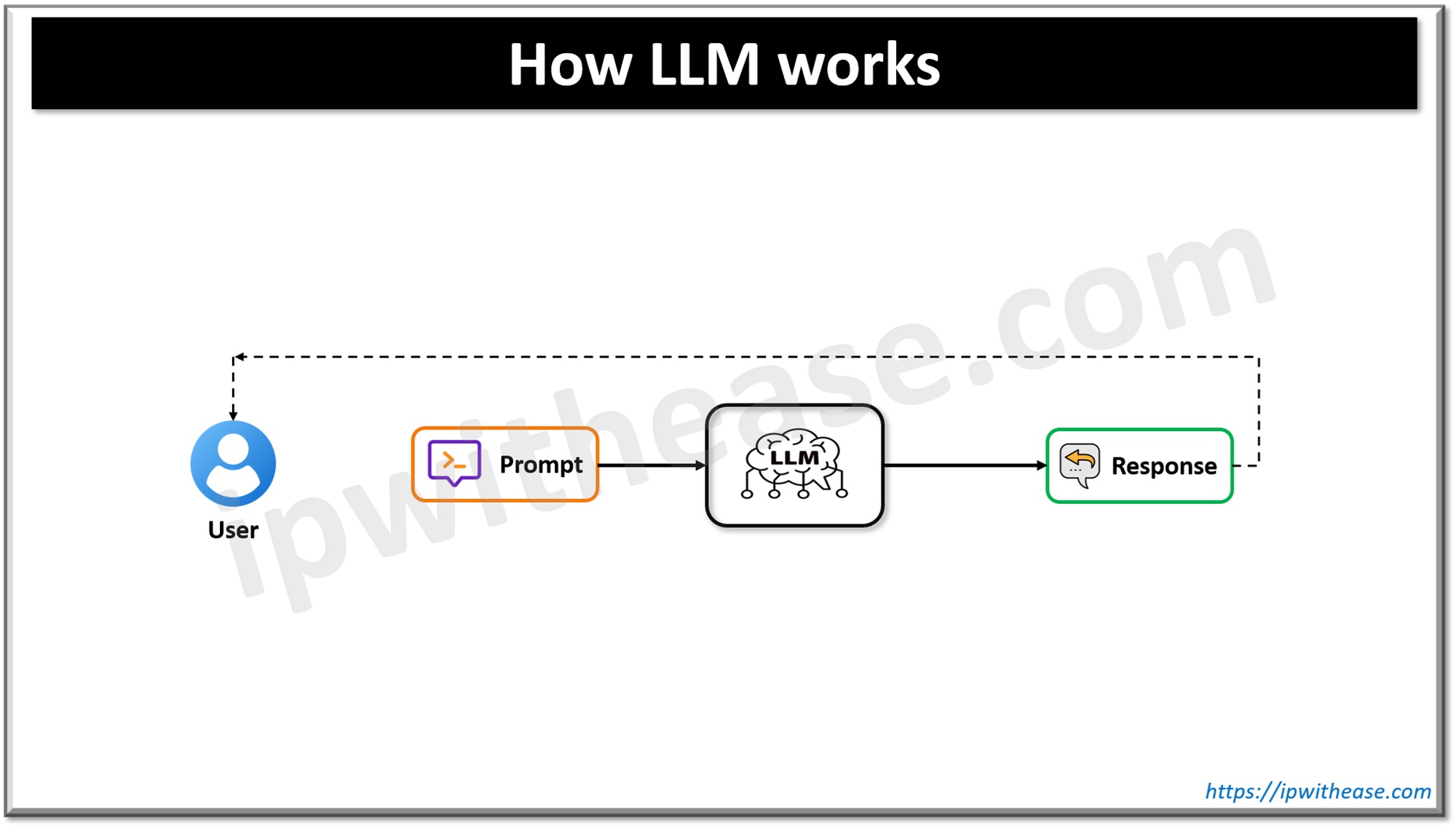
LLMs provide a prompt based interface where the user inputs the query and get the response back on the prompt. RAGs provides an interface between generative AI capabilities of LLM and ensures more accurate response from systems. AI agents behave like independent systems which learn from the environment like humans and take actions in an autonomous manner.
In today’s article we will cover in detail about Large language models (LLMs), Retrieval-Augmented Generation (RAG), and AI Agents, their key features, how they work and use.
What is LLM
LLM receives an input via a prompt and processes it with pre-trained responses and provides the response back on the prompt. The output of LLM is purely based on the knowledge encoded into the LLM AI model during its training phase. It does not have external data or retraining requirements.
LLMs are primarily used for general tasks such as text summarization, Q&A scenarios, drafting responses, brainstorming ideas or exploring creative solutions. Consumer Chatbot are the most common examples of LLM
Features of LLM
- Basic setup required setup the prompt and it is ready to go
- Pre-trained on general knowledge or vast data sets
- It is cost effective solution in AI frontier
- Limited responses based on pre-trained model
What is RAG
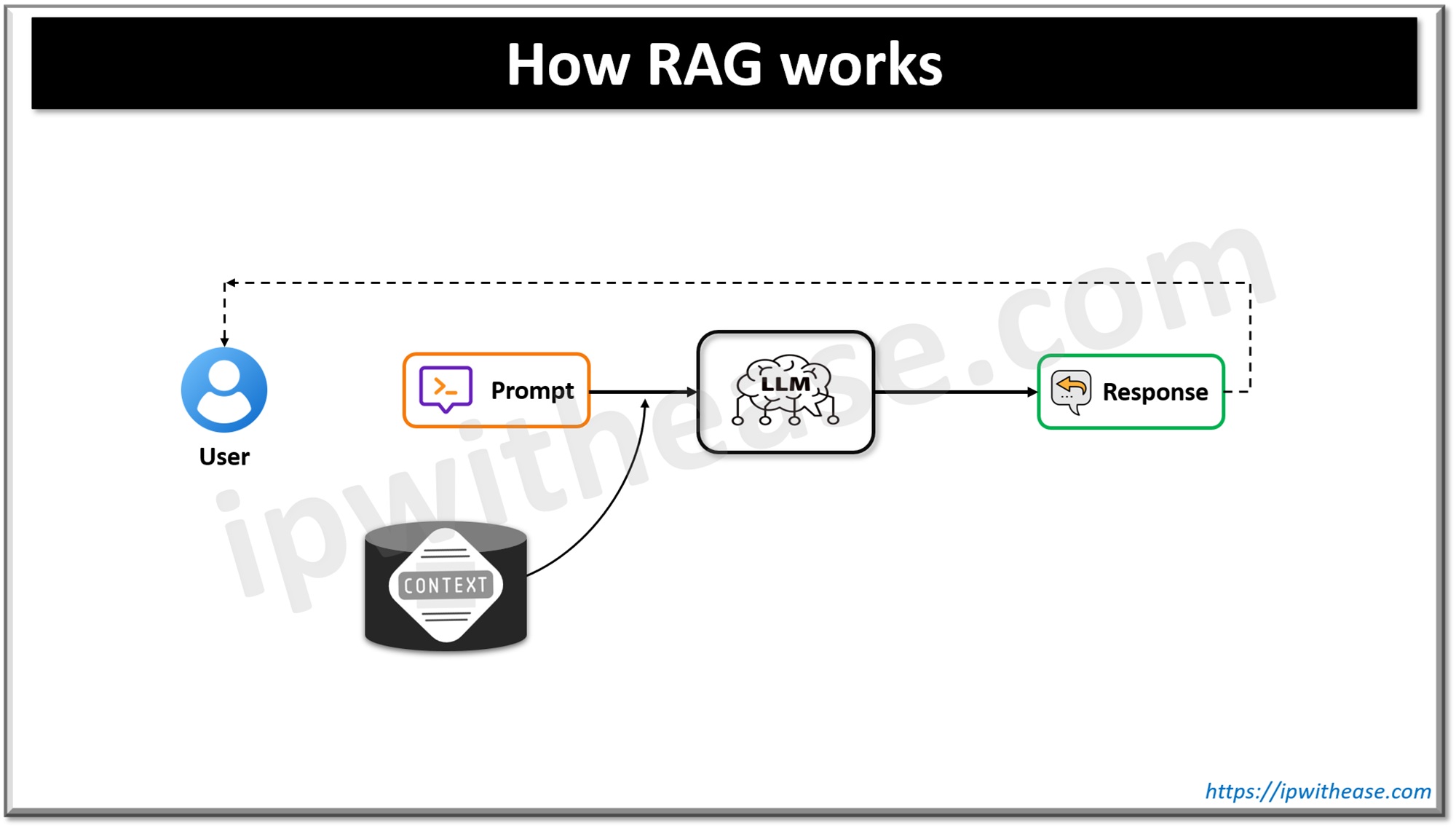
RAG is a combination of LLM with a capability to interface and fetch context from a knowledge base which could be documents, files, logs etc. RAG based models reference the relevant documents and use it to retrieve relevant information to produce more accurate and contextual output.
RAG is used where a user wants to use AI for knowledge base proprietary documents retrieval such as product documentation, policies, product catalogues, customer support tickets or logs etc.
Features of RAG
- Answers are more relevant to the context thus reduces hallucinations
- The knowledge base updates are not dependent on model training and ideal for dynamic data
- Computation expenses are saved
- Retrieved resources provide a traceability thus provide auditability for transparency and trust in output
What are AI Agents
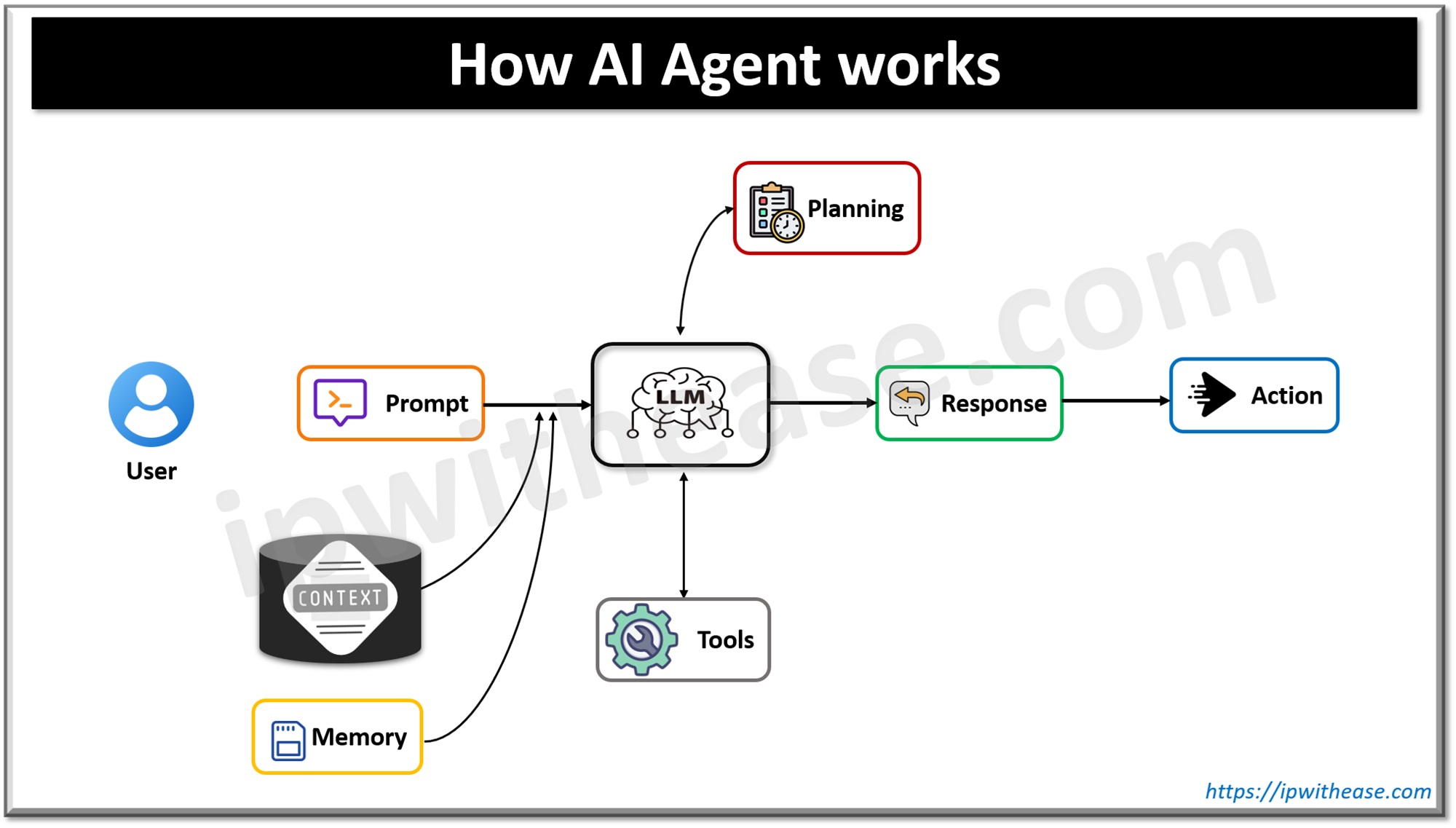
AI agents are smart and intelligent and they can carry out certain actions based without human-in-loop. The AI agents are programmed to engage with the environment they operate in and learn over time and make autonomous decisions based on preconditioning or behavior learned by observing the environment they reside in.
The AI agents are well suited in areas such as robotics, multi-decision making, troubleshooting, integration with external systems such as database queries, calling APIs, applications requiring context retention etc.
Features of AI agents
- Complex and multi-level tasks handling with reasoning
- Adaption of new information or interaction with user
- Automation of repetitive tasks with speed and efficiency
Comparison: LLM vs RAG vs AI Agents
| Features | LLM | RAG | AI Agents |
|---|---|---|---|
| Purpose | Ideal for general purpose tasks such as question and answers based responses, | More accurate output by combining LLM response aided by capability to query proprietary knowledge base such as documents, files, logs etc | Tasks are executed based on based on pre-conditioning or knowledge acquired in surrounding environment |
| Features | 1. LLMs are pre-trained on vast data sets 2. Prompt based input and output 3. No model training uses pre-trained models | 1. Access to proprietary knowledge base for additional input combined with LLM input 2. More accurate and context aware responses | 1. Learn from environment hosted in 2. Decisions based on preconditioning or learning from surrounding environment |
| Data sources | Pre-trained Large data sets | Knowledge bases such as documents, logs, files repositories | Works with external data sources such as LLMs, tools, APIs |
| Capabilities | Generic responses Natural language processing | Concise and context aware responses | Autonomous and adaptable |
| Limitations | 1. Lot of computing resources are consumed 2. Responses are based on capability of pre-trained model 3. Prone to incorrect responses and hallucinations | 1. Quality of documents used as additional source of input 2. Difficult to provide response for vague questions | 1. Lot of training requirements |
| Use cases | Chat bots, language translations, code generation | Research, customer care systems, technical support | Robotics, reporting, booking |
Download the comparison table: llm vs rag vs ai agent
How do I Decide which one my Use Case needs?
Ask three questions:
- Does the task need only general knowledge or language skill, like summarizing or drafting? A plain LLM is enough.
- Does it need accurate answers from your own or frequently changing data? Add RAG.
- Does it need multiple steps, decisions and actions in other systems? Build an agent, ideally with RAG as one of its tools.
Most organizations follow this same path: they start with an LLM, add RAG for an internal knowledge assistant, and later bring in agents for well-defined workflows with clear guardrails.
FAQs
Q.1 Does RAG eliminate hallucinations?
No, but it reduces them a lot. If retrieval pulls the wrong chunks, or the right answer isn’t in your documents, the model can still guess. Good RAG setups limit this by improving chunking, using hybrid search (keyword plus vector), reranking results, and telling the model to say “I don’t know” when the context doesn’t support an answer. Showing source citations in the response also helps users check the answer themselves.
Q.2 When should I choose RAG over fine-tuning?
Use RAG when the knowledge changes often, when you need answers traced back to a source, or when access to data must follow user permissions. Use fine-tuning when you want to change how the model behaves, such as its tone, output format or skill at a narrow task, and not what it knows. Many production systems use both: a fine-tuned model for consistent behaviour, with RAG supplying current facts.
Q.3 What makes something an AI agent rather than a chatbot?
A chatbot responds to one message at a time. An agent works toward a goal. It breaks the goal into steps, picks tools (a search API, a database query, a script, a ticketing system), reads the output of each step and decides what to do next. This loop of reason, act and observe is what makes it an agent. An agent can use RAG as one of its tools, so these approaches are layers rather than rivals.
Q.4 Do AI agents need RAG?
Not always, but most useful enterprise agents do. An agent that troubleshoots network issues, for example, may retrieve past incident reports and vendor documentation through RAG, then run show commands through a tool, then open a ticket. RAG grounds its decisions in your environment. Without it, the agent is relying only on general knowledge.
Q.5 Which approach costs the most to run?
A plain LLM call is the cheapest. RAG adds the cost of embedding documents, running a vector database and sending larger prompts. Agents usually cost the most, because one task may involve many LLM calls, tool executions and retries. For the same reason, agents also have higher and less predictable latency. Start with the simplest approach that solves the problem, and move up only when you need to.
ABOUT THE AUTHOR

You can learn more about her on her linkedin profile – Rashmi Bhardwaj