Table of Contents
Enterprise media workflows have undergone a considerable transformation over time. Rapid advancement of AI in video processing technology has overcome the requirement of dedicated hardware suites, specialized on-site engineers, and multi-day processing pipelines; as the same tasks can now be accomplished in minutes.
This shift is not just a convenience, it has become a competitive necessity for IT admins, cloud architects, and enterprise operations teams. From automated video transcoding and intelligent quality enhancement to compliance-driven tasks like watermark management (including the growing demand to remove video watermarks from trial-licensed or internally recorded media before archiving), AI is now embedded at every stage of the modern enterprise video pipeline.
In this blog, we will explore the key areas where AI-powered video processing tools are delivering measurable impact on enterprise environments.
The Traditional Enterprise Video Workflow Problem
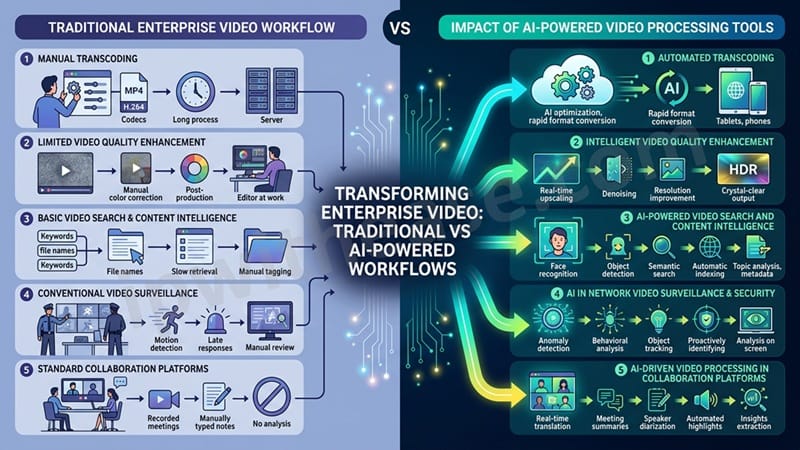
Enterprise video workflows suffered from a number of problems before the arrival of AI:
- Manual transcoding processes: consumed a significant compute resources and engineer time
- Inconsistent video quality: across different capture devices and platforms
- Siloed storage systems: with no intelligent indexing or content discovery
- Slow, reactive security video review: with no proactive alerting
- Heavy licensing costs: for proprietary hardware-based encoding solutions
In large enterprises, especially those with multiple branch locations, multi-cloud setups, or remote workforces these problems escalate rapidly. A single day’s collection of Webex, Teams, or Zoom recordings can create terabytes of raw, unsearchable video data that IT departments need to handle, store, and provide as needed.
How AI Is Transforming Enterprise Video Processing
1. Automated Transcoding and Format Optimization
Manual transcoding has been replaced by automated transcoding. AI-based transcoding systems can now autonomously identify the best codec, bitrate, and resolution for a specific video asset according to its content type and target delivery method. Traditional encoder configurations necessitated manual adjustments by skilled engineers. AI entirely eliminates this problem by:
- Analyzing the complexity of the scene to dynamically allocate bitrate
- Detecting and differentiating motion-heavy vs. static segments and encoding each appropriately
- Automatically generating multiple adaptive bitrate (ABR) renditions for diverse device playback
- Cutting storage expenses by as much as 40% via smart compression while maintaining noticeable quality
For enterprise IT teams managing substantial amounts of internal training content, product demo videos, or video-based SOPs, this automation significantly reduces processing overhead.
2. Intelligent Video Quality Enhancement
Poor-quality source footage, whether from outdated surveillance cameras, remote employee webcams, or field devices has posed a problem with traditional workflows.
AI super-resolution and enhancement models are now capable of:
- Upscaling 480p and 720p footage to 1080p or 4K using neural networks
- Removing noise, grain, and compression artifacts in real time
- Enhancing low-light footage from IP cameras and NVR systems
- Stabilizing shaky footage from mobile capture devices
Tools like Topaz Video AI, NVIDIA’s Video Super Resolution (VSR), and open-source models based on Real-ESRGAN are being integrated into enterprise media pipelines to improve the usability of historical footage and reduce hardware upgrade cycles.
3. AI-Powered Video Search and Content Intelligence
A key transformative feature of AI in enterprise video is its capacity to render video content entirely searchable, not merely by filename or timestamp, but also by spoken dialogue, on-screen text, faces, objects, and semantic topics.
Platforms such as Microsoft Azure Video Indexer, AWS Rekognition, and Google Video Intelligence API now offer:
- Automatic speech recognition (ASR) transcription for full-text search of spoken content
- Named entity recognition to identify people, brands, and topics mentioned
- Scene detection and keyframe extraction for visual navigation
- Sentiment analysis on speaker content for training and compliance use cases
In enterprise knowledge management, this implies that a collection of thousands of recorded meetings or training sessions can be entirely indexed and accessed in seconds; a functionality that is impossible with traditional metadata-only methods.
4. AI in Network Video Surveillance and Security
Network-attached video surveillance systems, a fundamental part of enterprise physical security infrastructure, are progressively being upgraded with AI features that function directly at the edge or within central management platforms such as Cisco’s Physical Security solutions. AI features implemented in enterprise video surveillance are:
- Object detection and classification (people, vehicles, packages) in real time
- Anomaly detection — identifying unusual behavior patterns without explicit rule configuration
- Facial recognition and access control integration
- License plate recognition (LPR) for physical perimeter management
- Automatic alert generation and escalation to IT Security Operations Centers (SOC)
On the infrastructure front, IT teams overseeing NVR and IP camera installations frequently handle footage sourced from demo or trial-licensed platforms, which might include vendor watermarks. Processing pipelines capable of removing video watermarks and standardizing footage prior to its entry into long-term storage or analytics systems are thus a practical operational need.
5. AI-Driven Video Processing in Collaboration Platforms
Enterprise collaboration tools like Cisco Webex, Microsoft Teams and Zoom now come with integrated AI video processing. Capabilities that were previously add-on modules or post-production workflows are delivered in real-time:
- Real-time background removal and replacement using semantic segmentation
- Automatic meeting recording transcription and summarization
- Noise cancellation powered by deep learning models (Cisco Webex’s background noise removal is a well-known example)
- Meeting highlight generation — AI automatically clips key moments from long recordings
- Speaker identification and diarization for accurate multi-party transcripts
For enterprise IT managers, managing unified communications (UC) platforms, these AI functionalities significantly reduce post-meeting administrative tasks and enhance knowledge retention among distributed teams
Conclusion
AI-driven video processing has become a capability no longer exclusive to media firms and tech giants. It is a feasible, implementable technology that is currently transforming how organizations capture, manage, process, and derive value from video content across all departments — including IT operations, physical security, HR, training, and compliance.
Whether you are managing terabytes of surveillance footage, building a searchable knowledge base from recorded meetings, or standardizing media assets for compliance archival, AI video processing tools offer the performance, scalability, and intelligence to do it right.
ABOUT THE AUTHOR

IPwithease is aimed at sharing knowledge across varied domains like Network, Security, Virtualization, Software, Wireless, etc.