Table of Contents
Picture this: it’s a Tuesday morning, your support queue has 400 open tickets, and half of them are the same five requests – refunds, order status, plan changes, password resets, “where’s my invoice.” Your team spends most of the day copy-pasting from a knowledge base into a helpdesk, updating a CRM field, tagging the ticket, then closing it. A conventional chatbot can reply to some of these. But it can’t actually do them – it can’t issue the refund, update the account, escalate the edge case, and log the outcome across three systems. That gap, between talking and doing, is exactly what agentic AI closes, and it’s why so many operations leaders are re-evaluating their stack heading into 2026.
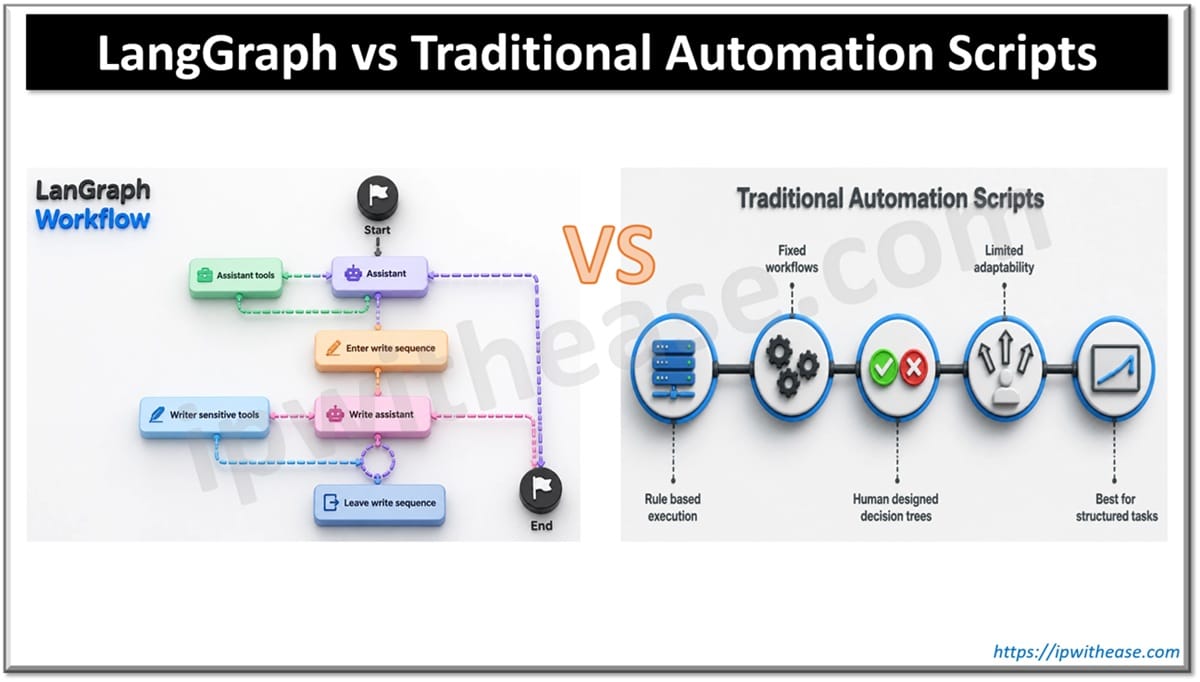
Agentic AI is a genuine step beyond both chatbots and the previous generation of automation. Where robotic process automation (RPA) follows a predefined script and breaks the moment reality deviates from it, and where a chatbot simply generates a plausible reply, an AI agent pursues a goal, chooses its own tools, and takes multi-step action to actually finish the job. Those three properties – goal pursuit, tool use, and autonomy – are what separate a real agentic AI platform from a marketing label. Early open-source experiments like AutoGPT proved the concept; the platforms in this guide turn it into something you can deploy against a live business operation and measure.
If you’re running customer support or sales operations on tools like Zendesk, Intercom, Freshdesk, Salesforce, or Gorgias, our top pick is AISSIST for teams that need autonomous, end-to-end task resolution rather than another chatbot that just drafts replies. It’s the only platform here purpose-built as a multi-agent AI workforce, and the numbers back it up: an 83% average resolution rate and a 4.8/5.0 CSAT measured across live deployments, at up to $0.60 per resolution – roughly a 40%+ cost saving versus human-agent alternatives. That said, it isn’t the answer for every problem.
For operations teams whose real challenge is stitching together dozens of enterprise systems – ERP, HRIS, CRM, ticketing – beyond a focused CX use case, Workato is the strongest alternative. And for engineering-led teams that want self-hosted, open-source flexibility with full data control, n8n is the one to shortlist.
Below, you’ll find seven agentic AI tools ranked and evaluated against a consistent, operations-first lens – resolution outcomes, satisfaction, integration depth, and multi-step execution – so you can match a platform to your actual problem instead of the loudest sales deck. This is a buyer’s guide for people who care whether the work gets done, not just started.
Related: How AI is Reshaping Software Development
Our selection criteria
Choosing the best agentic AI for business operations isn’t about counting features. Plenty of platforms list “AI agents” on a pricing page; far fewer can autonomously complete a multi-step task inside your existing tools and prove it moved a number that matters. To keep this ranking honest and operations-focused, we evaluated every platform against four criteria – the same lens analysts increasingly apply as, according to Deloitte’s Forbes analysis of the digitally-enabled workforce era, AI agents move from pilots to functional efficiency across the enterprise.
Autonomous resolution rate
The headline question: what percentage of tasks or tickets does the platform complete end-to-end _without_ a human stepping in? A tool that deflects a question but hands off every real action isn’t resolving anything. We weighted platforms that can close the loop autonomously and, ideally, publish real resolution data rather than vague “up to” claims.
CSAT and outcome quality
Automating fast but frustrating your customers is a false economy. Wherever a platform serves customer-facing operations, we looked for measurable satisfaction signals – CSAT, quality scores, or comparable feedback loops from live deployments – not just throughput. Speed without quality is churn in disguise.
Workflow integration depth
Can the platform operate _inside_ the systems you already run – Zendesk, Salesforce, Gorgias, your ERP – through native connectors and deep APIs, or does it demand a rip-and-replace migration? The best agentic tools slot into the existing stack and behave like a teammate from day one. Shallow “connect via webhook” integrations scored lower than genuine two-way, action-taking connectivity.
Multi-step, cross-system execution
Finally, can it actually chain actions across tools – read a ticket, look up an order, update a record, tag it, escalate the exception, and summarize the outcome – and produce multiple outputs per task? This is the true test of an agentic AI platform versus a repurposed chatbot or a linear automation. Genuine AI agent orchestration inside an orchestration environment is what earns the top spots below.
At-a-glance comparison
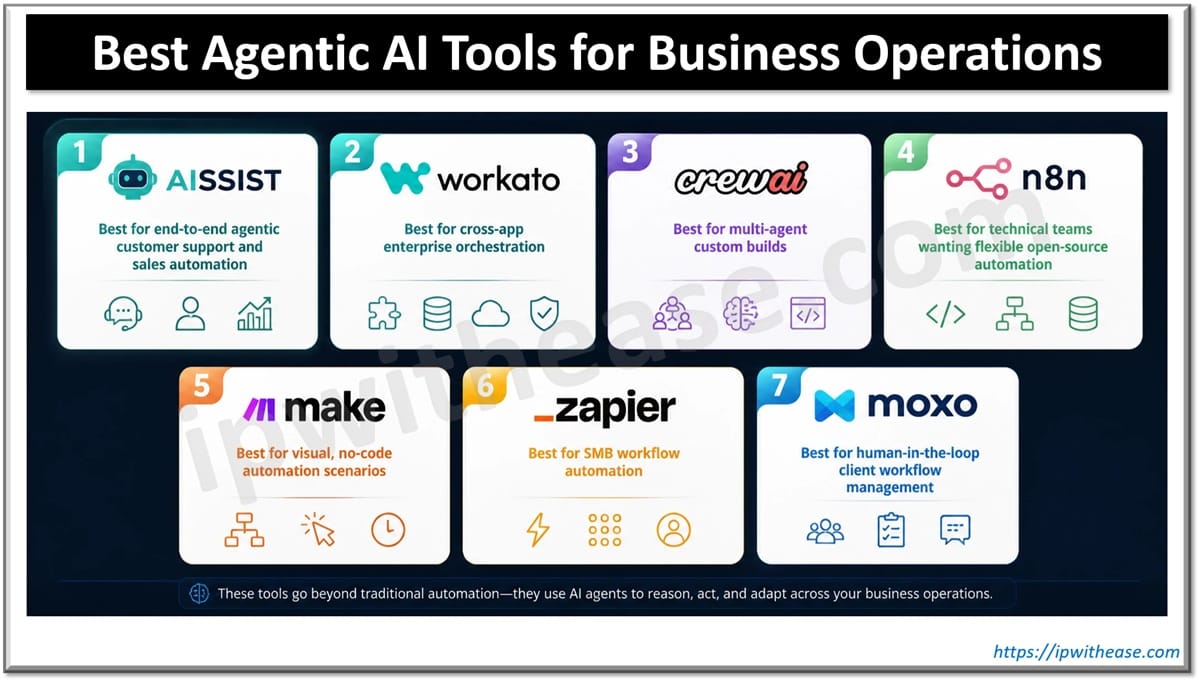
| Provider | Best for | Key strength | Pricing tier |
| AISSIST | End-to-end agentic customer support and sales automation | 83% avg. resolution, 4.8/5.0 CSAT, up to $0.60 per resolution | Per-resolution; enterprise custom |
| Workato | Cross-app enterprise orchestration | 1,000+ enterprise app connectors with an AI agent layer | Enterprise custom, no free tier |
| CrewAI | Multi-agent custom builds | Open-source, role-based agent framework for engineers | Free (OSS); Enterprise custom |
| n8n | Technical teams wanting flexible open-source automation | Self-hostable, source-available, AI agent nodes | Free self-host; Cloud from ~$20/mo |
| Make | Visual, no-code automation scenarios | Intuitive drag-and-drop builder, 1,000+ integrations | Free tier; paid from ~$9/mo |
| Zapier | SMB workflow automation | Largest integration library (7,000+ apps) plus Agents | Free tier; paid from ~$19.99/mo |
| Moxo | Human-in-the-loop client workflow management | Structured, approval-gated client workflows | Business from ~$36/mo; enterprise custom |
The 7 best agentic AI tools for business operations in 2026
With those four criteria in mind, here are the seven platforms that stand out this year – each judged on its real-world ability to complete tasks, not merely kick them off. The list runs from purpose-built agentic CX workforces to enterprise orchestration engines, open-source frameworks, and accessible no-code tools, so operations teams at almost any stage can find a fit. AISSIST takes the #1 spot for a specific, defensible reason we’ll unpack below, but the right pick for you depends on the problem you’re actually trying to solve.
1. AISSIST – Best for end-to-end agentic customer support and sales automation
AISSIST is the only platform here built from the ground up as a multi-agent AI workforce for customer support and sales operations, rather than a chatbot with an “agent” sticker slapped on it.
At its core is AgentMesh™, AISSIST’s agentic AI workforce product running on its Multi-Agent Platform (M.A.P.). The distinction matters more than it sounds. Most tools in the broader market generate a reply and hope it helps; you can dig into how the AISSIST approach differs, because AgentMesh is designed to autonomously complete the whole task – read the ticket, pull the order or account, take the cross-system action, tag it, summarize it, escalate the exceptions, and update your systems of record. In other words, it does what a human teammate would do, end to end, and it does it from inside the tools your team already lives in.
That’s the second thing worth understanding. AISSIST integrates natively inside Zendesk, Intercom, Freshdesk, Salesforce, Gorgias, and more, so it operates within your existing workflows on day one – no rip-and-replace, no forcing your team onto a new console. The performance numbers are what set it apart under our resolution-first lens: an 83% average resolution rate and a 4.8/5.0 CSAT measured across live deployments, at up to $0.60 per resolution, which the company positions as a 40%+ cost saving versus conventional human-agent handling.
Those aren’t capability claims; they’re outcome metrics, and they’re exactly the kind of evidence most competitors in this category can’t produce. The multi-agent architecture also enables continuous feedback loops, so resolution quality improves as the workforce learns from real interactions – a use case that aligns with the kind of agentic transformation Bernard Marr highlights in his Forbes look at AI agent use cases set to reshape business in 2026.
Pros
- Industry-leading 83% average resolution rate and 4.8/5.0 CSAT backed by live deployment data, not marketing estimates.
- The only purpose-built multi-agent AI workforce in this list – genuinely agentic, not a retrofitted chatbot layer.
- Runs natively inside Zendesk, Intercom, Freshdesk, Salesforce, and Gorgias with no rip-and-replace migration.
- Produces multi-output results per task – tags, summaries, escalations, and system updates in a single resolution cycle – rather than one-shot replies.
- Predictable, measurable cost-per-resolution economics, roughly 40%+ cheaper than human-agent alternatives.
Cons
- Specialized for CX and sales operations; it’s not a general-purpose automation platform for finance, HR, or IT workflows.
- Maximum value depends on already running a supported platform (Zendesk, Intercom, and so on) – teams without one face a heavier onboarding lift.
- Enterprise pricing is custom/quote-based, so very small teams wanting instant self-serve sign-up won’t get a transparent list price up front.
- The multi-agent architecture may be more capability than a very small team with simple, low-volume, linear support needs actually requires.
Who it’s best for: Support and sales operations leaders at SMB-to-enterprise companies already running a modern helpdesk or CRM, who want to move past chatbot deflection to genuine autonomous resolution – and who care about resolution rate, CSAT, and cost-per-resolution as their scoreboard. If your problem is “we’re drowning in repetitive, multi-step support and sales tasks and we want them _done_,” this is the sharpest tool on the list.
2. Workato – Best for cross-app enterprise orchestration
Workato is the platform to reach for when your automation problem isn’t a single CX queue but a sprawling web of enterprise systems that all need to talk to each other.
Built around “recipes” – its term for automation flows – Workato connects well over a thousand enterprise applications: ERP, CRM, HRIS, ticketing, finance, and more. In the last couple of years it has layered an AI agent capability on top of that integration backbone, so you can orchestrate multi-step business processes that span many systems, with an assistant (Workato Copilot) helping build the logic. If your ops team’s daily reality is “an event in the ERP needs to trigger updates in three other systems, with approvals in between,” Workato is squarely in its element.
It’s the kind of enterprise orchestration layer that fits the broader shift Genesys and others are chasing, as covered in Forbes’ report on companies orchestrating agentic AI beyond the contact center.
Governance is a genuine strength here. Role-based access, audit logs, and compliance controls make Workato a comfortable fit for regulated industries where every action needs a paper trail – the sort of governance constraints that stop most lightweight tools cold. The trade-off is that this power comes at an enterprise price and an enterprise learning curve.
Pros
- Exceptionally broad app connectivity – ideal for orchestrating workflows across many business systems at once.
- An AI agent layer adds agentic capability on top of a proven, mature integration engine.
- Strong governance, audit, and access controls suited to regulated environments.
- A large marketplace of pre-built recipe templates accelerates common deployments.
Cons
- Enterprise-tier pricing with no free tier – cost-prohibitive for smaller teams.
- Complex multi-system recipes carry a real learning curve and usually need dedicated ops or IT resource.
- Not built around CX outcomes – resolution rate and CSAT aren’t native KPIs.
- The AI agent features are newer and less battle-tested than the core integration platform.
Who it’s best for: Mid-market and enterprise operations or IT teams whose core challenge is connecting and automating across a large, heterogeneous stack – not resolving a focused support or sales queue. If breadth of systems is your problem, Workato wins; if resolution depth in CX is your problem, it’s the wrong shape.
3. CrewAI – Best for multi-agent custom builds
CrewAI is a developer’s tool through and through: an open-source Python framework for orchestrating role-based multi-agent pipelines that you design, build, and run yourself.
The mental model is a crew. You assign each agent a role, a goal, and a set of tools, then choreograph how they collaborate – sequentially or hierarchically – to complete a larger task. It plugs into the major LLMs (GPT-4, Claude, Gemini, local models) and sits comfortably alongside frameworks like LangChain and LangGraph in a modern AI engineering stack.
For teams that want to build something genuinely bespoke and domain-specific, the flexibility is close to unlimited. Growing enterprise adoption of exactly this kind of custom agent architecture reflects the reality that, as Reuters notes in its analysis of agentic AI’s greater capabilities and enhanced risks, more autonomy demands more deliberate design and oversight.
The catch is right there in the name: it’s a framework, not a finished product. You get building blocks, not a deployed workforce. There are no out-of-the-box Zendesk or Intercom integrations, no native CSAT reporting, and no production monitoring unless you build it. For a capable AI engineering team, that’s a feature; for a support director, it’s a non-starter.
Pros
- Maximum flexibility for engineers designing custom, domain-specific multi-agent systems.
- Role-based architecture maps neatly onto complex processes that need specialized sub-tasks.
- Open-source core means no vendor lock-in at the framework layer.
- Fast-moving community, with new integrations and patterns shipping frequently.
Cons
- Requires real developer resources – not accessible to non-technical operations buyers.
- No prebuilt CX integrations; every connector to Zendesk, Intercom, and similar must be custom-built.
- Production reliability, monitoring, and safety require additional infrastructure investment.
- No native resolution-rate or CSAT reporting – you instrument all metrics yourself.
Who it’s best for: AI engineers and technical product teams building a proprietary multi-agent system where control and customization outweigh time-to-value. If you have the engineering muscle and a differentiated use case, CrewAI is a superb foundation. If you want to _deploy_ rather than _develop_, look at the pre-built, metrics-ready options above.
4. n8n – Best for technical teams wanting flexible open-source automation
n8n hits a sweet spot that pure frameworks and pure no-code tools both miss: a source-available, self-hostable automation platform with a visual builder _and_ code-level control at any node.
With 400+ integrations and AI agent nodes, n8n lets engineering-led ops teams build LLM-powered, multi-step workflows that branch, loop, call webhooks, and drop into custom JavaScript or Python wherever the visual canvas isn’t enough. The headline differentiator for many buyers is self-hosting: because you can run n8n on your own infrastructure, you keep full data sovereignty – a meaningful advantage for privacy-sensitive or heavily regulated organizations that can’t send data through a third-party cloud. There’s also a managed n8n Cloud option for teams that don’t want to run the servers themselves.
Where it asks something of you is operational maturity. Self-hosting means DevOps ownership, and while the AI agent nodes are genuinely capable, the more ambitious agentic use cases still take custom logic to get right. The visual builder is powerful but less hand-holding than Make or Zapier, so it rewards technical users and frustrates non-technical ones.
Pros
- Full data sovereignty via self-hosting – a real edge for privacy-sensitive industries.
- AI agent nodes bring genuine agentic capability to an already powerful automation backbone.
- Highly extensible: developers can write custom nodes and integrate essentially any API.
- More affordable than enterprise iPaaS platforms at a comparable level of technical capability.
Cons
- Self-hosting requires DevOps resource; even managed Cloud doesn’t fully remove the technical overhead.
- The visual builder is less polished than Make or Zapier for non-technical users.
- AI agent nodes are still maturing – complex agentic scenarios may demand significant custom work.
- No native CX-specific metrics or resolution-rate tracking out of the box.
Who it’s best for: Engineering-led operations teams that want open-source flexibility, self-hosted data control, and the freedom to customize deeply – without paying enterprise iPaaS prices. If your team can run infrastructure and values sovereignty over plug-and-play convenience, n8n is the standout. For fast, no-code CX deployment, the purpose-built options are a better fit.
5. Make – Best for visual, no-code automation scenarios
Make (formerly Integromat) is the most visually intuitive builder on this list, and that accessibility is exactly its point.
You assemble automations as “scenarios” on a drag-and-drop canvas, connecting modules from more than a thousand apps into multi-step flows – with built-in real-time execution monitoring and error handling so you can see exactly where a run succeeded or stalled. AI and HTTP modules let you drop LLM-powered steps into a scenario, which brings a degree of agentic behavior within reach of teams that have no developers at all.
A generous template marketplace means many common automations are a few clicks away rather than a build project. Major productivity platforms – even mainstream tools like Microsoft Copilot – have normalized the idea of AI assisting inside everyday work, and Make rides that same wave for the operations and marketing crowd.
Two honest caveats. First, Make’s operations-based pricing (you pay per task execution) can climb faster than you expect in high-volume environments, so model your usage before you commit. Second, its AI capabilities are module-based additions rather than a native agent architecture – great for lightweight LLM steps, lighter when it comes to complex, multi-output CX resolution that needs coordinated cross-system writes.
Pros
- The most intuitive visual builder here – genuinely usable by non-technical ops and marketing teams.
- Broad connectivity covers most SMB and mid-market tool stacks.
- Affordable entry point with a functional free tier (around 1,000 operations/month).
- Scenario templates dramatically shorten time-to-value for common patterns.
Cons
- Per-execution “operations” pricing can scale unpredictably in high-volume use.
- AI/agentic capabilities are module-based, not a native agent architecture, so execution depth is lighter.
- Less suited to complex, multi-output CX resolution requiring coordinated cross-system writes.
- Enterprise governance features (audit, SSO, compliance) require higher-tier plans.
Who it’s best for: SMB and mid-market operations teams that want visual, no-code multi-step automation without hiring developers – and are automating general business workflows rather than high-volume support resolution. It’s the friendliest on-ramp on the list. For deep CX task completion, treat Make’s AI features as growing, not yet purpose-built.
6. Zapier – Best for SMB workflow automation
Zapier is the automation tool almost everyone has heard of, and for good reason: it connects an unmatched library of apps with essentially zero technical barrier.
Its trigger-action “Zaps” now span 7,000+ apps (and by some counts north of 9,000 as of 2026), making it the widest integration net you can cast. In the last couple of years Zapier has pushed into genuinely agentic territory with Zapier Agents – AI agents that can browse, act, and complete tasks across your connected apps – alongside products like Tables, Interfaces, and Chatbots that stretch it beyond pure automation into lightweight ops tooling.
For a small business that just needs “when X happens in this app, do Y in that one,” nothing is faster to stand up. The mainstreaming of business AI agents is very much the direction of travel; even platform giants are piling in, as Reuters reported when Meta launched an enterprise-focused AI business agent to automate daily operations.
The honest picture: Zapier’s agentic features are earlier-stage than a purpose-built platform’s. Complex, multi-step, multi-output resolution isn’t its strength, and its classically linear Zap logic needs workarounds for conditional or iterative flows. Task-based pricing can also spiral once you’re running high-frequency automations at volume.
Pros
- The largest app integration library available – virtually any SMB stack is covered.
- Zero technical barrier; the most approachable platform here for non-developers.
- Zapier Agents adds real autonomous task capability for lighter agentic use cases.
- Enormous community with abundant tutorials and support resources.
Cons
- Task-based pricing escalates quickly at volume, making cost hard to predict for high-frequency use.
- The Agents product is still maturing; complex multi-output agentic resolution lags purpose-built platforms.
- Linear Zap logic struggles with branching or iterative workflows without workarounds.
- Enterprise security and compliance features are gated behind the highest tiers.
Who it’s best for: Small and mid-sized businesses automating trigger-based tasks across many apps with minimal setup – and dipping a toe into agentic AI without committing engineering time. On breadth and accessibility, Zapier wins outright. On CX resolution depth and native support metrics, it’s not competing in the same weight class as the purpose-built option at #1.
7. Moxo – Best for human-in-the-loop client workflow management
Moxo solves a deliberately different problem than everything above it, and that’s precisely why it earns a place: structured, human-in-the-loop client workflows.
Rather than chasing full autonomy, Moxo is built for professional services and relationship-driven B2B teams that need controlled, compliant, approval-gated processes – client onboarding, service delivery, document collection, account management. Workflows run through a branded client portal with checklists, approval gates, and built-in escalation and handoff, so the human stays in the loop by design. AI here assists the workflow (routing, reminders, document handling) rather than replacing the person, which is exactly right for engagements where a missed approval or a compliance gap is expensive. It integrates with common CRM and document management tools to reduce the manual coordination overhead that eats professional-services margins.
The flip side is straightforward. Because human oversight is baked into the model, Moxo isn’t the tool for high-volume autonomous resolution – its AI is workflow-assistance-level, not full agentic task completion. Its integration ecosystem is also narrower than the orchestration and automation platforms elsewhere on this list.
Pros
- Best-in-class for professional services teams needing structured, compliant, approval-gated client workflows.
- Human-in-the-loop design is a feature, not a shortcoming – ideal for regulated or relationship-led industries.
- A branded client portal delivers a polished, professional experience for B2B engagements.
- Cuts manual coordination overhead across onboarding and service-delivery workflows.
Cons
- Not designed for high-volume autonomous resolution – human oversight is inherent to the model.
- AI is workflow-assistance-level, not full agentic task completion.
- Limited relevance to inbound customer support or sales automation at scale.
- Narrower integration ecosystem than Workato, n8n, or Zapier.
Who it’s best for: Professional services firms and B2B teams that need structured, auditable, approval-gated client workflows with a human firmly in control. If your value lies in managed, compliant client relationships rather than autonomous ticket resolution, Moxo is the right tool – a different problem solved well, not a lesser version of an agentic CX workforce.
How to choose: a quick decision framework
The “best” agentic AI platform is entirely a function of the problem in front of you, so let the outcome you’re chasing point you to the right pick.
Choose AISSIST if you run customer support or sales operations on Zendesk, Intercom, Freshdesk, Salesforce, or Gorgias and you want autonomous, end-to-end resolution measured by real outcomes – an 83% average resolution rate, 4.8/5.0 CSAT, and up to $0.60 per resolution. For most operations leaders reading this, that’s the default answer to “what’s the best agentic AI for business operations?” and the reason it holds the #1 spot: it’s the only platform here purpose-built as a multi-agent AI workforce rather than a chatbot in disguise.
Choose Workato if your real challenge is orchestrating processes across many enterprise systems, and choose n8n if you’re an engineering-led team that values open-source flexibility and self-hosted data control. Choose CrewAI if you have the developer muscle to build a bespoke multi-agent system from the ground up. Choose Make if you want an approachable, visual no-code builder, and choose Zapier if you need the widest possible app coverage for lightweight SMB automations. And choose Moxo if your world is structured, human-in-the-loop, approval-gated client workflows in professional services.
Whatever you land on, the bigger shift is already underway: agentic AI is moving from experiment to operating standard in 2026, and the teams that win will be the ones who measure it by tasks _completed_, not conversations started. Shortlist against the four criteria above, ask every vendor to show you real resolution and satisfaction data, and start with a use case where the payback is obvious – then scale from there.
ABOUT THE AUTHOR
IPwithease is aimed at sharing knowledge across varied domains like Network, Security, Virtualization, Software, Wireless, etc.