Table of Contents
Why is this topic important for Network Engineers?
If you’re working in a real enterprise or ISP network, iBGP is the silent backbone of your network. When everything is working correctly, iBGP is almost invisible. But when the iBGP design is flawed, the issues are random, misleading, and time-consuming.
In real life, engineers hear these complaints:
- The route is appearing on some routers, but not on others.
- All BGP sessions are up, yet traffic is taking the wrong path.
- Routing became unpredictable after maintenance.
- A partial outage occurred after adding a new site.
Most of these problems stem from iBGP full-mesh scalability and design limitations, not from syntax or command issues.
iBGP Advertisement Rule
When an iBGP router picks up a route from an iBGP neighbor, it holds onto it but doesn't pass it along to any other BGP routers.This rule basically says that if a router gets a route over an iBGP session, it won’t share that route with any other iBGP peers.
It’s not a glitch or setup issue. It’s intentional, built in to stop routing loops from happening. People often call this the “BGP split-horizon rule.”
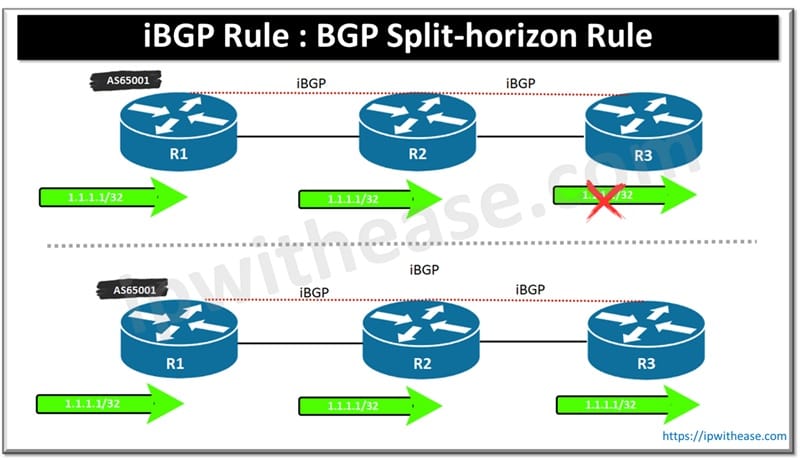
This diagram shows the iBGP split-horizon rule in action: R2 gets a route from R1 but doesn’t pass it on to R3. BGP builds this rule into iBGP specifically to prevent routing loops..
One downside of this rule is that if you want every router to get the same routing info, each one has to set up a direct iBGP peering session with every other router. That’s what’s called an iBGP full mesh.
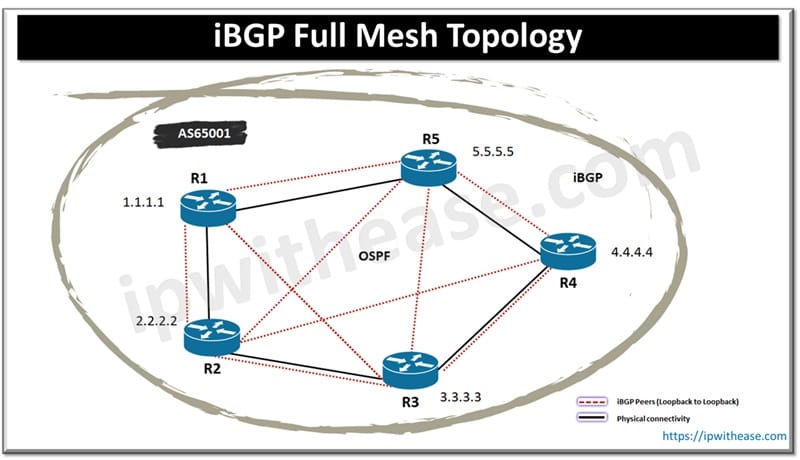
This diagram shows an iBGP full-mesh setup inside a single AS, where every router sets up an iBGP session with every other router, all using their loopback interfaces. As you add more routers, the number of iBGP sessions grows too, which makes the whole design tough to manage and hard to scale.
Related: Sample Configuration for eBGP and iBGP
Operational Issues Caused by iBGP Full-Mesh
In real-world production networks, iBGP full-mesh setups often run into a few common headaches:
1. Partial Route Visibility
Routes show up on some routers but not others. This happens if the full mesh isn’t complete or a session drops without any obvious signs.
2. Inconsistent BGP Tables
BGP tables don’t match up across routers in the same AS, which leads to weird, unpredictable traffic patterns.
3. Misleading “All Sessions Are Up” Scenario
Monitoring tools and quick checks just look at BGP session status. A session might say it’s UP, but that doesn’t guarantee routing info is actually flowing right.
These issues tend to sneak up quietly and only get noticed once they’re messing with apps or end users.
Why Traditional Troubleshooting Often Fails in Full-Mesh iBGP Networks
Old-school troubleshooting usually zeros in on interface status, BGP session state, and CPU/memory usage. But with iBGP full-mesh problems, all those metrics typically look totally fine.
The real problem lies in control plane visibility, not protocol failure. Until the engineer understands the iBGP advertisement rules and full-mesh dependencies, the problem will seem random or inexplicable.
This is the stage where junior-level troubleshooting fails, and a design-level understanding is required.
Partial Route Propagation in iBGP Full-Mesh
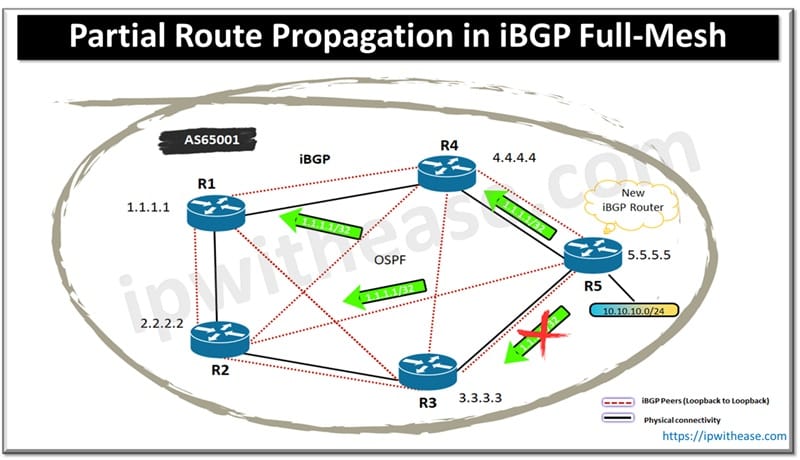
This scenario shows a typical iBGP full-mesh network inside AS65001, where R1, R2, R3, and R4 are running smoothly with no issues. All the iBGP sessions look fine, and nothing seems wrong at first glance. Trouble starts when you add a new router, R5, which advertises its prefix—but its iBGP session with R3 was accidentally left out of the config.
In this situation, R5’s routes reach R1 and R4, but not R3. Checking the BGP status shows all configured sessions as “UP,” so at first glance, it appears that BGP is functioning correctly. However, the reality is that routing information is not being distributed uniformly throughout the AS.
This type of problem is quite insidious in iBGP because no sessions are down, and no alarms are triggered. The only issue is that an expected iBGP peer was never established, and consequently, some routers receive the necessary routes while others do not. This is a silent routing problem that only becomes apparent when traffic exhibits unexpected behavior or application reachability breaks down.
The main purpose of this example is to demonstrate that problems in an iBGP full-mesh network are not always due to protocol failures, but rather to incomplete peering and partial route visibility. This is why managing iBGP full-mesh in production networks becomes challenging and requires scalable design approaches.
Why are Route Reflectors needed to scale an iBGP network?
iBGP full-mesh networks may seem manageable initially, but as the network grows, this design becomes operationally risky. With each new router added, new iBGP sessions must be configured on all existing routers. This approach not only increases configuration effort but also significantly increases the chances of human error. A single missed peer can silently create routing inconsistencies, as seen in the real-world example in the previous section.
The biggest problem with this type of network is that the behavior of iBGP becomes unpredictable. Routes reach some routers but not others, and yet the BGP sessions still appear “UP.” It becomes difficult for engineers to determine whether the issue is due to configuration, design, or the expected behavior of the protocol. This leads to reactive troubleshooting and unnecessary time wasted in identifying the root cause.
As the number of routers increases, the session count in an iBGP full-mesh also increases exponentially. This is not just a scalability issue, but also an operational visibility issue. The overall behavior of the network becomes dependent on the correct configuration of each individual router, which is considered a weak design assumption in production environments.
This is where the need for Route Reflectors becomes apparent. Route Reflectors handle the core advertisement behavior of iBGP in a controlled manner, eliminating the full-mesh dependency. By using RRs, engineers can centralize and make iBGP route propagation predictable without requiring every router to directly peer with every other router.
This doesn’t mean that Route Reflectors are only used for “optimization.” In real-world networks, RRs become a design requirement to ensure consistent route visibility and manageable complexity as the network grows. Without RRs, an iBGP full-mesh becomes a design that becomes increasingly fragile with scale.
Route Reflector – Based iBGP Design
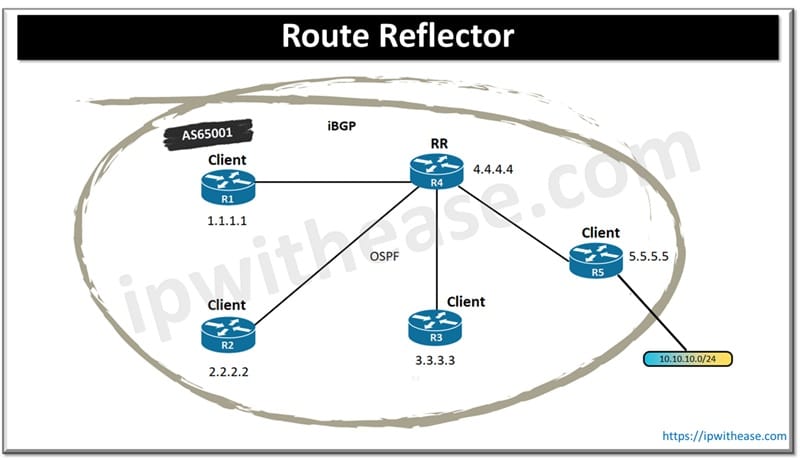
This diagram shows a typical route reflector-based iBGP design within AS65001. Here, RB (4.4.4.4) is configured as the route reflector, while R1, R2, R3, and R5 are its iBGP clients. The underlying network is maintained via OSPF, ensuring that all router loopback addresses are reachable and that iBGP sessions remain stable.
The main aspect of this design is that iBGP clients do not peer with each other using iBGP. Instead, clients only establish iBGP sessions with the route reflector.
This eliminates the need for a full-mesh setup in iBGP, making network configuration much simpler. Furthermore, when you add a new router to an iBGP network, it only needs to peer with the route reflector – it doesn’t need to connect to every other router.
For example, if R5 advertises a new prefix (like in the diagram), it sends that route only to RB, the route reflector. RB then bounces that same route out to the other clients (R1, R2, R3). This way, a route from one client spreads across the whole AS without needing a full-mesh iBGP setup.
The biggest win here is rock-solid route visibility, nothing gets stuck on just one router, dodging those “partial route propagation” headaches that plague full-mesh iBGP configs. Plus, config mistakes drop way off since no router has to peer with every single other one.
That’s why route reflectors rule in real production networks. They keep iBGP routing predictable, scalable, and easy to handle. They don’t break iBGP rules at all; they just enforce them smartly, so things stay stable even as the network scales up.
ABOUT THE AUTHOR