Table of Contents
Signal loss is a quiet killer of performance across all manner of data and telecommunications projects.
You may find that when you’re wiring a home cinema, running Ethernet to a home office, or installing an aerial feed, a mismatched cable or the wrong connector turns a crisp picture, fast network, or clean audio into dropouts, noise, and frustration.
On the backdrop of such issues, you might appreciate reading an article that explains the technical aspects of electronic connectors and cables, in addition to providing practical guidance to help you decide on the right pairings and install them correctly.
So, let’s do exactly that for you.
Why Signal Loss Occurs, And What You Should Watch For
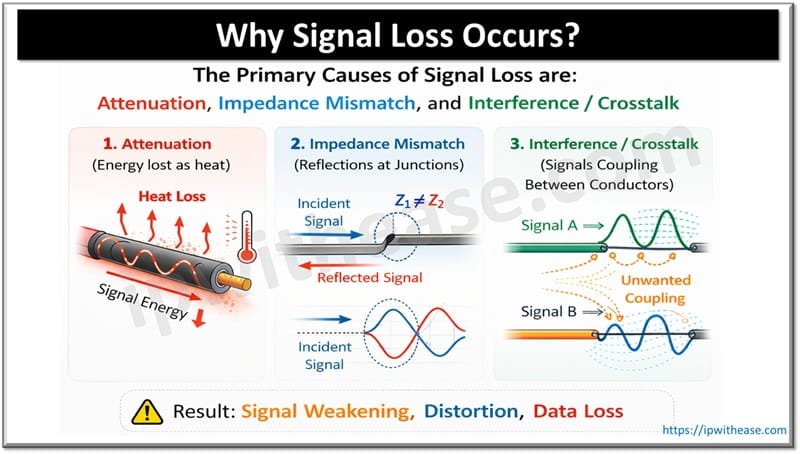
Signal loss happens due to energy being dissipated, reflected, or corrupted during its journey from source to destination.
The primary causes of signal loss are attenuation (energy lost as heat), impedance mismatch (reflections at junctions), and interference or crosstalk (signals coupling between conductors). The effects worsen at higher frequencies and over longer runs.
Classic symptoms of signal loss include intermittent video or audio dropouts, lower network throughput, and humming, buzzing, or hissing on audio lines. This problem can also manifest, of course, in the complete loss of signal beyond a certain cable length.
How Can You Ensure Signal Loss Doesn’t Happen?
It is often the case in a data or telecommunications network that any “lag” is largely attributable to the physical layer. However, you can’t simply depend on buying the most expensive components as a means of preventing signal loss or attenuation.
Below, then, we’ve focused on how you can achieve a precise pairing of cables and connectors tailored to your environment, as a proven defence against signal loss.
1. Match Impedance to Avoid Reflection
We referenced earlier the issue of impedance mismatch, which is the most common cause of signal degradation. If the ratings of your cable and connector differ from each other – for example, you’ve paired a 50-ohm cable with a 75-ohm connector – signals will “bounce” back towards the source. This will cause return loss.
For instance, 75 ohm is a standard for UK video transmission, CCTV, and satellite TV. 50 ohm, meanwhile, is primarily used for data, RF testing, and wireless communication systems.
2. Select The Right Cable Category
Signal decay will rapidly set in if you use a cable that cannot handle your required frequency.
Again, there are certain key things to know about cable categories, including that:
- Cat5e is suitable for basic home or small office networks up to 1 Gbps.
- Cat6/6a is better for modern business environments, supporting a speed of as much as 10 Gbps. However, it falls back to 1 Gbps reliably at 100 meters. For maintaining a speed of 10 Gbps over longer runs of up to 100 meters, Cat6a is essential.
For distances exceeding 100 meters, professionals often switch to fiber optic cabling, so that they can eliminate electromagnetic interference (EMI) entirely.
3. Choose Connector Quality and Plating
The connector is the system’s “bridge”. It probably shouldn’t be overly surprising, then, that cheap unbranded connectors are often largely to blame for high loss.
Gold plating is strongly recommended for connectors to prevent corrosion risks presented by countries with damp climate. It can also be counted on to maintain high conductivity over time.
In environments with heavy electrical noise – for example, in proximity to power lines or plant machinery – the use of shielded cables and shielded connectors can allow for interference to be drained to the ground.
Optimal Connector and Cable Pairing Can Have a Profound Impact
Getting the cable-connector pairing right on your next installation, could be enough to recover several dB of signal. That could be the difference between pixelated view in poor weather and rock-solid reception, or between marginal satellite and crystal-clear HD/4K.
The term “matching” is really the watchword when it comes to avoiding signal loss across data and telecommunications projects. It really is broadly about matching the right cable to the right connector, as well as ensuring careful installation.
ABOUT THE AUTHOR

IPwithease is aimed at sharing knowledge across varied domains like Network, Security, Virtualization, Software, Wireless, etc.