Table of Contents
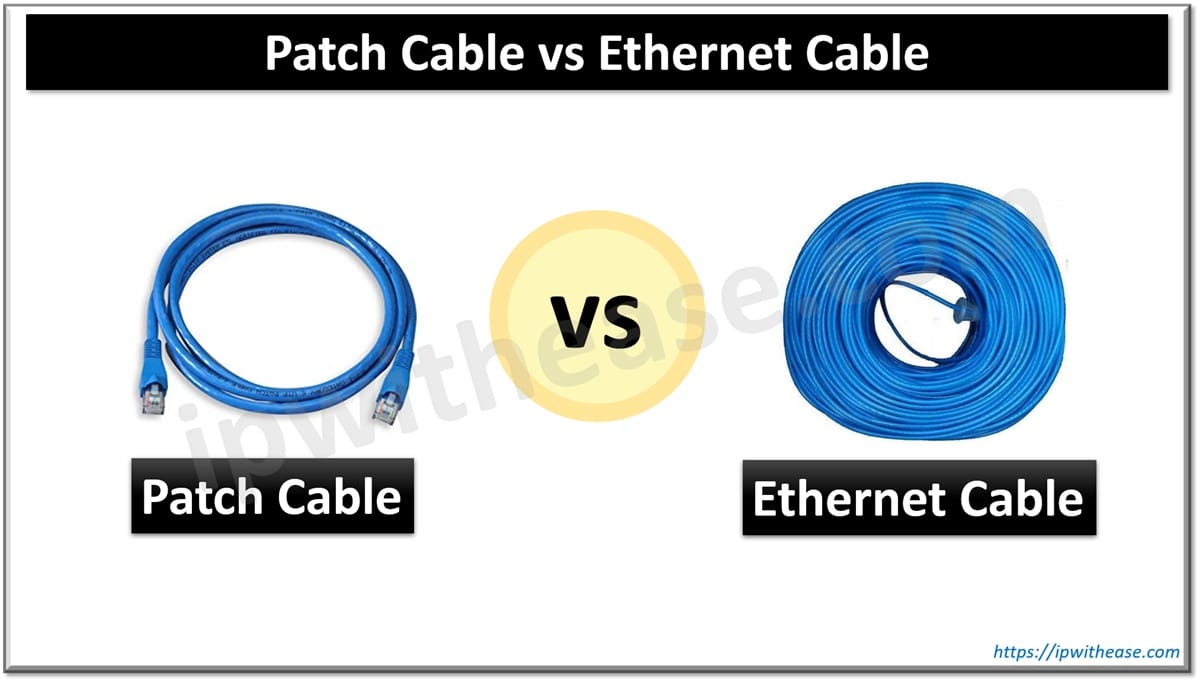
A patch cable is just a short Ethernet cable (usually 0.5-3 m) used to connect devices to a patch panel, switch, or wall port, so it’s a use case, not a different technology. Ethernet cable is the broader term for any twisted-pair cable (Cat5e/6/6a) carrying network data, including long solid-core runs inside walls, while patch cables are typically stranded and more flexible for frequent plugging and unplugging.
What is a Patch Cable?
This word has been taken from keyword “patch in”, ie to “patch” a signal from one hub/switch, or router to another hub/switch, or router for signalling and traffic flow.
Patch cable can also be used to connect the patch panel to switch or a hub. Patch cables are often used for short distances in offices and wiring closets.
Ethernet patch cable can link a computer to a network hub or a router which is useful for constructing home computer networks.
Related: CAT6 vs CAT6A vs CAT7
What is an Ethernet Patch Cable?
Ethernet is basically a protocol, which defines how bits of information travel over a particular medium (medium can be Copper, Fiber or Coaxial). The cable such as fibre optic cable, twisted pair or coaxial cable.
In most cases, in Ethernet cable vs patch cable, both are more or less same, however, the former refers to the flow of information across locations while latter is usually for shorter distance i.e. “patch” from the patch panel to switch.
Related – Ethernet Loopback Cable with RJ45 Connector
The reason for shorter distance supported by patch cables is because they are stranded for flexibility and attenuation is higher which leads to shorter distance support to signal.
Another significant difference Patch cable vs Ethernet Cable is that Patch cables have connectors at both ends for terminating different types of devices while Ethernet cables may not have connectors and could terminate devices directly on their inbuilt interfaces.
Comparison: Patch Cable vs Ethernet Cable
Below table clearly elaborates the comparison on Patch Cable vs Ethernet Cable –
| PARAMETER | PATCH CABLE | ETHERNET CABLE |
|---|---|---|
| Purpose | Patch cable is required for connecting Router or Switch through the patch panel. It is mostly used in wiring or office closets | Ethernet cables are required to connect devices over long distances (Copper or Fiber) |
| Length | Smaller than a general purpose Ethernet Cable. | Mostly longer than patch cables. |
| Types | Can be for – coaxial cables Ethernet Cables Optical Fiber cables | Can be for – coaxial cables Ethernet Cables Optical Fiber cables |
| Termination | Connectors at both ends of patch cable | May not have connectors at both ends and could be terminated on the device directly. |
| Attenuation | Patch cable is stranded for flexibility and attenuation (signal loss) is higher on patch cords than solid cable | Since Ethernet cables are structured, hence experience less attenuation compared to Patch cables, therefore used for longer distance. |
Download the difference table patch cable vs ethernet cable
Related FAQs
Q.1 Can I use a long patch cable instead of running proper Ethernet cable?
For a quick fix at home, it will usually work. For anything permanent, it’s a poor choice. A 30 or 50-metre stranded cable loses more signal, is harder to route cleanly, and may not be rated for installation inside walls or plenum spaces. If the run is going to stay there, use solid-core cable with the correct fire rating (CM, CMR or CMP) and terminate it on keystone jacks or a patch panel.
Q.2 Is a patch cable straight-through or crossover?
Almost all patch cables sold today are straight-through, meaning the pins are wired identically on both ends. Crossover cables were once needed to connect like devices, such as switch to switch or PC to PC. Modern network ports support Auto-MDIX, which detects the wiring and adjusts automatically, so crossover cables have largely disappeared from everyday use.
Q.3 Do patch cables support the same speeds as regular Ethernet cable?
Yes, as long as the category matches. A Cat6a patch cable is built to the same performance standard as Cat6a horizontal cable, which means it can support 10 Gbps. The limitation is distance, not speed. Your network will only perform as well as its weakest link, so pairing a Cat6a permanent link with a Cat5e patch cord brings the whole channel down to Cat5e performance.
Q.4 Why do patch cables come in so many colours?
Colour has nothing to do with performance. Teams use it to make racks easier to manage, for example blue for user access, yellow for uplinks, red for critical systems and green for management networks. A consistent colour scheme saves a lot of time during troubleshooting and moves, adds and changes.
Q.5 Which one should I buy?
Buy patch cables when you need to connect a device to a wall jack, link a switch to a patch panel, or make short connections inside a rack. Buy bulk solid-core Ethernet cable when you’re installing permanent runs between rooms, floors or cabinets. Most well-designed networks use both, with solid cable forming the backbone and patch cables handling the flexible connections at each end.
Watch Related Video
ABOUT THE AUTHOR

You can learn more about her on her linkedin profile – Rashmi Bhardwaj