Table of Contents
AI Agents are transforming the way enterprises worked and operated their businesses as they enable faster decision making, smarter decisions at a scale.
AI Agents are nothing but sophisticated software programs which are enabled with the power of artificial intelligence and operate autonomously. AI agents work autonomously using a predefined set of instructions defined by humans. Internal heuristics and environment stimuli help AI agents in refining and initiating goals with continuous learning.
AI Agents take information from their surroundings and run it through algorithms and use that to make decisions as per defined goals. They act on decisions, observe the outcome and learn from past experience and improvise.
In today’s article we will learn about AI agents and their key components, how AI components function and aid in making AI agents more powerful and autonomous decision makers.
What are AI Agents
AI agent is a sophisticated special software program fuelled by artificial engineering technology. AI agents are defined to work in an autonomous manner within the predefined boundaries set by humans. AI agents are capable of exploring, redefining or initiating goals based on their learning from real-world environments and stimuli.
AI agents feed onto information available in their surroundings, feed it into an algorithm and use the output to make decisions based on goals defined for them. They act on decisions and observe the outcome and also learn from the surroundings and outcome to deliver better results next time.
AI agents are not simply taking instructions in fact they are built to think, decide, act and learn.
AI Agent Use Cases
- AI Customer Service Agents – An AI Customer Service Agent handles tier-1 support queries, resolve tickets, and escalate complex cases to human agents in real time.
- Sales & Lead Qualification Agents – Engage inbound leads, qualify intent, and schedule meetings without human intervention.
- IT Helpdesk Agents – Triage internal tickets, reset access, and auto-remediate common infrastructure issues.
- HR & Onboarding Agents – Guide new hires through documentation, policy Q&A, and benefits enrollment.
- Network Operations Agents – Monitor telemetry, detect anomalies, and trigger remediation workflows autonomously.
- Procurement & Vendor Agents – Negotiate terms, compare vendor quotes, and manage purchase order approvals.
- Financial Analysis Agents – Pull data across systems, reconcile reports, and flag anomalies for finance teams.
- DevOps/SRE Agents – Detect incidents, run diagnostics, and execute rollback or scaling actions automatically.
- Legal & Compliance Agents – Review contracts against playbooks and flag non-standard clauses for counsel.
- Personal Productivity Agents – Manage calendars, draft emails, and summarize meetings on a user’s behalf.
Components of AI Agent
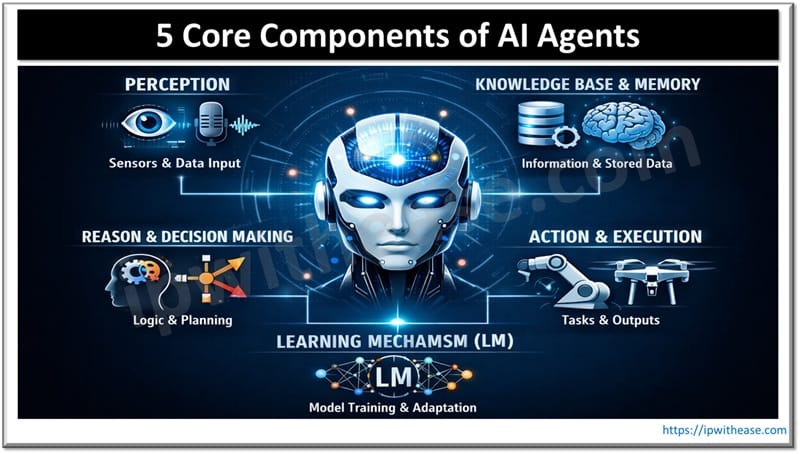
There are five core components of AI agents. We will look at them in more detail in this section.
1. Perception: How AI looks at the world
Information is collected by AI agents from their surroundings and experiences to make informed decisions. Data is collected and processed from many sources such as:
- Sensors collecting data on – temperature, pressure, light, sound and other heretics. Motion sensors provide real-time data on the surrounding environment to AI agents.
- Databases – AI agents can access databases, knowledge bases and other structured data sources
- User input – user input can be provided to an AI agent using various interfaces such as text input, command and gestures
- IoT devices – AI agents can collect data from IoT devices such as smart home appliances, wearable and industrial sensors
The perception component does data processing using data filtering, data exfiltration and feature extraction techniques. The output of perception could be symbolic or could be numerical. Better observation capability leads to informed decisions which aid in achieving end goals.
2. Knowledge Base and Memory – Brain behind the AI bot
This component is an AI agent brain which constantly stores and manages knowledge and experiences to enable decision making. This component enables:
- Knowledge representation – Storing and organizing knowledge in structured manner and in supported format using techniques such as ontologies, knowledge graph and semantic networks
- Knowledge acquisition – Knowledge repository enrichment using input from various sources such as user inputted information, data obtained from databases and sensors and learning from the surrounding environment to update and refine knowledge repository.
- Memory management – Storage, retrieval and Updation at regular intervals
The knowledge and memory enables AI agents to reason, learn and produce output. AI agents can operate more effectively, have improved decision making, enhanced adaptability and increased autonomy due to this component.
3. Reason and Decision Making – AI problem solving engine
Data analysis, knowledge and goals identification for the best course of action and making smarter decisions. Some subcomponents work here to enable the reasoning component for knowledge integration and evaluation of options such as the inference engine to draw conclusions (rule based or symbolic systems).
Optimizing algorithms – decision trees, neural networks or optimization algorithms help to choose the best course of action.
4. Learning Mechanism (LM)
Learning mechanism aids in AI agent to change the behavior based on new data which improves performance, adaptation of new scenarios and decision making strategies revision autonomously for improved outcome.
5. Action & Execution: Transform learning into action
Strategic plans are converted into execution steps with multiple interfaces which enable AI agents to interact both with the digital and physical world. AI agents are transformed into operational assets rather than mere theoretical concepts. Model action modules enable AI agents in a secure manner to manipulate both digital and physical environments.
ABOUT THE AUTHOR

You can learn more about her on her linkedin profile – Rashmi Bhardwaj