Table of Contents
With today’s increasing sophistication of cyber attacks, being reactive is not sufficient. For those who wait for the breach in order to identify their weak spots, things are getting out of hand. Introducing Continuous Threat Exposure Management, which is a proactive way to detect, prioritize, and minimize attack surfaces.
What is Continuous Threat Exposure Management?
Continuous Threat Exposure Management is a cyber security model developed by Gartner which provides the organizations a platform to continuously assess and reduce the organization’s exposure to cyber threats. Unlike the conventional method of vulnerability management that is normally periodic and reactive, Continuous Threat Exposure Management is an ongoing process where the security priorities of the organization are set according to the current threat intelligence and risks to the organization.
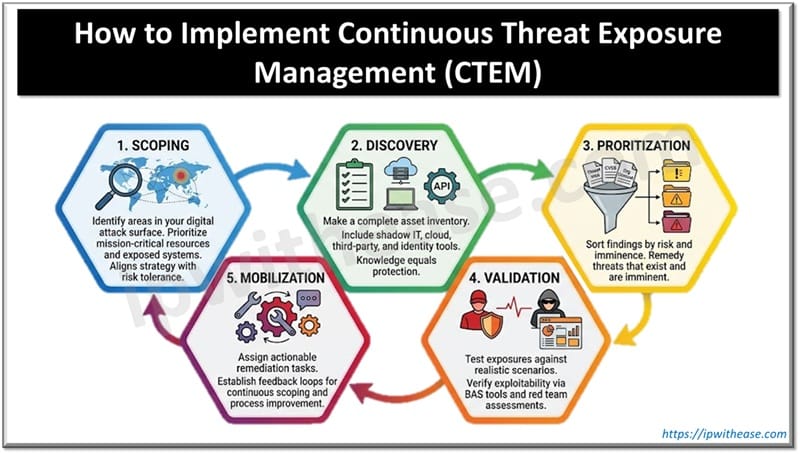
The main objective of Continuous Threat Exposure Management is answered by asking the question: How exposed are we currently from the attacker’s point of view? The process goes beyond the detection of vulnerabilities to analyze the entire attack surface. The process includes external facing infrastructure, configuration of internal environment, integration of the system with third parties, identity and access management. CTEM consists of five repetitive phases: Scoping, Discovery, Prioritization, Validation and Mobilization.
Why CTEM is Essential for Modern Cybersecurity Strategies
Cybersecurity has completely evolved. The increasing reliance on cloud technology, remote working, IoT proliferation, and software supply chain complexity have increased the attack surface like never before. Conventional strategies like performing vulnerability assessments and compliance-based patch management will not suffice anymore.
CTEM takes into account these changes in many important ways:
1. Adversary-oriented Approach
CTEM aligns with an attacker’s mindset by going after weaknesses that can be exploited, rather than simply scanning for potential threats. Vulnerabilities are confirmed using the same method that attackers would use.
2. Prioritization Based on Risk Factors
Vulnerabilities are not created equal. CTEM utilizes threat intelligence and business logic to prioritize remediation actions.
3. Alignment Across Functions
The information security results are converted into actionable remediation initiatives that are communicated to IT, DevOps, and management teams, overcoming siloed structures that delay responses.
4. Continuous, not Periodic
Attacks don’t follow any quarterly cycle. The CTEM process is an ongoing initiative, making sure new devices, setups, and attack vectors are continuously evaluated. Gartner forecasts that companies investing in Continuous Threat Exposure Management initiatives will experience two-thirds fewer breaches than companies using static vulnerability management by 2026.
5 Top Solutions for Continuous Threat Exposure Management
The Continuous Threat Exposure Management market has been witnessing rapid growth with a number of well-developed platforms capable of providing strong capabilities for all five phases of CTEM. The following are some of the top contenders organizations should consider for their CTEM initiatives:
- Tenable One: – Exposure management solution that combines vulnerability intelligence, asset discovery, and attack path identification in cloud, on-premises, and OT Environments.
- XM Cyber: – Simulation-based attack planning tool that identifies critical choke points required to access an organization’s crown jewels from the attacker’s perspective.
- Palo Alto Cortex XSIAM: – Intelligent operations for cybersecurity integrating threat intelligence with real-time telemetry data.
- Cymulate: – Automated testing of security control efficacy by means of breach and attack simulation (BAS).
- Rapid7 InsightVM:- Real time dynamic vulnerability management and risk management by providing visibility of assets, attacker analysis, and remediation workflows for DevSecOps teams.
How to Implement a CTEM Program
Developing an effective CTEM program demands significant technical and organizational effort. Below is a concrete blueprint to consider:
Stage 1 – Scoping
Identify those areas in your digital attack surface that need assessment. Start with prioritizing mission-critical resources, exposed systems, and valuable information. The scoping process aligns cybersecurity strategy with business tolerance for risk.
Stage 2 – Discovery
Make a complete list of the assets in scope. Include shadow IT, cloud resources, third-party solutions, and any identity management tools. In cybersecurity, knowledge equals protection; make sure you know everything in scope.
Stage 3 – Prioritization
Use threat intelligence feeds, CVSS scores, exploitability data, and contextual information from your organization to sort the findings. Concentrate your efforts on remedying the threats that exist and are imminent – not high-severity issues in general.
Stage 4 – Validation
Test the discovered exposures against realistic attack scenarios. Verify their exploitability by running breach and attack simulation tools and red team assessments.
Stage 5 – Mobilization
Assign actionable remediation tasks to appropriate teams. Establish feedback loops, so that each remediation outcome is incorporated into future scoping phases. In other words, continuously improve your CTEM process.
6 Benefits of Implementing CTEM Solutions
Leadership that leverages CTEM will find their cyber program maturing and becoming more effective, leading to tangible benefits in the areas of technology, operations, and business that will decrease their exposure risks and improve their security posture overall. Below are six ways CTEM will help your organization change from its current reactive state to a proactive posture that continuously enhances security in response to business requirements:
- Business Alignment: CTEM creates a link between technical intelligence and business strategy, allowing for the translation of security information into actionable insights, which will aid in decision-making and improve communication between the security team and executives.
- Continuous Validation: The implementation of activities such as breach simulation exercises and red teams will validate the effectiveness of controls and security posture in general; far beyond what periodic auditing can achieve.
- Scalable Efficiency: CTEM automates tasks such as asset identification, control validation, and data correlation, which increases frequency and scope without increased costs or complexity.
- Actionable Guidance: In addition to discovering any gaps and weaknesses that exist, CTEM provides actionable guidance that allows an organization to prioritize their response and implement a solution much more efficiently.
- Tangible Metrics: With specific metrics and trend analysis, CTEM provides organizations with tangible proof of the improvement of their security position and reduction in risk exposure over time.
- Streamlined Operations: Instead of creating siloed processes, CTEM consolidates several processes into one, streamlining operations in the process.
Key Considerations Before You Begin
Implementing CTEM is a continual process, not a one-off endeavor.It needs executive buy-in for obtaining budget and coordination across teams.More importantly, security teams need to shift away from just checking the boxes to real risk reduction.Go big by starting small: implement the CTEM cycle on a well-defined portion of your attack surface, prove success, and build out further from there. A failure to focus too broad of an effort initially is often the cause behind many failed implementations of CTEM.
Integration is crucial as well. The most significant benefit of CTEM is derived when exposure data is integrated into existing security processes: SIEMs, ticketing systems, DevOps pipelines, etc., and not merely stored in another unused dashboard.
Looking for Professional CTEM Services?
For those seeking assistance in CTEM, a professional CTEM Service is advisable, as a skilled team offers sophisticated and proactive cyber security measures that can detect, evaluate, and mitigate your organization’s cyber vulnerabilities. With the use of advanced technology and real-time monitoring, professional services ensure that your systems remain secure from any potential threat.
Conclusion
CTEM is a paradigm shift in the world of enterprise security because it is no longer based on identifying vulnerabilities to patch them, but on managing risks continuously by looking at them from an attacker’s perspective. With threats moving faster than ever before, companies who adopt CTEM can prepare themselves instead of constantly playing catch-up.
ABOUT THE AUTHOR

IPwithease is aimed at sharing knowledge across varied domains like Network, Security, Virtualization, Software, Wireless, etc.