Table of Contents
Signal integrity means maintaining a signal’s strength and clarity as it moves through the transmission line. This is not as easy as it seems, especially when dealing with high-speed, high-frequency signal transmission above the 1Ghz. At this threshold, crosstalk, bounce backs, EMI, and reflections become significant bottlenecks as they can cause transmission errors, slower propagation speeds, erroneous timing, and data corruption. So it is important to optimize the PCB layout to ensure better signal integrity, which begins all the way from design to component selection. Here are some tips to help you during the optimization process.
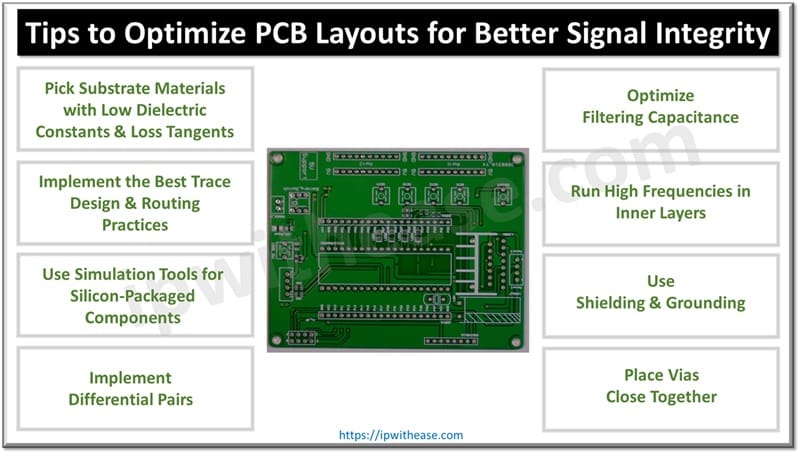
Tips to Optimize PCB Layouts for Better Signal Integrity
Pick Substrate Materials with Low Dielectric Constants and Loss Tangents
Dielectric constant refers to a material’s ability to store electrical energy via polarization, giving it sort of a capacitance effect. On the other hand, loss tangent or dielectric loss gives a measure of a material’s dissipation of electromagnetic energy.
In PCBs used for high-speed networking, dielectric materials with high dielectric constants and loss tangents should not be used to avoid signal attenuation. On the wireless signal transmission spectrum (radio and microwave), select materials with dissipation factors lower than 0.005 and loss tangents between 0.0022 and 0.0095. Typical materials that fit this description include PTFE (Teflon), ceramic-filled PTFE, and hydrocarbon-ceramic laminates, such as Rogers RO4000.
Other critical items to consider during material selection include:
- CTE (Coefficient of Thermal Expansion), which should be between 10 and 20 ppm/°C to ensure PCB stability
- Low moisture absorption of less than 0.1%
For high-frequency PCBs transmitting signals at frequencies above 10GHz, thin substrates (10-20 mil) are recommended.
Implement the Best Trace Design and Routing Practices
After the material, comes the traces, which should be short (about 2 inches max) to reduce impedance mismatching and delays. These transmission lines should also have a controlled impedance that matches the connected components to reduce reflections.
On routing, avoid sharp corners (90° bends) because they cause impedance changes that result in mismatching, meaning the signal can reflect, ring, or cause EMI. The best practice is to use two 45° bends or smooth rounded corners to achieve a 90° turn.
Optimize Filtering Capacitance
Filtering capacitors help to maintain signal strength and clarity by keeping voltage levels steady and eliminating noise. But to optimize filtering, you have to do two things.
First, you have to pick capacitors that match the required frequencies for your design. For instance, using 10 µF and 0.1 µF capacitors can steady lower frequencies while also blocking high-frequency noise.
Second, you have to consider where and how to use these capacitors. For instance, you can place the 10 µF and 0.1 µF capacitors near power pins to keep the voltage steady while eliminating fluctuations.
In high-speed networking systems, interfaces like Ethernet, USB, PCIe, and DDR require filtering capacitance for impedance control to ensure signal integrity when transmitting data.
Use Simulation Tools for Silicon-Packaged Components
Although silicon packaging bundles components and functions into tiny structures, their power networks might have an effect on signal quality. This power network usually introduces capacitance and inductance, which alter how quickly pulses are handled. The on-chip power impedance also affects power quality, and this impedance changes with GHz speed circuits.
Since these silicon dies are more like black boxes, the best way to ensure signal integrity when incorporating them on the PCB is by using simulation tools to check for factors that affect the signal quality, particularly impedance. You can also study the chip’s internal structure to analyze its electrical characteristics and determine the signal integrity issues it might bring to the PCB when placed at a certain point.
Implement Differential Pairs
In high-speed networking systems, PCBs must transmit data in differential mode between signal and return paths. Without a well thought-out layout, the PCB might experience circuit imbalances that cause common-mode currents, where current flows along unintended paths, resulting in EMI.
The best way to ensure this common-mode noise doesn’t occur is by enhancing the differential pair routing by matching the trace lengths and keeping them even. You should also use proper termination to match the impedance at the trace ends and place ground vias close to signal vias to halt mode conversion (differential to common mode).
Use Shielding and Grounding
Shielding and grounding are no-brainers when it comes to lowering EMI. Shielding blocks electromagnetic energy from leaving or entering the board while grounding provides a low resistance path for these waves to pass through.
To implement these two, use conductive coatings or metal covers on sensitive parts and add ground planes below the high-speed transmission lines to absorb the electromagnetic noise.
Also, ensure ground planes or connections are continuous. Placing gaps in between can create antennas that radiate EMI. When using ground vias, make them symmetrical because when uneven, they can cause differential-to-common mode conversion, resulting in high electromagnetic noise.
Run High Frequencies in Inner Layers
Inner layers on the PCB shorten the signal path, which helps to stop signal bouncing and reduce signal delays. This technique should be coupled with small vias to eliminate mismatched impedance issues and stubs. The inner high-frequency layers should be sandwiched between two ground planes or between a ground and power plane to provide interference shielding and a short return path.
Place Vias Close Together
First and foremost, avoid implementing too many vias because these can introduce unwanted interference. But for those that are necessary, try to group them to enhance signal flow, reduce resistive losses, and improve signal conductivity.
Wrapping Up
Designing a high-frequency PCB for high-speed networking systems requires a re-think of the basic electrical wiring practices that might seem obvious in low-speed boards. Since errors can occur during design, you also need to have an experienced high-frequency PCB manufacturer to help you in the design and layout evaluation processes to ensure the prototype and final production PCB deliver the intended performance consistently.
ABOUT THE AUTHOR

IPwithease is aimed at sharing knowledge across varied domains like Network, Security, Virtualization, Software, Wireless, etc.