Table of Contents
Nobody plans to build a messy cloud environment. It usually starts with a sensible decision. Move email and collaboration tools to the cloud. Shift a few applications to Azure or AWS. Keep the more sensitive systems in a private environment for now. Add better backup. Improve remote access. Roll out a new analytics platform because the business wants faster reporting. Each move makes sense on its own.
Then six months or a year passes, and the environment no longer feels simple. One workload lives in AWS, another in Azure, a third is still tied to on-prem infrastructure, and half the team is juggling separate consoles, separate vendors, separate security policies, and separate performance alerts. Costs are harder to explain. Troubleshooting takes longer. Small changes seem to have side effects somewhere else.
That is the moment many IT leaders recognize a hard truth: cloud complexity does not arrive with a warning banner. It builds quietly, then starts showing up everywhere at once.
Why Cloud Environments Get Complicated Faster Than Expected
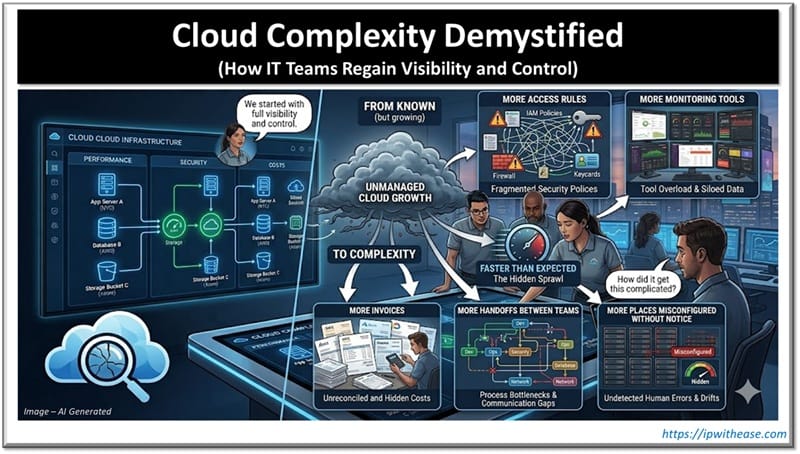
On paper, most modern setups look reasonable. A company wants flexibility, better uptime, stronger disaster recovery, and room to scale. So it mixes public cloud, private cloud, SaaS platforms, legacy systems, and on-prem resources in whatever combination gets the job done.
The problem is not that this model is wrong. The problem is that every added layer brings more to manage.
- More access rules.
- More monitoring tools.
- More invoices.
- More handoffs between teams.
- More places where something can be misconfigured without anyone noticing right away.
A lot of businesses do not feel the strain on day one because the early phase of cloud growth can feel smooth. New resources are fast to deploy. Teams gain flexibility. Projects move forward quickly. But once the environment begins supporting critical operations, the cracks become easier to see.
An app slows down, but nobody knows whether the issue sits in the network, the database layer, or the cloud instance itself. Backups exist, but no one has checked recently whether recovery works the way leadership assumes it does. Security policies are documented, yet privilege creep has quietly expanded over time. Finance sees the monthly bill going up, but the technical owners cannot immediately explain what changed.
This is why businesses often end up needing managed IT support for complex cloud environments long before they expected to. Not because cloud failed, but because success created more moving parts than the original team structure was built to handle.
The First Signs That Cloud Complexity Is Becoming a Risk
Cloud complexity rarely announces itself in dramatic fashion. It usually shows up through friction.
Troubleshooting Starts Taking Too Long
One of the clearest warning signs is when ordinary issues begin eating too much time.
A user reports slow performance. The infrastructure team says compute looks fine. The network team sees no obvious congestion. The application owner suspects a dependency issue. Security logs show nothing urgent. Everyone is checking something, but nobody has a clean, end-to-end view.
When environments are simple, teams can usually isolate problems quickly. When environments become layered and fragmented, diagnosis slows down. And slow diagnosis is expensive even when the root issue is small.
Security Becomes Inconsistent Rather Than Weak
Most cloud environments are not failing because nobody cares about security. They struggle because security becomes uneven.
One platform may be tightly managed, while another has looser access controls. Patching is strong for one group of systems but inconsistent for another. Logging is enabled, but not always centralized. Backups are configured, but not always validated.
That kind of inconsistency is dangerous because it creates blind spots. It also makes compliance harder, especially for businesses that need to show clear evidence of control, not just good intentions.
Cloud Costs Become Harder to Defend
There is a big difference between paying for cloud and understanding cloud spend.
Most organizations accept that usage-based infrastructure will fluctuate. What frustrates leadership is when the costs keep rising and nobody can confidently explain whether the increase reflects growth, inefficiency, poor tagging, idle resources, oversized instances, duplicate tooling, or weak governance.
That is where cloud cost optimization stops being a finance concern and becomes an operational one.
Migration Solves One Problem but Creates Three Others
Moving systems to the cloud often gets treated like a finish line. In reality, it is usually the start of a new operating model.
After migration, teams still need to tune performance, tighten permissions, revisit backup policies, review connectivity, monitor usage, and validate whether the workload behaves well under real business conditions. A successful cutover is important, but it does not mean the hard work is over.
What Mature Cloud Operations Actually Feel Like
A lot of cloud articles talk about transformation in vague, polished language. Real operations do not feel vague. They feel practical. A well-run environment feels calm.
Issues are visible earlier. Access is cleaner. Monitoring is useful rather than noisy. Recovery plans have been tested, not just documented. People know who owns what. Costs still rise and fall, but not mysteriously. When something breaks, the response is structured instead of chaotic.
That is what strong cloud management looks like in real life. It usually includes:
- continuous monitoring across infrastructure, applications, identity, and network layers
- clear incident management and escalation paths
- regular cloud cost optimization reviews
- tested backup and disaster recovery processes
- disciplined identity and access management
- ongoing security monitoring and configuration review
- practical compliance reporting
- automation for repeatable changes, patching, and provisioning
- performance tuning across storage, compute, and connectivity
None of that sounds glamorous, but that is exactly the point. Reliable cloud operations are built on repeatable discipline.
And that is where managed IT support for complex cloud environments becomes genuinely useful. Not as a sales phrase. As an operating advantage. The right support model helps internal teams spend less time reacting to noise and more time focusing on architecture, business priorities, and long-term improvement.
Automation Helps, But It Does Not Rescue a Messy Environment
Automation absolutely matters. Without it, cloud operations become too manual, too inconsistent, and too dependent on whoever happens to be available at the moment.
Good automation reduces repetitive work. It can standardize provisioning, improve patching, enforce baseline settings, and reduce the number of avoidable human mistakes.
But automation has limits.
If access policies are sloppy, automation can spread sloppy access faster. If templates are poorly designed, teams simply deploy the same mistake over and over again. If nobody agrees on governance, automation just makes the disagreement more efficient.
The same thing is true of AI-driven operations. Smarter alerting, anomaly detection, and log analysis can help a lot. But those tools are only as valuable as the processes around them. Good tooling helps strong teams move faster. It does not replace operational judgment.
Governance Works Best When It Feels Lightweight
Many teams hear the word governance and immediately think of friction. Too many approvals. Too many forms. Too many reasons a project gets delayed.
But bad governance is what creates most of that pain. Good cloud governance is usually quieter and more useful than people expect. It answers basic questions early, so teams do not waste time arguing about them later.
- Which services are approved?
- Who is allowed to spin up new resources?
- How is access reviewed?
- What is the required backup standard?
- How is cloud spend tagged and tracked?
- What changes need oversight, and which ones do not?
Once those rules are clear, work tends to move faster, not slower. Teams stop guessing. Security gains consistency. Finance gets cleaner visibility. Leadership gets fewer surprises.
Why Cloud Performance Problems Often Start in the Network
This is where many businesses get caught off guard.
An issue appears in a cloud-hosted application, so everyone assumes it is a cloud resource problem. But in practice, the root cause may sit in connectivity, routing, segmentation, latency, unstable VPN performance, or poor traffic handling between environments.
Hybrid and multicloud setups make this even more common. Once workloads, users, and dependencies are spread across different platforms, network architecture becomes part of the cloud conversation whether teams like it or not.
That is one reason managed IT support for complex cloud environments has to go beyond server uptime. Real support has to connect the dots between infrastructure, networking, security, access, and user experience. Otherwise, teams spend too much time solving the symptom in one layer while the real cause lives in another.
The Real Goal Is Not More Cloud. It Is More Control.
Businesses do not win by having the most cloud services. They win by having an environment they can trust.
That means systems are stable. Costs are explainable. Security controls are enforced consistently. Recovery plans are realistic. Performance is monitored in a way that actually helps. Internal teams are not trapped in permanent firefighting mode.
When those conditions are in place, cloud starts delivering what it promised in the first place: flexibility, resilience, speed, and room to grow.
For many organizations, getting there requires more than good intentions and overextended internal staff. It requires operational consistency, specialist knowledge, and enough coverage to keep things running well day after day. That is why managed IT support for complex cloud environments has become such a practical answer for businesses that are trying to grow without letting complexity run the show.
What Better Cloud Management Looks Like a Year From Now
A year after improving cloud operations, the difference is usually not flashy. It is noticeable in smaller, more important ways.
Incidents are resolved faster. Fewer alerts turn into emergencies. Access reviews are cleaner. Recovery testing is routine. Bills are easier to explain. Teams spend less time guessing and more time improving. Leadership has more confidence in the environment because the environment behaves more predictably.
That kind of stability does not happen by accident. It comes from treating cloud management as an operational discipline, not just an infrastructure decision. And once a business makes that shift, the cloud stops feeling like something that constantly needs rescuing.
It starts feeling like a system the business can actually rely on.
ABOUT THE AUTHOR

IPwithease is aimed at sharing knowledge across varied domains like Network, Security, Virtualization, Software, Wireless, etc.