Table of Contents
Let’s be honest, a few years ago, most “AI in business” conversations were either breathless hype or quiet skepticism. Today, neither of those responses quite fits. AI has quietly become part of how businesses actually run. Not as a flashy side project, but woven into day-to-day operations in ways that are starting to show up on the bottom line.
The numbers tell you something is really happening: 77% of companies are either using or exploring AI, and 83% have made it a top business priority. Deloitte found that 66% of organizations are already seeing real productivity gains, not just promising pilots, but measurable outcomes.
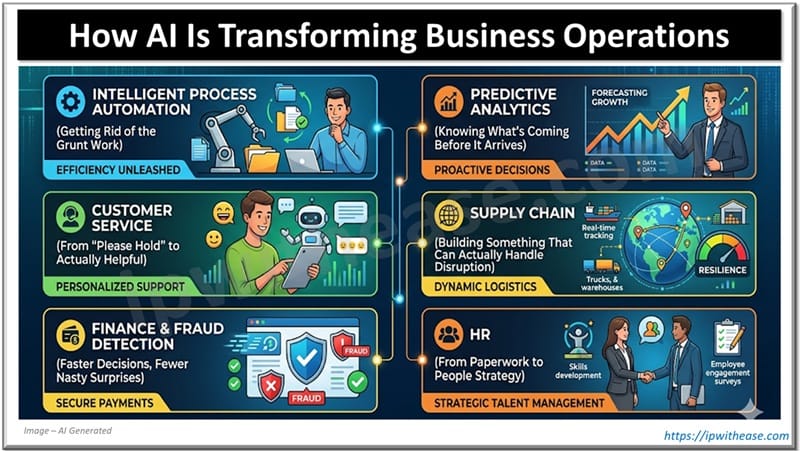
Still, statistics can only take you so far. What’s more interesting is where and how this change is showing up on the ground. Here are six areas where AI Is Transforming Business Operations.
How AI Is Transforming Business Operations
Intelligent Process Automation: Getting Rid of the Grunt Work
Every business has work nobody wants to do – processing invoices, triaging IT tickets, sorting through resumes, sending the same response to the same customer question for the hundredth time. For years, “automation” meant building rigid rule-based systems that broke the moment something unexpected happened. Interestingly, the other side of that equation, actually creating and sending the invoices in the first place, is often solved with something much simpler: a free invoice generator rather than a full AI platform.
AI changed that. Modern intelligent process automation doesn’t just follow rules – it reads context, handles exceptions, and learns from new inputs. It can process an invoice that looks slightly different from the last one, and in financial services, platforms are now using it to automate underwriting and approvals, running over 100 risk checks in minutes rather than waiting days for a manual review. It can flag an anomaly in a financial report without being told exactly what to look for.
The results are hard to argue with. Businesses using AI automation are cutting process cycle times by nearly 50%, especially in finance, HR, and supply chain. Enterprises that have gone all-in on intelligent automation are seeing 3x return on investment within 18 to 24 months.
The deeper shift, though, isn’t just speed. It’s about freeing up people for work that actually needs a human – problem-solving, relationship-building, judgment calls. AI handles the repetitive; people handle the meaningful.
Related: Generative AI vs ChatGPT
Predictive Analytics: Knowing What’s Coming Before It Arrives
There’s a big difference between understanding what happened last quarter and knowing what’s likely to happen next month. Traditional business intelligence was mostly backward-looking. AI flips that around.
Predictive analytics lets businesses get ahead of problems rather than react to them. A manufacturer can spot that a piece of equipment is likely to fail in the next 10 days and schedule maintenance before it causes a shutdown. A retailer with 4,700 stores can balance inventory across locations before stockouts happen. A bank can flag a loan applicant’s credit risk with far more nuance than a simple score.
McKinsey found that 72% of organizations are now using generative AI in at least one business function, and data analytics is near the top of that list. It’s not hard to see why – when you can model outcomes before committing to a decision, you make fewer expensive mistakes. That kind of foresight compounds over time into a real strategic advantage.
Customer Service: From “Please Hold” to Actually Helpful
If you’ve used a customer support chatbot in the last year or two and found it genuinely useful, you’ve already experienced one of the biggest operational shifts AI has driven. The clunky bots that could only handle three topics before giving up? Those are largely a thing of the past.
Today’s AI customer service tools understand conversation context, remember what was said earlier in an interaction, handle handoffs to human agents smoothly, and resolve most common issues without anyone waiting on hold. Businesses are deploying these not as a cost-cutting afterthought, but as a genuine upgrade to the customer experience.
One enterprise saw response times drop by 65%, ticket resolution speed double, operating costs fall by around 30%, and customer satisfaction improve by 24%; all from a single AI deployment. That kind of outcome is why 74% of business owners now expect AI to handle the majority of customer responses.
The important thing to understand here is that this isn’t about removing humans from customer service. It’s about making sure that when a customer actually gets to talk to a person, it’s because the situation genuinely warrants it, not because the bot hit a wall.
Related: Types of AI Algorithms and how AI Algorithms work
Supply Chain: Building Something That Can Actually Handle Disruption
The last few years taught every business leader a hard lesson about supply chains: they’re only as strong as their weakest assumption. When things go sideways, a port backup, a supplier going dark, a sudden demand spike – companies without good visibility into their supply chain are just guessing.
AI is changing that by making supply chains genuinely responsive rather than just efficient. Real-time tracking, demand forecasting, fleet routing, inventory balancing, supplier risk assessment – AI tools are running all of these simultaneously, adjusting continuously rather than waiting for a monthly report.
General Mills deployed AI-driven supply chain optimization and saved over $20 million in the process. Amazon’s AI packaging algorithm saves 500,000 tons of packaging every year. Logistics companies using AI for route optimization are cutting fuel costs and reducing delays without adding headcount.
Across supply chain and procurement, companies with mature AI deployments are reporting cost savings of 26 to 31%. But the real value isn’t just the savings – it’s the resilience. When something unexpected happens, AI-powered supply chains can adapt in hours rather than days.
Finance and Fraud Detection: Faster Decisions, Fewer Nasty Surprises
Finance teams have always been under pressure to do more with less – close the books faster, catch errors earlier, spot fraud before it becomes a crisis. AI is genuinely helping with all of this, and the business case is unusually clear-cut.
On the fraud side, AI systems monitor transactions around the clock, flag unusual patterns in real time, and catch things that would slip past any human reviewer working from a spreadsheet. IBM’s research found that companies using AI-based security and automation reduced average data breach costs by $2.2 million. That kind of risk reduction is hard to ignore.
JPMorgan is running over 450 active AI agent deployments across its operations. One of them generates investment banking presentations in 30 seconds – work that used to take junior analysts hours. Charles Schwab has used AI-driven automation to reduce per-client account servicing costs by more than 25% over the past decade.
For CFOs, the pitch is simple: AI gives you financial data that’s more accurate, more current, and more useful for actual decision-making. Less time chasing down errors, more time acting on insights.
HR: From Paperwork to People Strategy
HR is one of those functions where the administrative burden has always threatened to crowd out the actual people work. Screening hundreds of resumes, tracking down onboarding forms, answering the same policy questions repeatedly – it all adds up. AI is taking a big chunk of that off HR teams’ plates.
In hiring, AI tools can screen thousands of applications quickly, surface the candidates most likely to be a good fit based on historical data, and even conduct preliminary video interviews. That doesn’t mean humans are out of the picture – far from it. It means the humans in your HR team spend their time on the interviews and decisions that actually matter, rather than sorting through stacks of CVs.
In retention, AI is doing something even more valuable: identifying which employees are quietly heading for the exit before they actually leave. By analyzing patterns across engagement data, performance metrics, and tenure, these tools give HR leaders a chance to have a conversation before it’s too late.
In learning and development, AI personalizes training to each person’s actual skill gaps and role – a much better outcome than mandatory compliance modules that everyone clicks through without absorbing. And in workforce planning, AI helps model different staffing scenarios, flag future skill shortages, and align headcount with where the business is actually going.
AI is projected to improve employee productivity by 40% overall. In roles where it’s fully embedded in daily workflows, productivity can double. That’s the kind of gain that changes what a team of 20 can accomplish.
So What Separates the Businesses Actually Winning with AI?
Here’s the honest truth: not every company is getting the same results. Deloitte’s research found that only about a third of organizations are using AI in ways that truly transform their business – building new products, reinventing core processes, changing the business model. Another third are meaningfully redesigning processes around AI. The remaining third are mostly adding AI tools to the edges without changing how the business fundamentally operates.
The gap between these groups is not really about technology. It’s about approach. PwC found that the companies getting the best results have made AI a top-down strategic priority – leadership identifies the two or three workflows where AI can deliver the biggest payoff, and then they commit to doing it properly rather than spreading thin across dozens of small experiments.
If you’re trying to figure out where to start, that’s actually good news. You don’t need to transform everything at once. You need to find the right places, go deep, measure what matters, and build the governance habits now before scale forces the issue.
Final Thoughts
The businesses asking “should we be using AI?” are already a step behind. The real question now is where to focus, how to implement thoughtfully, and how to make sure the gains are sustainable rather than just a burst of early efficiency.
The six areas in this article – process automation, predictive analytics, customer service, supply chain, finance, and HR – cover the operational core of most businesses. AI is making meaningful inroads in all of them. The companies treating it as a long-term capability rather than a short-term fix are the ones building advantages that compound over time.
That’s the difference between using AI and being transformed by it.
ABOUT THE AUTHOR

You can learn more about her on her linkedin profile – Rashmi Bhardwaj