Table of Contents
Vibe coding is the practice of building software by describing intent in natural language and letting AI generate the code, with the developer guiding through iteration and review rather than writing syntax line-by-line. It shifts the developer’s role from typing code to directing, testing, and refining AI-generated outputs.
If you’ve spent any time on LinkedIn, Reddit, or in a developer Slack channel over the past year, you’ve almost certainly run into the phrase “vibe coding.” It started as a throwaway joke and turned into one of the defining shifts in how software gets built. Here’s what it actually means, why it matters for IT and infrastructure teams, not just app developers, and where the hype meets reality.
The Origin of the Term
Vibe coding was coined by AI researcher and OpenAI co-founder Andrej Karpathy in early 2025. He described a workflow where he would talk to an AI coding assistant, accept its suggestions, run the code, and fix problems through more conversation — without carefully reading every line the AI produced. His own words were that he would “fully give in to the vibes” and “forget that the code even exists.”
What started as a half-joking observation about his own workflow went viral almost overnight. Within months it moved from meme to methodology, get picked up by tool vendors, tutorial creators, and eventually enterprise engineering teams. Collins Dictionary even named it Word of the Year for 2025.
How Vibe Coding Actually Works
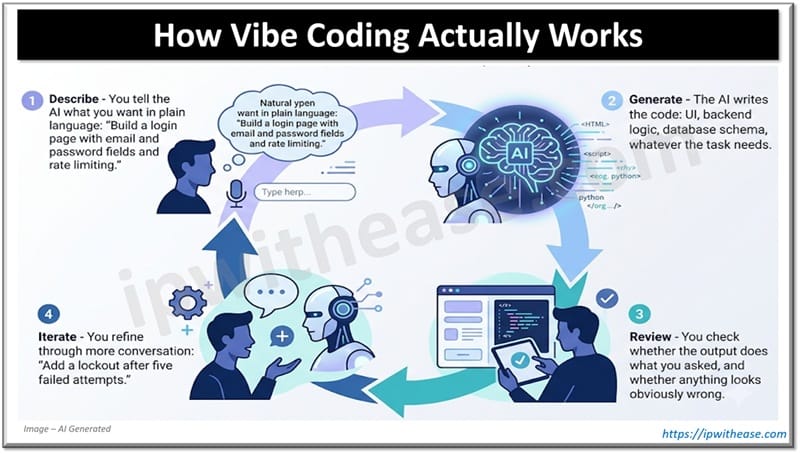
At its core, the workflow is a simple loop:
- Describe – You tell the AI what you want in plain language: “Build a login page with email and password fields and rate limiting.”
- Generate – The AI writes the code: UI, backend logic, database schema, whatever the task needs.
- Review – You check whether the output does what you asked, and whether anything looks obviously wrong.
- Iterate – You refine through more conversation: “Add a lockout after five failed attempts.”
The person is no longer typing syntax line by line. They’re directing an AI collaborator and evaluating outcomes rather than implementation details. That’s the “vibe” – moving the human’s attention from how the code is written to what it accomplishes.
It’s worth being precise here, because the term gets used loosely. Few AI researchers have publicly pushed back on it, arguing that it wrongly suggests engineers are simply “going with the vibes” when they use AI coding tools – when in practice, most professional usage still involves real review and iteration.
Why It Took Off So Fast
A few forces converged to make this more than a passing trend:
- Tooling matured quickly. Tools like Cursor, Windsurf, Lovable, Bolt.new, Replit, and Claude Code turned natural-language prompting into a genuinely usable development environment rather than a novelty.
- Speed became a competitive weapon. Y Combinator reported that roughly a quarter of startups in its Winter 2025 batch had codebases that were 95% AI-generated, a level of AI dependence that would have been unthinkable a year earlier.
- Non-technical builders got a seat at the table. Designers, product managers, and marketers can now assemble working prototypes without writing code by hand, compressing the gap between idea and demo from weeks to hours.
By 2026, industry surveys put daily AI coding tool usage among US developers at over 90%, and a large share of new SaaS MVPs are now built primarily through vibe coding workflows.
The Reality: More Discipline, Less “Vibes”
The casual, hands-off version of vibe coding that Karpathy described has already evolved. What’s practiced in serious engineering teams today looks less like blind trust and more like a structured discipline: developers write precise natural-language specs, AI generates code under active human oversight, and the output goes through architectural review before it ships. It isn’t no-code, and it isn’t low-code, the developer stays involved in specification and quality control, even as the medium of expression shifts from hand-written syntax to guided generation.
A common pattern that’s emerged is what some call the “graduate workflow”: prototype fast in browser-based tools, then hand the validated idea off to more rigorous, IDE-integrated tools for production hardening.
The Part Nobody Can Ignore: Quality and Security
This is where infrastructure and platform teams should pay close attention, because the risks aren’t hypothetical anymore.
Multiple independent studies through late 2025 and into 2026 point in the same direction:
- AI co-authored code has been found to contain significantly more major issues than human-written code, including elevated rates of logic errors, misconfigurations, and security vulnerabilities.
- Security researchers testing several popular vibe coding tools built identical applications and uncovered dozens of vulnerabilities, several of them critical.
- A widely cited controlled study found experienced open-source developers were measurably slower when using AI coding assistants on real tasks and didn’t realize it even after the fact.
There’s also a second-order effect that’s now reshaping open source itself: maintainers of major projects have had to shut down bug bounty programs or restrict external contributions altogether because AI-generated pull requests and vulnerability reports were arriving faster than anyone could review them.
None of this means vibe coding is a bad idea, it means it’s a tool with a specific risk profile that needs to be managed deliberately, the same way any other productivity shift in engineering history has needed guardrails (think the early days of outsourced development, or the shift to cloud-native architectures).
Where Vibe Coding Fits and Where It Doesn’t
Good fit:
- Rapid prototyping and MVPs
- Internal tools and CRUD-heavy applications
- Solo projects or small teams with strong self-imposed review discipline
- Greenfield exploration where speed of iteration beats micro-optimization
Poor fit:
- Safety-critical systems (healthcare, avionics, industrial control)
- Highly regulated codebases requiring formal verification
- Performance-sensitive, low-level systems work
- Long-lived production infrastructure without a governance layer around it
For infrastructure and network architects specifically, this distinction matters. Vibe coding is genuinely useful for internal automation, scripting, dashboards, and proof-of-concept agentic tooling. It’s a poor substitute for the kind of rigor that production network, security, and cloud architecture demands, where an unreviewed misconfiguration doesn’t just create a bug, it creates an outage or a breach.
The Bottom Line
Vibe coding isn’t a fad, and it isn’t magic. It’s a real shift in where human attention goes during software development, from syntax to specification, from typing to reviewing. Used well, with governance and code review still firmly in place, it’s a genuine productivity multiplier. Used carelessly, it’s a fast way to accumulate technical debt and security exposure that shows up months later, when nobody on the team can explain how the system actually works.
The teams getting real value from it in 2026 aren’t the ones who’ve abandoned engineering discipline, they’re the ones who’ve figured out how to wrap that discipline around a much faster generation loop.
Have you experimented with vibe coding tools in your own projects or infrastructure automation? Share your experience in the comments.
ABOUT THE AUTHOR

You can learn more about her on her linkedin profile – Rashmi Bhardwaj