Table of Contents
Enterprise cloud migration can shorten infrastructure lead times, improve recovery options, and give security teams better ways to enforce controls across distributed workloads.
Yet those gains depend on treating Cloud Computing Security as part of the migration design, rather than a project added after applications have moved.
Picture a mid-size financial services firm shifting customer-facing systems into a hybrid cloud. The first workloads perform well, but the SOC receives incomplete logs, privileged accounts multiply, and nobody can quickly explain which team owns a public storage policy. The infrastructure has changed. The operating model hasn’t caught up.
That gap is where many cloud programs run into trouble. Moving servers is fairly mechanical. Reworking identity, monitoring, incident ownership, network controls, and cost accountability is harder.
Why Migration Changes Both Operations and Security
Cloud adoption replaces long hardware procurement cycles with software-controlled infrastructure. Teams can provision capacity in minutes, deploy services closer to users, and test changes without committing to permanent equipment.
Speed, though, cuts both ways.
A developer can create a needed resource before lunch. The same developer can accidentally expose it before the SOC knows it exists. Cloud operations therefore need guardrails that work at deployment speed, not quarterly review speed. That is a core requirement of Cloud Computing Security in modern enterprise environments.
A useful starting point is to assess the key operational and cloud security benefits together. Faster delivery means little if every change creates a new visibility gap. Likewise, strict controls that delay routine releases will encourage teams to work around them.
Elastic Capacity Without Permanent Overprovisioning
On-premises infrastructure is commonly sized for peak demand, even when that peak lasts only a few days each quarter. Cloud platforms let enterprises expand or reduce capacity as business needs shift.
This can improve cost control, but only when resource ownership is visible. Effective Cloud Computing Security depends on that visibility, since unmanaged assets often become unmanaged risks.
Unused instances, forgotten test environments, and oversized databases quietly erase the expected savings. Set tagging rules before migration. At minimum, every resource should identify:
- Its business owner
- Its technical owner
- Its data classification
- Its environment, such as production or testing
- Its approved retention period
These tags support billing, incident triage, access reviews, and eventual decommissioning. One control serves several teams.
Faster Recovery and More Flexible Resilience
Cloud architectures give enterprises more options for replication, backup isolation, and regional failover. That doesn’t make an application resilient by default.
Recovery still has to be designed and tested.
Teams should map dependencies before setting recovery targets. An application may restart successfully while its identity service, message queue, or third-party connection remains unavailable. That’s not recovery. It’s a running server with nowhere useful to go.
Recovery exercises should test business transactions, not merely infrastructure status. Can customers authenticate? Can staff process an order? Can the SOC investigate activity generated during failover? Those are better questions than asking whether a virtual machine turned green.
For a broader view of migration stages and operating considerations, the publishing site’s guide to cloud migration benefits, processes, and types offers useful background.
Cloud Computing Security Must Follow the Workload
Traditional security designs often assume traffic will cross a known perimeter. Cloud services don’t behave so neatly. Workloads communicate through APIs, managed services, temporary identities, and internal connections that might never pass through an old inspection point.
Security controls must move closer to identities, data, applications, and workloads.
Identity Becomes the Main Control Plane
Most cloud administration happens through identities and permissions. A compromised privileged account can change network rules, copy data, disable logging, or create new credentials without touching an office network.
Enterprises should begin with a small set of practical controls:
- Require multifactor authentication for administrative access.
- Keep routine user accounts separate from privileged accounts.
- Grant permissions for specific tasks rather than broad job titles.
- Remove dormant identities and access keys automatically.
- Record privileged activity in a protected logging environment.
Don’t assume least privilege is a one-time configuration exercise. Permissions accumulate as roles change, projects expand, and temporary exceptions become permanent.
Visibility Has to Survive the Move
A migration can weaken detection if logs arrive late, lack context, or sit in separate consoles. Before each workload moves, the SOC should know which events it needs, how quickly they’ll arrive, and who owns the first response.
This calls for a migration security acceptance test. Check that:
- Administrative actions are logged.
- Identity events can be tied to workloads and data.
- Network activity is visible where technically possible.
- Alerts contain an owner and escalation path.
- Log retention matches legal and investigative needs.
- Time settings remain consistent across systems.
What happens if a high-risk alert fires during the migration weekend? If nobody has a clear answer, the workload isn’t ready.
The Cloud Security Technical Reference Architecture from CISA also treats migration, shared responsibility, data protection, and cloud security posture management as connected concerns rather than separate workstreams.
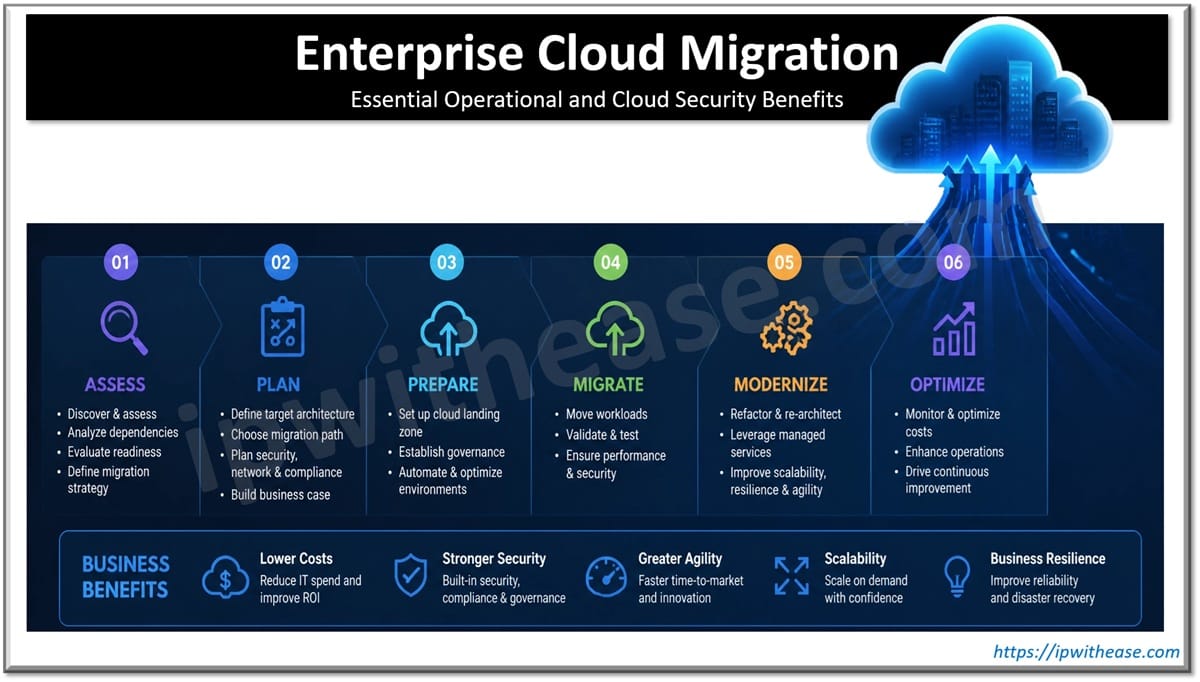
A Practical Control Framework for Migration Teams
Security reviews shouldn’t become a stack of documents that nobody uses under deadline pressure. A short control gate at each migration stage works better.
Before Migration
Classify the workload and its data. Map users, service accounts, dependencies, regulatory obligations, recovery targets, and expected traffic. Record the existing security controls too. Otherwise, teams may discover after cutover that a quiet on-premises control had been doing useful work for years.
During Migration
Monitor configuration changes, privileged activity, data transfers, and temporary connectivity. Migration accounts should expire when the work ends. Temporary firewall rules need owners and removal dates.
Short-lived exceptions are normal. Invisible exceptions aren’t.
After Cutover
Compare the deployed state with the approved design. Remove old accounts, migration tools, duplicate data, unused network paths, and abandoned infrastructure. Then run a focused incident exercise while the migration decisions are still fresh.
This review should include operations, application owners, networking, risk, and the SOC. Each group sees a different failure mode.
Making Security Controls Work Across Hybrid Environments
Cloud platforms introduce new operating models, but the core challenge remains the same: security controls need to maintain visibility, context, and policy consistency wherever workloads run.
The more important architectural question isn’t which tool is deployed. It’s whether controls can exchange context and follow workloads across hybrid environments as applications, identities, and data move between systems.
Product coverage alone isn’t enough. Cloud Computing Security still depends on consistent policy enforcement, visibility, and incident accountability across environments.
Teams should test whether policies remain consistent, alerts reach existing workflows, encrypted traffic is handled appropriately, and incident responders can trace activity across identity, network, endpoint, and cloud records. Procurement should follow the control model. Not the reverse.
Cloud Migration Is an Operating Model Decision
Cloud migration can reduce infrastructure friction and give enterprises stronger options for scaling, recovery, automation, and distributed access. It can also scatter ownership, multiply permissions, and leave the SOC watching only part of an incident.
The difference comes down to operating discipline.
Effective Cloud Computing Security connects identity, configuration, network activity, data protection, logging, and response ownership from the first migration plan onward. When those pieces move together, the cloud becomes easier to run and harder to misuse. When they don’t, enterprises may gain flexible infrastructure while inheriting a slower, murkier form of risk.
ABOUT THE AUTHOR

IPwithease is aimed at sharing knowledge across varied domains like Network, Security, Virtualization, Software, Wireless, etc.