Table of Contents
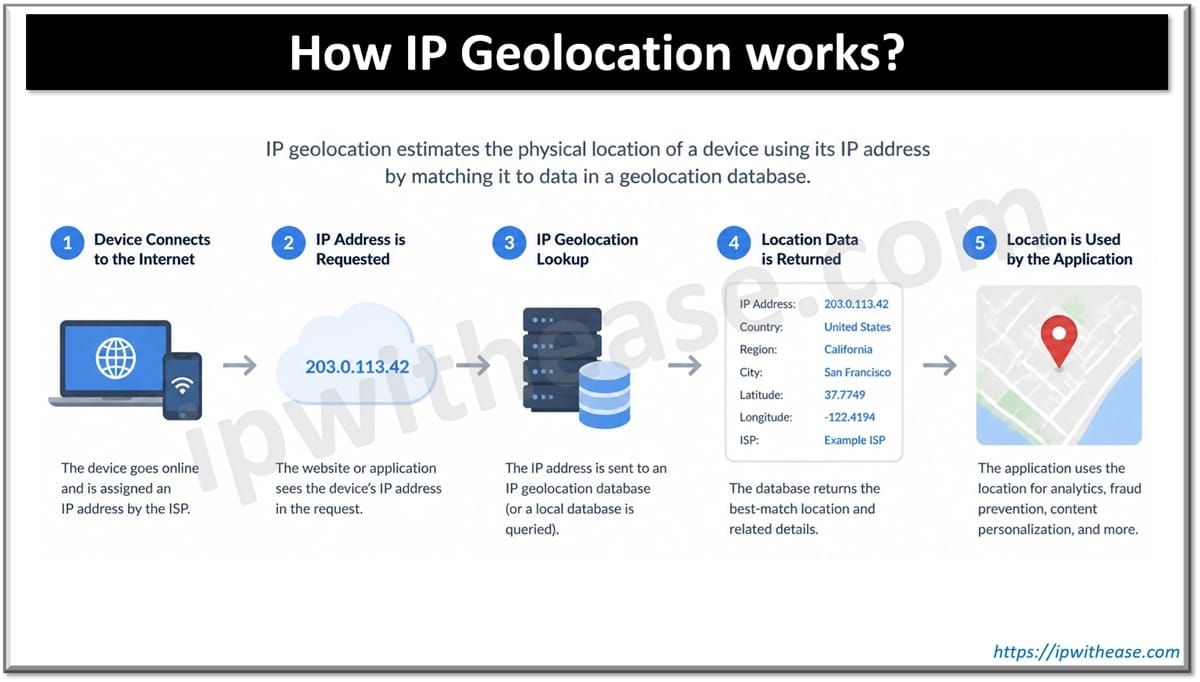
We often visit websites to gather information, buy something, have fun, or play games. But did you know that whenever you visit a website, it sees your IP address? Using your IP address, the site knows much of your information, like what network you are using and from what location. But this location is not your exact physical address. It is an estimated location based on the network you are using and is called IP geolocation.
What is IP Geolocation Lookup?
IP geolocation lookup means finding the likely location of an IP address. A geolocation service checks an IP against network data. It then gives an estimated location that is different from your GPS location.
If you want to check the geolocation of a public IP address, you can do that using an IP address lookup tool. Just open one and run the IP address through it. IP lookup results will usually provide you with:
- Country name
- Region or state
- City name
- Time zone
- ISP
- ASN
- Approximate latitude and longitude
An IP address does not carry your GPS location. Instead, the service links the IP to data about the network that uses it.
How Does IP Geolocation Work?
IP geolocation services use many data sources. They then combine these sources to make a location estimate.
1. RIR and WHOIS Data
RIR stands for Regional Internet Registries. They are responsible for managing IP address blocks. These blocks of IP addresses are then assigned to internet service providers (ISPs), firms, and other groups.
IP WHOIS data shows who owns or is responsible for managing an IP block. This data can give a good clue about the country or network. But it has a limit. The address linked to an IP block may not match the place where a user sits.
2. ISP and Network Data
Internet service providers run large networks and connect you with global networks. Depending on their location, they use many IP ranges across many places. Geolocation firms study these ranges. They also track how ISPs use them. This data can help a service guess the area linked to an IP.
3. BGP and ASN Data
BGP helps networks share routes on the internet. An ASN, or Autonomous System Number, identifies a network. For example, an ISP or cloud firm may have its own ASN.
Geolocation services can use ASN and BGP data to learn more about an IP. This can show the network owner and add more context to the location result.
4. Network Measurements
There are some services that also use network tests. They can check how long it takes for an IP to respond from known points (latency). Based on that, they narrow down the estimated area that likely is an IP’s geolocation. Because multiple factors affect network speed, latency can’t provide an exact location for an IP address.
How Accurate Is IP Geolocation?
IP geolocation works well for broad locations. It often gives a useful country and city-level result. Area-level results are generally estimated and can be less reliable.
For example, an IP may point to a city where an ISP has a network gateway. The user may live in another city.
Why Can an IP Show the Wrong Geolocation?
There are various things that affect IP geolocation results. Here are some of the most common among them.
VPN & Proxies
Many people use a VPN to mask their IP address and browse privately over the internet. When a VPN is active on a device, the user’s original public IP hides behind another virtual IP.
In such situations, IP geolocation lookup shows the VPN server’s location instead of the original public IP. A proxy can also cause a similar result.
Mobile Networks
Mobile carriers often use shared IP addresses. Many users may connect through the same public IP. The IP may then point to a carrier gateway instead of the user’s real area.
Corporate Networks
A company may send traffic from many offices through one internet gateway. The IP may then show the gateway’s location instead of the user’s office.
Cloud & Hosting Networks
A cloud server may sit in a data center. The IP result may show that data center rather than the person using the service.
Common Uses of IP Geolocation Lookup
IP geolocation lookup has many useful roles.
- Online services like banks can use IP geolocation as one risk signal to protect their users’ data.
- Websites can use location data to offer a better local experience.
- Content delivery networks, or CDNs, use network location data to help route traffic.
- Let content compliance teams limit content by region.
- Cybersecurity teams use geolocation data to spot bots and suspicious activities.
Conclusion
IP geolocation uses network data to estimate where an IP address sits. It can use RIR records, WHOIS data, ISP data, BGP, ASN details, network tests, and other signals. It can give useful country, region, and city data. However, area-level results can have limitations.
Various online tools are available that help you check IP geolocation. Checking the geolocation seems to be helpful for various purposes, like monitoring website traffic and enhancing cybersecurity.
ABOUT THE AUTHOR

IPwithease is aimed at sharing knowledge across varied domains like Network, Security, Virtualization, Software, Wireless, etc.