Table of Contents
Most people treat network compliance monitoring like a reporting task. Gather logs, check several controls, produce evidence, and move along.
Still, that approach misses the harder issue. For instance, a network might appear compliant on paper. Meanwhile, operational gaps quietly develop across devices, user accounts, communication tools, and remote access paths.
The problem has grown more complex because enterprise networks no longer sit inside a neat perimeter.
- Employees connect from different locations
- Cloud workloads change rapidly
- Business communication moves across several channels.
Therefore, compliance teams need continuous visibility. It does not want another quarterly spreadsheet that describes what happened months ago.
Compliance Needs Operational Context
For financial organizations, FINRA Rule 3110 provides a positive framework for building clearer supervisory responsibility. It encourages firms to connect written procedures with –
- Real oversight
- Assigned accountability
- Documented review.
However, technology teams still need to translate that supervisory logic into practical network controls.
In fact, a firewall alert alone does not explain whether an employee accessed a restricted system for a valid reason. Likewise, a successful login does not show whether the device met security requirements.
Consequently, compliance monitoring must bring the following aspects together:
- Identity
- Network
- Endpoint
- Communication data.
Otherwise, reviewers see isolated events rather than the full sequence.
This context matters because supervision depends on relationships between events. For example, a remote login may look normal. Minutes later, the same identity downloads unusual files and connects through an unmanaged device.
Basically, each event appears harmless when viewed separately. However, when combined, they reveal a pattern worth examining.
Different Types of Monitoring
In most cases, security and compliance teams use the same logs. Still, their questions differ. Usually, security teams ask whether an attack or compromise has occurred. Meanwhile, compliance teams ask –
- Whether activity followed approved procedures
- Did someone review an exception?
- Whether the organization can prove that review later.
| Monitoring Area | Primary Question | Typical Evidence | Common Weakness |
| Security monitoring | Is malicious activity occurring? | Alerts, traffic records, endpoint events | Too much focus on immediate threats |
| Compliance monitoring | Did activity follow policy? | Access records, approvals, review history | Evidence remains scattered |
| Supervisory monitoring | Did the right person review the activity? | Assigned ownership, decisions, escalation records | Responsibility becomes vague |
| Audit preparation | Can the organization reconstruct events? | Time-stamped records and retained reports | Teams collect evidence too late |
That distinction changes system design. For instance, a security platform may close an alert after analysts confirm that no malware existed. However, compliance reviewers may still need to know whether the user broke an access rule.
Therefore, closing the security case should not erase the compliance trail.
What Effective Compliance Monitoring Should Capture
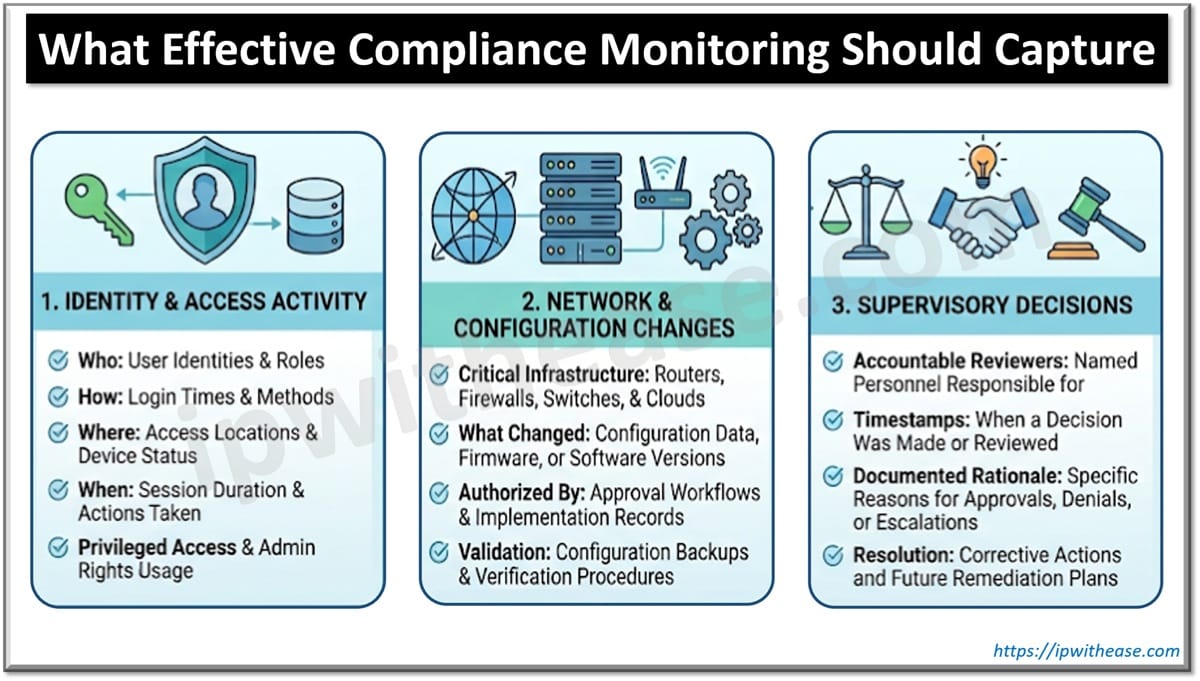
A practical compliance monitoring program does not need every available data point. In fact, collecting everything creates more confusion. Instead, teams should prioritize records that explain –
- Who performed an action?
- What changed?
- Where did it happen?
- Who reviewed the resulting exception?
1. Identity and Access Activity
Teams should connect authentication records with –
- User roles
- Device status
- Location changes
- Privileged access.
As a result, reviewers might distinguish routine work from activity outside an employee’s approved responsibilities.
2. Network and Configuration Changes
Router, firewall, VPN, and cloud configuration changes require clear ownership. Moreover, monitoring should connect each change with –
- A request
- Approval
- Implementation record
- Rollback plan.
It must not be about preserving only the technical command.
3. Supervisory Decisions
Although alerts matter, decisions matter more. Therefore, systems should retain –
- The reviewer’s name
- Review time
- Supporting evidence
- Escalation path
- Resolution.
This way, the organization can reconstruct why an unusual activity received approval.
Where Monitoring Programs Commonly Break
The first failure usually appears between policy and configuration. For instance, a written procedure may require restricted access. Meanwhile, an old group membership still grants broader permissions. Nothing looks broken from the network’s perspective.
Nevertheless, the control no longer matches the documented rule.
Another problem comes from fragmented ownership.
- Security operates the monitoring platform
- Infrastructure manages devices
- Compliance defines review requirements.
Meanwhile, nobody owns the complete evidence chain. As a result, each department completes its assigned task. Still, the organization cannot explain the entire process during an examination.
In addition, alert volume creates problems. When every deviation generates the same priority, reviewers start clearing queues rather than investigating risk.
Therefore, monitoring rules should consider –
- User role
- System sensitivity
- Previous behavior
- Business context.
Fewer useful alerts beat thousands of technically correct but operationally empty notifications.
Building a Defensible Monitoring Model
Organizations should begin with supervisory outcomes, not tools.
- Identify the activities that require oversight.
- Define the person responsible for each review.
- Decide what evidence proves that the review occurred.
- Technology selection comes later.
Although this order feels slower initially, it prevents expensive systems from collecting irrelevant data.
Moreover, teams should test monitoring controls through realistic scenarios. For instance, the following issues quickly expose gaps:
- A departed employee retaining access
- An administrator making an emergency change
- A remote worker using an unapproved device.
Consequently, scenario testing reveals a lot more than a polished policy review.
Better Visibility Creates Better Supervision
Network compliance monitoring works when it turns technical activity into an understandable supervisory record. It should not merely produce alerts or fill an audit folder. Instead, it must connect –
- Actions
- Policies
- Reviewers
- Decisions.
That connection makes accountability visible.
Ultimately, strong monitoring does not mean watching everything equally. Rather, it means watching the right activity with enough context to make a sound decision.
So, organizations must align network visibility with supervisory responsibility. This way, compliance becomes less reactive, and investigations become sharper. Moreover, oversight starts reflecting how modern infrastructure actually works.
ABOUT THE AUTHOR

IPwithease is aimed at sharing knowledge across varied domains like Network, Security, Virtualization, Software, Wireless, etc.