Table of Contents
Hybrid cloud environments let organizations keep some systems on-premises while using private and public cloud services for other workloads. This flexibility also spreads data across databases, applications, APIs, storage platforms, and processing pipelines that may follow different rules.
Keeping information accurate across those systems requires consistent controls. Teams may use a data quality platform to profile records, apply validation rules, monitor quality issues, and standardize data as it moves through different parts of the environment.
Without those controls, small inconsistencies can travel through connected systems and eventually affect analytics, applications, automated processes, and operational reporting.
Why Hybrid Clouds Create Data Quality Gaps
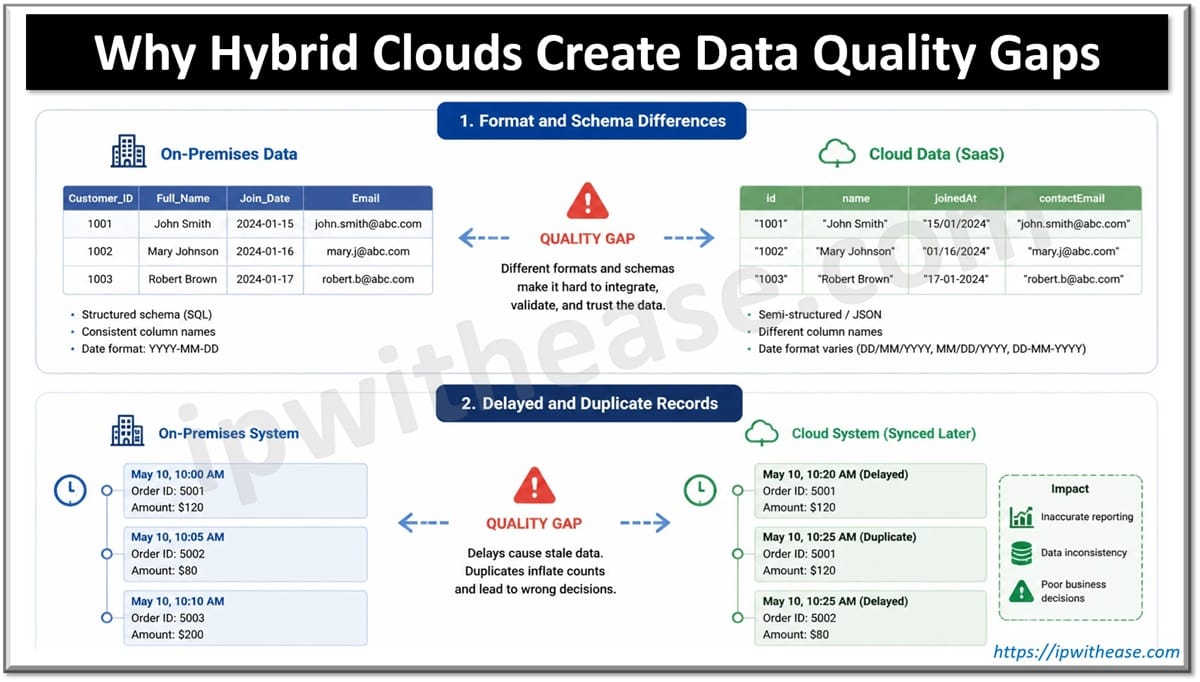
Hybrid architecture increases the number of places where data can be created, copied, transformed, and stored. Each platform may handle the same information differently.
An on-premises customer database, for example, might require a specific date format and use fixed field lengths. A cloud application connected to it could accept several date formats or use a different schema. Data may still move successfully between the two systems, yet the resulting records can become inconsistent.
Several issues appear regularly in hybrid environments:
- Schema differences can cause fields to be renamed, dropped, truncated, or mapped incorrectly when information moves between systems.
- Synchronization delays can leave different platforms holding different versions of the same record for hours or even days.
- Duplicate records can appear when failed requests are retried, integrations create new records instead of updating existing ones, or separate systems maintain their own copies.
These problems become harder to trace as more applications join the architecture.
Format and Schema Differences
Schema changes deserve particular attention because they can break downstream processes without causing an obvious infrastructure failure.
Suppose an application changes a field from a numeric customer ID to an alphanumeric value. An older integration may continue expecting integers. Some records could fail validation while others are silently transformed or rejected.
Mapping rules need to account for these differences before records reach downstream applications.
Delayed and Duplicate Records
Hybrid systems also mix different processing schedules. Some applications update records in real time, while older platforms may rely on hourly or nightly batch jobs.
This difference creates temporary gaps between systems. Users may update information in one application and see an older version somewhere else. Retry logic can create another problem. If an integration does not correctly recognize that a previous transaction succeeded, it may send the same record again.
Clear identifiers, timestamps, and deduplication rules help systems determine which copy is current.
Where Data Problems Usually Begin
Data quality issues often enter a hybrid environment at integration points. Information rarely moves directly from one database to another without processing. APIs, ETL jobs, message queues, connectors, and transformation layers usually sit between the source and destination.
Each step can modify the data. Transformation logic may convert currencies, normalize addresses, change field names, combine tables, or remove unsupported values. Incorrect mappings can therefore produce valid-looking records with the wrong meaning.
Integration Pipelines
ETL and ELT pipelines can introduce problems during extraction, transformation, or loading. Failed jobs are relatively easy to detect because they usually generate errors. Partial failures are harder. A pipeline may process 98 percent of the expected records and still report a successful run. Missing records may remain unnoticed until someone compares the source and destination.
Technical teams should monitor more than job completion. Useful checks include expected record counts, rejected rows, processing delays, schema changes, and unusual shifts in field values.
Distributed Storage
Hybrid environments can also keep several copies of the same dataset. Customer information might exist in an on-premises CRM, a cloud data warehouse, an analytics platform, and a SaaS application. Each copy may be updated on a different schedule.
Problems appear when teams cannot identify the authoritative source. One application may correct an address while another later overwrites it with an older version.
Defining systems of record for important datasets reduces this confusion. Replication processes should also preserve timestamps and other metadata that help determine where a record came from and when it changed.
Governance Across Cloud Boundaries
Technical controls work better when teams agree on ownership and common rules. Hybrid environments often involve infrastructure teams, cloud engineers, application owners, data engineers, security specialists, and business departments. Each group may control part of the data path. Problems can remain unresolved when responsibility becomes unclear.
Governance gives those teams a shared framework for handling important data. Organizations can use data governance tools to support functions such as metadata management, data lineage, policy enforcement, cataloging, and ownership across distributed environments.
Good governance also answers practical questions. Teams should know who owns a dataset, who can change its definition, where it is allowed to move, and which systems depend on it.
Three areas deserve clear rules:
- Ownership: Critical datasets should have assigned owners or stewards who can approve definitions and resolve quality issues.
- Lineage: Teams should be able to trace important data from its source through transformations and downstream systems.
- Access: Permissions should follow agreed policies across cloud services and on-premises platforms.
Governance becomes especially useful during incidents. Engineers can trace affected records faster when lineage, ownership, and system dependencies are already documented.
Set Common Quality Rules
Different infrastructure does not require different definitions of good data. Core requirements should remain consistent as records move across systems. If a customer email address must follow a valid format in one application, the same rule should apply when that record reaches a cloud warehouse or analytics platform.
Teams should first identify the datasets that carry the greatest operational or compliance risk. Trying to apply the same level of validation to every field can create unnecessary work.
High-priority records may include customer identifiers, financial values, product codes, device IDs, transaction dates, and regulated information.
Validate Data at Ingestion
Validation works best when errors are detected close to their source. An API receiving customer records can check required fields before accepting a request. An ingestion pipeline can verify data types before loading files into storage. Streaming systems can flag records that fall outside expected ranges.
Early validation limits how far bad data can travel. Correcting one record near the source is usually easier than finding every copy after it has passed through several systems.
Rules should also be reusable. If separate pipelines apply slightly different definitions of a valid record, inconsistencies can return even after an initial cleanup.
Monitor Data as It Moves
Hybrid environments change constantly. Applications receive updates, cloud services add features, APIs change versions, pipelines are modified, and datasets grow.
Periodic cleanup cannot catch every issue created by these changes. Teams need ongoing visibility into the health of important data.
Monitoring should cover the data itself along with the systems transporting it. A healthy server or successful API response does not prove that the records inside the pipeline are complete and correct.
Useful quality indicators include:
- Completeness: Are required fields populated, and did the expected number of records arrive?
- Validity: Do values follow the expected type, format, and allowed range?
- Consistency: Does the same information agree across connected systems?
- Uniqueness: Are duplicate entities or transactions appearing?
- Timeliness: Is current data reaching downstream systems within the expected period?
Thresholds can help teams identify meaningful changes. A sudden rise in empty customer IDs, for example, deserves investigation even if the integration itself continues running.
Quality monitoring can also support root-cause analysis. If errors begin immediately after a schema update or deployment, engineers have a much smaller area to investigate.
Control Changes Across Systems
Infrastructure changes often create data issues indirectly. Cloud migrations, application upgrades, new API versions, and database changes can alter the way information is stored or transferred. Downstream teams may discover the impact only after reports fail or records begin disappearing.
Change management should therefore include data dependencies.
Before modifying a schema, API, or transformation rule, teams should review:
- which applications consume the affected fields;
- which pipelines transform or copy them;
- which quality checks rely on the current structure;
- which teams need advance notice of the change.
Testing should use realistic data whenever possible. Simple connectivity tests confirm that systems can communicate, while representative datasets reveal mapping, formatting, and validation problems.
Version control is also useful for transformation logic and validation rules. Engineers can see what changed, compare revisions, and restore a previous version when an update causes unexpected behavior.
Data contracts can provide another layer of control between producers and consumers. They define expectations such as field names, data types, required values, and update behavior. Changes then become easier to coordinate across teams.
Keep Hybrid Data Reliable
Hybrid cloud architecture gives organizations flexibility in where they run applications and store information, but every connection creates another place where data can change.
Reliable data depends on common definitions, validation near the source, clear ownership, visible lineage, continuous monitoring, and controlled system changes. These practices help teams detect issues before incorrect records spread through cloud services and on-premises platforms.
Data quality also needs to remain part of day-to-day operations. Hybrid environments keep evolving, so the controls surrounding their data must evolve with them. Teams that understand where information comes from, how it changes, and where it travels are better equipped to keep distributed systems dependable.
ABOUT THE AUTHOR
IPwithease is aimed at sharing knowledge across varied domains like Network, Security, Virtualization, Software, Wireless, etc.