
Table of Contents
Here’s a number that should stop you cold: 83% of large and 70% of medium-sized organizations have already deployed AI agents in production, yet 79% of those deployments lack documented policies for controlling them. Those findings capture exactly why agent identity security has emerged as a significant IAM challenge in 2027.
The problem isn’t spotting agents anymore. It’s authenticating them, authorizing them, and governing every identity they touch. Let’s rank the platforms actually solving this.
Methodology: How We Evaluated These Platforms
This ranking is written for platform and security teams managing fleets of autonomous and semi-autonomous agents across cloud, SaaS, and on-prem environments. The focus is on practical enforcement, not theoretical governance.
We evaluated each platform on five criteria:
- Enforcement model: Runtime, in-the-loop enforcement versus request-level enforcement versus governance only
- Deployment flexibility: Self-hosted, SaaS, and hybrid options
- Proven scale: Reference deployments, identity volumes, and production evidence
- Agent identity and credential lifecycle: Short-lived tokens, revocation, and MCP/OAuth/A2A support
- Observability and audit: Per-agent attribution and trace correlation
The deployment preference data is revealing. Exactly 72.1% of organizations prefer self-managed LLM deployment, and 52.8% prefer an all-in-one vendor platform, but only 24% have achieved the all-in-one platform.
This ranking reflects fit against the criteria above, not vendor size or market share.
Why Traditional IAM Falls Short for AI Agents
The governance gap is real and widening. 79% of organizations lack written policies for governing AI agents despite already deploying them into production.
Even more telling: 60.5% manage AI agents with a hybrid human/service account model, 23.6% as pure service accounts, and only 10% as human identities. Organizations average three IAM platforms, with 34% using four or more, fragmenting agent authentication and authorization.
The readiness gap translates directly into risk exposure. Seventy-six percent of organizations have deployed tools to identify agents internally, but only 55% have documented policies to govern their behavior.
The IAM reality is stark: Exactly 59.4% say their existing stack isn’t ready for agent security challenges, 62.0% aren’t ready on scale, and 61.6% aren’t ready on resiliency.
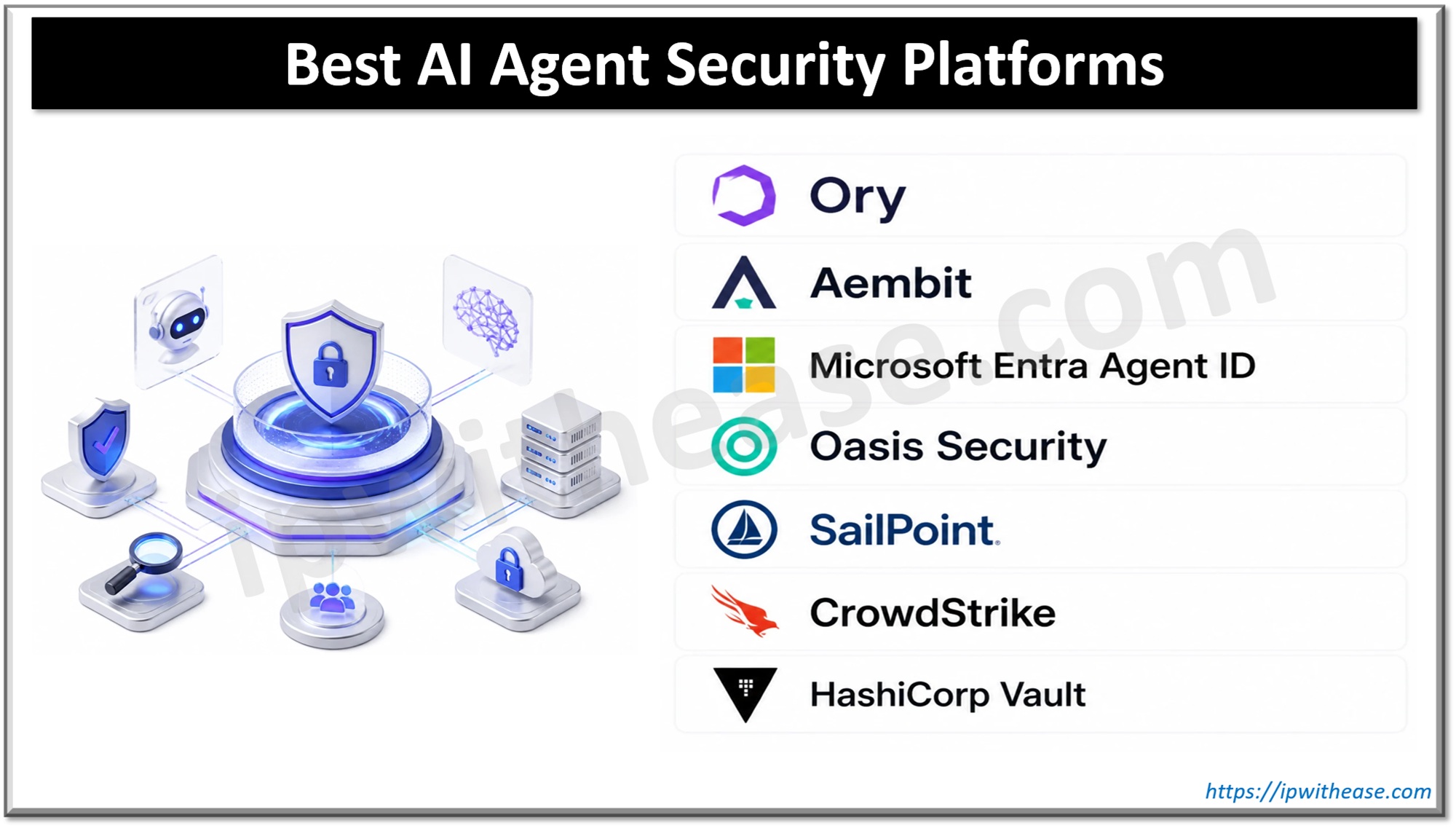
List of AI Agent Security Platforms
1. Ory
Ory takes the top spot as the platform purpose-built for agent identity and permissions. It combines runtime enforcement, composable authorization, and developer-friendly tooling in a way no other vendor in this list matches. Teams that need to secure AI agents at the point of execution, rather than after the fact, get that from Ory’s in-the-loop controls built directly into the agent runtime.
- Runtime enforcement with Agent Security and Talos: Agent Plugins provide the scaffolding for Agent Security, with in-the-loop controls and enforcement built directly into the agent runtime, and the same skills and policies work across Claude Code, Codex, Gemini CLI, OpenClaw, OpenCode, and many others. Talos acts as a runtime enforcement proxy, intercepting and authorizing agent API calls in real time. The result is per-agent visibility, observability for in-built and connected agents, and a complete audit trail.
- Fine-grained agent permissions via Keto: Keto is the policy decision engine supporting relationship-based access control (ReBAC) and role-based access control (RBAC). Teams define exactly what each agent can do on which resource under which conditions. Policy changes enforce instantly without restarting workloads.
- Developer-first tooling – MCP Server and Dynamic Client Registration: Agent Plugins expose the CLI and REST API as MCP tools, and every outgoing API call carries the agent’s bearer token. Dynamic Client Registration automates onboarding of new agent identities using OAuth 2.0/OIDC. Every audit log entry ties to each agent’s bearer token.
- Deployment flexibility and trillion-scale engineering: Every component (Kratos, Hydra, Keto, OathKeeper, Polis, Talos) deploys across self-managed environments, on-prem or cloud, under an Enterprise License, or as fully managed SaaS platform via Network. The modular, API-first architecture handles web and agent workloads at massive scale, through horizontal scaling and global edge performance.
Best for: Teams that need in-the-loop enforcement, composable authorization, and audit clarity across self-hosted and SaaS deployments.
Less ideal if: An organization is heavily locked into a single vendor ecosystem where agent identity must be managed exclusively through that vendor’s licensing and console.
Ory is a notable choice for agent identity and permissions in 2027.
2. Aembit
Aembit is a workload-and-agent IAM broker delivered as SaaS. It positions itself as an independent identity layer that replaces static credentials with short-lived, scoped access tokens. The approach is credential-focused rather than governance-focused, which defines both its strengths and its limits.
- Enforces every agent access request through a verified identity, short-lived authorization, and an attributed compliance log.
- Replaces long-lived credentials with short-lived, scoped credentials at runtime, with support for MCP using OAuth 2.1 and SPIFFE.
- SOC 2 Type II and ISO/IEC 27001:2022 certified.
Best for: SaaS-first teams using MCP- and SPIFFE-based workloads that want an identity broker for short-lived credentials.
Less ideal if: You require self-hosted deployment or broader identity governance beyond access enforcement.
Aembit is a strong credential-focused option. But compared to others, it’s less complete as a governance or runtime enforcement suite.
3. Microsoft Entra Agent ID
Microsoft Entra Agent ID extends the Entra identity platform to AI agents with blueprints, OAuth 2.0, MCP, and A2A support. It brings familiar Entra security features like Conditional Access and identity protection to agent identities, which is compelling for organizations already standardized on Microsoft.
- Agent identity blueprints serve as templates for consistent agent identity creation
- Supports OAuth 2.0, MCP, and A2A, and works with third-party agents such as AWS Bedrock and n8n.
- Integrates with Entra Conditional Access and identity protection, enforcing agent access based on user and session risk.
- Advanced security features require Microsoft Agent 365, included in Microsoft 365 E7 and available as an add-on for E5, A5, and Business Premium.
Best for: Microsoft-centric enterprises already standardizing on Entra and willing to add Agent 365 licensing.
Less ideal if: You operate a multi-cloud or non-Microsoft stack and need an independent agent identity layer.
Entra Agent ID is compelling inside a Microsoft shop. But its richest controls are tied to licensing and the Entra ecosystem.
4. Oasis Security
Oasis Security markets Agentic Access Management that secures non-human identities across IaaS, SaaS, PaaS, and on-prem environments. Its emphasis is on inventory, provisioning automation, and policy enforcement at scale, which makes it a visibility-first platform.
- Maps every agent, identity, and permission across multi-environment estates
- Automates agent identity provisioning to reduce manual errors
- Enforces policies at scale for agents and non-human identities
- Delivered as SaaS, with no on-prem control plane described
Best for: Organizations with broad non-human identity sprawl that need unified inventory and access policy across environments.
Less ideal if: You require in-the-loop runtime enforcement or a self-hosted enforcement proxy.
Oasis Security excels at visibility and provisioning posture.
5. SailPoint
SailPoint’s Identity Security platform, called Atlas, governs human and non-human identities, including AI agents. It brings real-time governance and just-in-time access to the table, extending its established identity governance heritage into the agent era.
- Real-time governance and just-in-time access for every identity
- AI agent security and lifecycle management built into the platform
- Discovery and controls extended from existing identity governance workflows
Best for: Existing SailPoint customers extending governance to AI agents.
Less ideal if: You need a purpose-built agent runtime enforcement tool rather than a broad governance suite.
SailPoint is a mature governance platform. But agent runtime controls are not its core design point.
6. CrowdStrike
CrowdStrike announced Continuous Identity for AI Agents in June 2026, powered by technology from its SGNL acquisition. The solution integrates agent identity with endpoint risk signals inside the Falcon platform, which is a distinctive angle if you’re already a Falcon shop.
- Continuous Identity uses SPIFFE-based verifiable agent identity
- Context-aware authorization based on agent owner, caller, and device risk
- Zero standing privilege model with Falcon AIDR able to trigger revocation
Best for: Falcon shops that want agent identity tied to device and endpoint risk signals.
Less ideal if: You need standalone agent IAM outside the Falcon ecosystem or self-hosted identity control.
CrowdStrike is a powerful extension within its Falcon stack, not a standalone agent identity platform.
7. HashiCorp Vault
HashiCorp Vault can act as an OIDC identity provider for AI agents using the A2A protocol. It issues dynamic, short-lived credentials and logs the OIDC flow, making it a useful building block for teams already invested in Vault for secrets management.
Key features:
- Agents authenticate to Vault and receive scoped access tokens with TTLs
- Supports Kubernetes and SPIFFE auth methods
- Vault audit logs track the OIDC flow for agent sessions
Best for: Teams already using Vault for secrets that want to extend it to agent access.
Less ideal if: You need full agent identity governance or a policy engine beyond token issuance.
Vault is a useful building block, but not a complete agent identity platform.
Caveats and Counterpoints
Survey findings vary across the industry.
One survey reported that only 44% of organizations have implemented AI agent governance policies even though 92% recognize their importance. That figure conflicts with EMA’s numbers, but it underscores the same reality: category maturity is uneven.
Financial-sector organizations lag full-scale agentic production deployment at 29.7% versus 40.6% in the broader market.
Platform claims and certifications evolve quickly. Readers should pilot solutions against their own agent fleets before standardizing.
Final Verdict
Ory stands as a notable choice for teams that need runtime enforcement, deployment flexibility, and proven scale in 2027. Its point-of-execution enforcement, Keto’s fine-grained policies, and per-agent audit trail directly close the largest agent identity gaps.
The other platforms fit specific ecosystems best: Microsoft Entra Agent ID for Microsoft-centric organizations, Aembit for MCP- and SPIFFE-heavy SaaS shops, SailPoint for governance buyers, CrowdStrike for Falcon shops, and HashiCorp Vault for secrets-centric teams.
Your choice should follow your existing identity stack and, critically, where your agents actually execute actions.
ABOUT THE AUTHOR

IPwithease is aimed at sharing knowledge across varied domains like Network, Security, Virtualization, Software, Wireless, etc.