Table of Contents
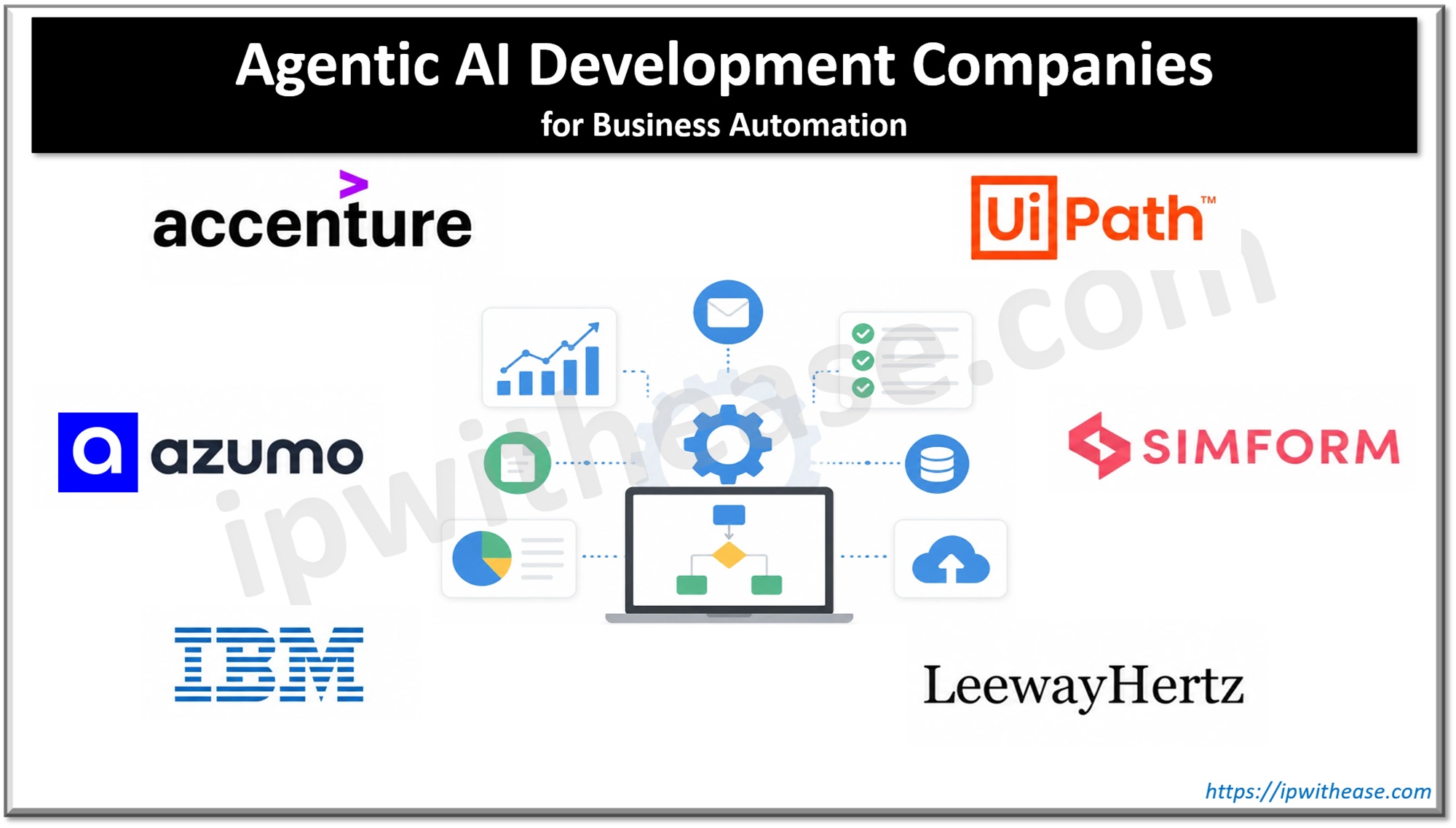
Enterprises spent 2024 and 2025 running generative AI pilots. In 2026, the budget line reads “agentic AI,” and vendors now compete to be the partner that pushes those systems into production. This guide covers six AI agent development companies that each solve a different flavor of the problem: Accenture, Azumo, IBM, UiPath, Simform, and LeewayHertz.
The money follows the shift. MarketsandMarkets projects the global agentic AI market to grow from $19.33 billion in 2026 to $205.88 billion by 2033, a 40.2% CAGR. And the returns justify the spend: enterprises deploying agentic AI average 192% ROI, roughly 3x the return of traditional automation.
Below, you will find a definition of what these services include, a short checklist for choosing a partner, six company profiles with sourced metrics, and an FAQ.
What Are AI Agent Development Services, and Why Do They Matter for Business Automation?
AI agent development services help organizations design, build, and deploy autonomous AI systems that reason, plan, and execute multi-step tasks across enterprise applications. These systems do not just answer questions. They take action.
The practical difference lands fast. A generative AI model writes an email about an invoice. An agentic AI system logs into the accounting system, verifies the invoice against the purchase order, schedules the payment, and updates the ledger, as Accenture describes it. That jump from text output to executed workflow is where business automation value shows up.
A full AI agent development engagement usually covers:
- Strategy and use-case discovery to pick workflows worth automating
- Data engineering and RAG pipelines so agents retrieve accurate, current context
- Model selection and evaluation across commercial and open-weight LLMs
- Multi-agent orchestration with routing, tool calls, and fallback logic
- Integration with SAP, Salesforce, Workday, ServiceNow, Slack, and internal APIs
- Governance, observability, and MLOps for audit trails and production monitoring
Why does this matter now? Gartner forecasts 40% of enterprise applications will embed task-specific AI agents by end of 2026, up from less than 5% in 2025. Yet 88% of organizations report regular AI use while only 23% have scaled an agentic system into production. That gap is an implementation gap, and it is exactly what AI agent development companies exist to close.
How to Choose the Best AI Agent Development Company for Your Business
Not every AI agent development company fits every business. Your choice depends on scope, industry regulation, existing automation investments, and whether you want a platform, a build partner, or both. Run your shortlist through these six filters.
- Scope fit. Enterprise-wide transformation points to Accenture or IBM. An embedded engineering team points to Azumo, Simform, or LeewayHertz. A platform-first approach points to UiPath or IBM.
- Platform ownership. Ask whether the firm runs a proprietary agent platform such as AI Refinery, watsonx Orchestrate, Maestro, ZBrain, or Valkyrie, or whether it builds on open-source frameworks. Both work, but the answer shapes your lock-in risk.
- Industry depth. Healthcare, finance, and insurance teams need SOC 2, HIPAA readiness, model governance, and clear audit trails from day one.
- Hybrid architecture. If you already run a large RPA footprint, prioritize firms that bridge deterministic bots with probabilistic agents instead of forcing a rip-and-replace.
- Proof of ROI. Ask for published case metrics. IBM cites 176% ROI, Accenture cites 50% faster design cycles, and Azumo cites a 40%+ precision gain on its Meta engagement.
- Team seniority. Senior-led engagement models keep agentic projects from stalling as expensive pilots. Ask who writes the architecture and who stays on the project after kickoff.
1. Accenture: Enterprise-Scale Agentic AI Powered by AI Refinery, NVIDIA, and OpenAI
When a Fortune 500 company wants agentic AI wired across SAP, Salesforce, and ServiceNow at the same time, Accenture usually sits on the shortlist. The firm reported $69.67 billion in FY2025 revenue and runs under Chair and CEO Julie Sweet.
Its platform is AI Refinery, an agentic AI environment where teams build and run multi-agent workflows, customize language models, and connect agents to enterprise tools. Engineers configure agents for retrieval, analytics, and research through the SDK, while business teams assemble agent squads and monitor performance through Studio without writing code.
Two partnerships anchor the delivery engine. The Accenture NVIDIA Business Group helps clients scale agentic systems on the full NVIDIA stack, including AI Foundry, AI Enterprise, and Omniverse. A separate OpenAI partnership deploys agentic systems that autonomously execute complex workflows. On the ServiceNow side, Accenture reports 50+ agentic workflows and more than 100,000 hours of productivity gains delivered with clients.
Proof points:
- $2.7 billion in advanced AI revenue in FY2025, triple the prior year.
- $5.9 billion in generative AI bookings in FY2025, nearly double the year before.
- 57,000 AI practitioners across AI Refinery Engineering Hubs in Europe, Asia, and North America.
- More than 30,000 professionals trained globally to help clients adopt agentic AI.
- Eclipse Automation, an Accenture-owned manufacturing firm, uses agentic AI to deliver up to 50% faster designs and a 30% cycle-time reduction.
2. Azumo: Nearshore AI Agent Development with Proprietary Dev Tooling
Azumo suits teams that want hands-on AI agent developers embedded in their project rather than an account layer wrapped around an offshore pool. Chike Agbai founded the company in San Francisco in 2016, and Azumo’s AI agent development services now cover LLM applications, RAG pipelines, voice and chat interfaces, computer vision, MLOps, and business automation workflows.
The engineering differentiator is tooling the team built for itself. Valkyrie gives developers a universal REST interface for calling any model, Charli handles voice, and an AI Schema Generator speeds data modeling. Azumo also runs an AI-Orchestrated Development System that cuts project planning time by roughly 85%.
Engagements open with a “First Touch Deep Dive” led by the VP of Engineering, CTO, and senior leads before anyone writes code. Engineers work across 20+ Latin American countries, many in Argentina, one hour ahead of EST, so standups happen in real time.
Proof points:
- 100+ customers including Meta, Twitter, Discovery, NCsoft, and Omnicom.
- 4.9/5 on Clutch and DesignRush, 93% NPS, and 150% net retention.
- SOC 2 certified, GDPR and CCPA compliant, HIPAA-ready.
- Named a Top AI Development Company by Clutch, The Manifest, and DesignRush, plus Aragon Research “Hot Vendor for AI.”
- Built AI-powered search across 3.5M+ supplier records for Meta with a 40%+ precision improvement.
3. IBM: Multi-Agent Orchestration for Regulated Enterprises via watsonx Orchestrate
If your agents have to operate inside a bank, insurer, or hospital, IBM watsonx Orchestrate tends to be the first platform on the evaluation list. It handles building, deploying, governing, and operating AI agents across business applications and data.
The orchestration layer does the heavy lifting. watsonx Orchestrate coordinates agents, tools, workflows, and foundation models from one center and routes work to the right specialized agent in real time. It supports ReAct for open-ended exploration, Plan-Act for structured execution, and deterministic orchestration when predictability beats flexibility.
A model-agnostic AI Gateway routes requests across IBM Granite, OpenAI, Anthropic, Google Gemini, Mistral, or Llama while preserving governance, observability, and auditability. Support for Agent-to-Agent (A2A) and Model Context Protocol lets teams manage external agents centrally instead of letting shadow deployments spread.
Proof points:
- $3.5 billion in internal productivity gains from IBM’s own agentic rollouts.
- 176% ROI over three years in a commissioned study of watsonx Orchestrate deployments.
- 94% of IBM’s company-wide HR requests handled by watsonx Orchestrate.
- Dun & Bradstreet’s Ask Procurement agent runs on watsonx Orchestrate.
- Named among top agentic AI market companies by MarketsandMarkets, alongside Microsoft, AWS, Google, Salesforce, and OpenAI.
4. UiPath: Hybrid RPA and Agentic Automation on a Single Platform
UiPath built its business on RPA bots. In 2025, the company bet on bridging those bots with AI agents, and Co-Founder and CEO Daniel Dines called the launch “one of the most important and successful product introductions in our history.”
UiPath Maestro sits at the center as a vendor-agnostic orchestration layer for agents, robots, and humans working across systems. The thesis is simple: compliance-heavy steps need deterministic automation, while adaptive steps need probabilistic agents, and both should run on one control plane. As Dines put it, the combination gives enterprises “the execution layer enterprises trust to run mission-critical processes in the agentic era.”
The surrounding stack includes Studio for low-code workflow design, Robots for attended and unattended automation, Orchestrator for governance, and Automation Cloud for document understanding and process mining. Partnerships span Microsoft, OpenAI, Google, NVIDIA, and Snowflake.
Proof points:
- Annual recurring revenue of $1.85 billion, up 11% year over year.
- FY2026 revenue of $1.61 billion, with FY2027 projected at $1.75 billion.
- 450+ customers actively building agents and roughly 1 million agent runs processed by Maestro.
- Around 170,000 process instances orchestrated through Maestro by Q2 FY2026.
- A Fortune 15 global health company runs as a flagship agentic automation customer, and UiPath acquired WorkFusion to expand agentic capabilities.
5. Simform: Agentic AI Product Engineering with Branded AI Accelerators
Simform does not position itself as an AI boutique. It runs as a product engineering firm that promoted agentic AI to a top-line service, with its own branded accelerators behind it. The company is privately held and bootstrapped, headquartered in Florida, with 501 to 1,000 employees across distributed delivery centers. Hiren Dhaduk serves as President and CTO.
Its Clutch profile headlines Agentic AI alongside product engineering, cloud, data, and enterprise platform innovation. Underneath sits an AI/ML engineering practice covering generative AI, custom machine learning, MLOps, and AI-ready data platforms.
Three proprietary accelerators, PexAI, TrueMorph, and NeuVantage, target specific business functions and shorten the path from pilot to working system. Simform also runs a co-engineering model, embedding its engineers inside client teams rather than managing arm’s-length agency projects.
Proof points:
- Positioned as an “Aspirant” in Everest Group’s Software Product Engineering Services PEAK Matrix Assessment 2023.
- Consistently rated a top software developer on GoodFirms.
- Named in 2026 roundups of top US AI software development companies.
- Serves hi-tech ISVs, digital natives, healthcare and life sciences, financial services, retail, manufacturing, logistics, and professional services.
6. LeewayHertz: Specialized AI Agent Development Backed by The Hackett Group
LeewayHertz moved into enterprise AI agents earlier than most, and as a Hackett Group company it now carries the backing of a public consulting firm. Akash Takyar founded the company in San Francisco in 2007, and CTO Deepak Shokeen brings 20+ years in enterprise applications and 50+ delivered AI projects.
Its platform is ZBrain, an end-to-end AI enablement stack with two modules. ZBrain AI XPLR handles strategy and use-case discovery, while ZBrain Builder handles AI agent and application development. Together they compress the path from AI ideation to enterprise-scale deployment.
After the acquisition, LeewayHertz and Hackett formed the ZBrain XPLR joint venture, combining ZBrain with Hackett’s AI XPLR strategy tool. ZBrain stays model-agnostic by design, so clients avoid binding their agent layer to a single cloud or model vendor. Service lines extend into custom LLM applications, AI copilots, MLOps consulting, and data engineering.
Proof points:
- Client roster includes McKinsey & Company.
- Serves finance, healthcare, retail, manufacturing, logistics, legal, and hospitality.
- Repeatedly named a top AI agent development company in the USA in 2026 roundups.
- 15+ years of enterprise delivery experience behind the ZBrain platform.
Bottom Line
Agentic AI is moving business automation beyond simple chatbots and rule-based workflows. The right development partner can help companies turn AI agents into production systems that retrieve data, make decisions, trigger actions, and operate across tools like Salesforce, SAP, ServiceNow, Workday, Slack, and internal APIs. Pasted markdown
Accenture and IBM are strong fits for large enterprises that need broad transformation, governance, and multi-agent orchestration. UiPath is best for teams that want to combine existing RPA investments with AI agents. Azumo, Simform, and LeewayHertz are better suited for companies looking for custom development, embedded engineering teams, and faster agentic AI implementation.
The best choice depends on the company’s automation maturity, existing tech stack, compliance needs, and internal AI capabilities. Businesses should compare each provider by scope fit, platform ownership, industry experience, architecture, ROI proof, and team seniority before choosing a partner.
ABOUT THE AUTHOR

IPwithease is aimed at sharing knowledge across varied domains like Network, Security, Virtualization, Software, Wireless, etc.