Table of Contents
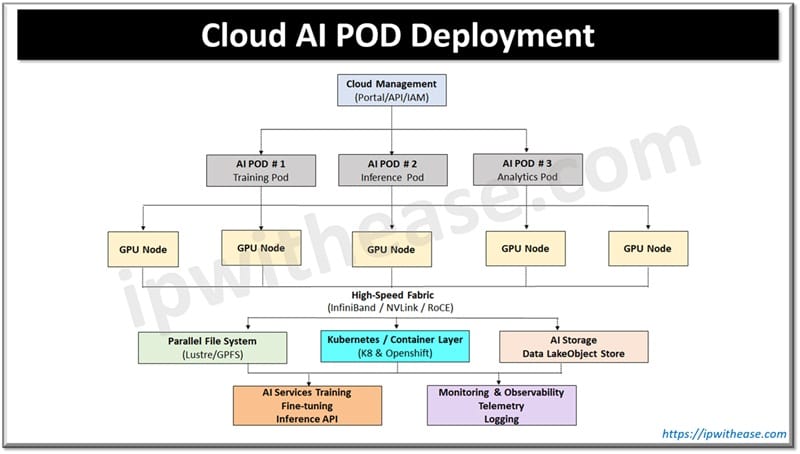
An AI POD is a pre-engineered, tightly integrated unit of GPU compute, high-speed networking, and storage designed to deliver plug-and-play AI/ML infrastructure at scale. Cloud AI POD deployment is a scalable, containerized cluster of AI services (models, inference, orchestration) hosted in a public cloud, managed for elasticity, updates, and integrated cloud storage/ML tooling. On the contrary, in on-prem AI POD deployment, the same containerized AI stack is deployed within an organization’s local data center or private infrastructure, providing low-latency, security/compliance control, and direct hardware access.
Artificial intelligence is widely getting adopted but the key decision is to make whether you want to run AI workloads on cloud or you want to host them on prem infrastructure. A diverse set of AI workloads deliver different functionality. Compute requirements, latency requirements and sensitive data handling could be certain criterions to determine deployment strategy.
Workload categorization is necessary to decide deployment models. Usually Workloads are categorized based on data they will handle, training requirements, low latency requirements for inference workloads, data sensitive in nature need to remain on premises. At times there could be need for hybrid solutions especially when AI is used on edge for IoT devices or edge devices.
In today’s article we will cover in detail difference between an AI POD deployment in cloud or On prem, what are pros and cons of both approaches, limitations for cloud and On prem deployments
AI POD Deployment in Cloud
AI POD deployment in cloud is cloud AI where AI models run over major cloud platforms such as Microsoft Azure, Amazon AWS, Google GCP, Oracle cloud they offer scalable, resilient managed services such as out of the box AI for AI usage and provides AI models across the globe. Cloud based AI POD setups are an ideal choice when it comes to low cost of ownership.
Cloud based AI PODs Advantages
- The cloud based AI PODs have scalability as big advantage and they are ideal for AI model training which requires compute intensive capability
- Cloud AI is a preferred choice for variable workloads and for start-ups as it is a Pay-as-you-go model
- Maintenance, updates and infrastructure management is cloud service provider responsibility so organizations can focus on harnessing power of AI
Limitations of AI POD in Cloud
- Data resides with 3rd party cloud services provider hence organisations have concerns on data security
- Organizations have to deal with vendor lock in risk as they rely on cloud service providers for business crucial services hence impacting the flexibility and negotiation scope
- Latency issues do occur sometimes in real-time workloads in cloud setups
AI POD Deployment On-prem
AI POD deployments in on premises setup means AI models run on infrastructure – servers, network etc. is owned by the organization. The organization had full control on infrastructure and data resides on prem and never leaves outside the organization setup however, the capex costs are higher initially but no recurring subscription cloud fees. Since the setup is internal, the organization has more control in terms of custom configurations or optimizations for hardware and software to meet compliance requirements. On prem setups are ideally suited for regulatory, privacy centric businesses such as healthcare, finance etc.
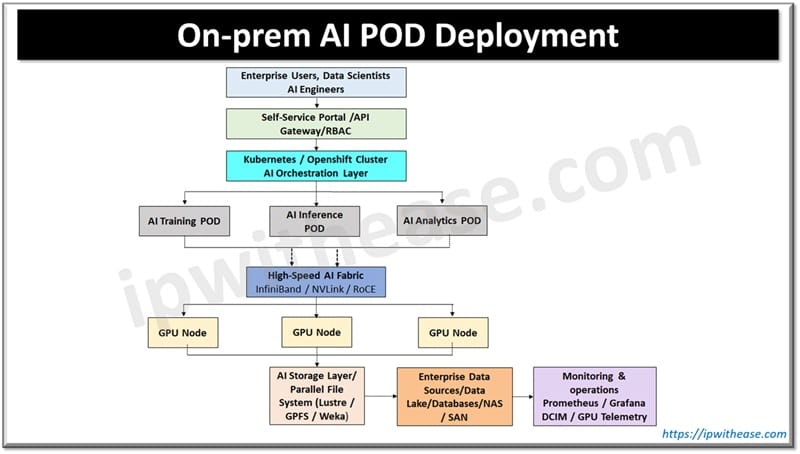
On-prem based AI PODs Advantages
- To meet regulatory requirements such as GDPR, HIPPA etc organizations prefer on prem setups to have complete control over their data
- Infrastructure tailored as per AI workload requirements
- As there is no subscription based resources costs involved the capital costs are up front and predictable
Limitations of On-prem AI POD Deployments
- High upfront capex costs related to hardware, software and personnel
- Adding more hardware to handle AI workload spikes is slow and expensive and could take couple of weeks or months
- All management of on premises infrastructure, patching, upgrades etc is to be taken care by organization only
GPU POD vs TPU POD
- Scalability and Flexibility – It is easier to scale in cloud based AI deployments on the fly during AI model training and computation requirements. While, additional resources are required as AI workload requirements go up or there are bursts during model training and computation. Hence there is a limit on flexibility and scalability which can be achieved in on prem setups.
- Latest Hardware – Latest GPU hardware and AI accelerators is deployed by Cloud providers to service their customers. On the other hand, the on-prem deployments entail huge capex costs and usually a onetime setup is done.
- Managed Services and Abstraction Layer – Data model and data training is supported with advanced MLOps platforms. The ML layer performs GPU optimization, cluster management and maintenance of s/w stack and development of AI model left with end user teams.
- Costs – Pay-as-you-go model is ideal for variable workloads and for start-ups who do not wish to invest heavily on capex costs and look for a quick turnaround time. While, capex costs are upfront here for investing in infrastructure – hardware, software etc. no cloud subscription costs involved here.
- Hardware Control and Customization – In cloud setups the control of hardware and customization is with cloud service provider as underlying infrastructure is provided by CSP. While on-prem setups organization has complete control over hardware and customization can be achieved as desired.
- Data Sovereignty and Compliance – For general workloads, cloud setups provided security controls around encryption, access management, region specific data hosting etc. On the contrary, regulated industries require to adhere to data residency requirements where data is stored within organization boundaries.
- Use Cases – Use cases of cloud deployment are Deep learning and LLMs training, quick pilots and POCs, where sensitive data not involved, AI workloads having unpredictable spikes. And the use cases of on-prem deployment are Sensitive data sets, Fraud detection, customization of AI workloads, regulatory data processing.
Comparison Table
| Dimension | Cloud (AWS/Azure/GCP/OCI) | On-Prem (Private AI POD) |
|---|---|---|
| Time to Deploy | Days to weeks (provision GPU instances on demand) | 4–9 months (procurement, power/cooling buildout, rack-and-stack, cabling) |
| CapEx | None – pure OpEx | High – GPU servers, spine-leaf fabric, storage, power/cooling infra |
| OpEx | High per-hour GPU costs (e.g., H100 instances often $2–5+/GPU-hr on-demand) | Lower marginal cost once amortized; power, cooling, staff, maintenance contracts |
| GPU Availability | Subject to capacity constraints/quotas, especially for H100/H200/B200 | Fully owned – guaranteed availability once deployed |
| Networking Control | Limited visibility into underlying fabric (EFA, InfiniBand abstracted) | Full control over InfiniBand/RoCEv2 fabric, topology, oversubscription ratios |
| Latency/Throughput | Good, but shared multi-tenant fabric; noisy-neighbor risk | Deterministic – dedicated non-blocking spine-leaf, GPUDirect RDMA tuned end-to-end |
| Storage | Managed (FSx for Lustre, Azure NetApp Files) – simpler, less tunable | Full choice (VAST, WEKA, Pure, NetApp AFF) with GPUDirect Storage tuning |
| Scalability | Elastic – scale from 1 to 1000s of GPUs quickly | Bounded by physical capacity; scaling = new procurement cycle |
| Power & Cooling | Provider’s problem entirely | Your problem – liquid cooling, power density (30–120kW/rack) planning required |
| Data Sovereignty/Compliance | Depends on region/provider; data residency contracts needed | Full control – critical for BFSI, defense, government workloads |
| Security Posture | Shared responsibility model; provider-managed isolation | Full physical and logical control, air-gapped options possible |
| Talent Requirement | Cloud/MLOps skills | Deep infra skills – network, systems, GPU ops, facilities |
| Cost at Scale (steady-state) | Expensive for sustained, predictable, large workloads | Cheaper long-term for sustained high utilization (>60-70%) |
| Cost at Scale (bursty) | Efficient – pay only for burst usage | Wasteful – idle capacity during low-demand periods |
| Vendor Lock-in | Higher (proprietary networking, managed services) | Lower – open standards (InfiniBand/Ethernet, open orchestration) |
| Ideal Use Case | Experimentation, bursty training, variable inference load, fast time-to-market | Sustained large-scale training, regulated industries, cost optimization at scale, IP-sensitive models |
| Hybrid Pattern | Burst to cloud for peak training | Steady-state training/inference on-prem POD, burst overflow to cloud |
ABOUT THE AUTHOR

You can learn more about her on her linkedin profile – Rashmi Bhardwaj