Table of Contents
Last year, Deloitte Australia wrote a report for the Australian government that contained multiple errors, including a forged quote from a federal court judgement and a non-existent reference.
A Sydney university teacher claimed there were twenty errors in the first draft, which was later revised. Moreover, they had to subsidize a colossal amount of dollars for the Australian government.
In the revised version, they disclosed that a generative AI language model was used to write the report.
The incident vividly explains why AI output strictly needs verification in an Enterprise AI or any type of organization. It is undeniable that AI expertise has evolved and continues to evolve, making human tasks much easier and less time-consuming.
Many big organizations and enterprise IT have deployed AI in their workflow and trusted its given outputs and decisions. But, similar to Deloitte, they had to face heavy consequences and pay a huge cost for blindly trusting AI solutions.
To avoid that, there are no shortcuts or alternatives to proper governance and output verification.
What Is AI Governance?
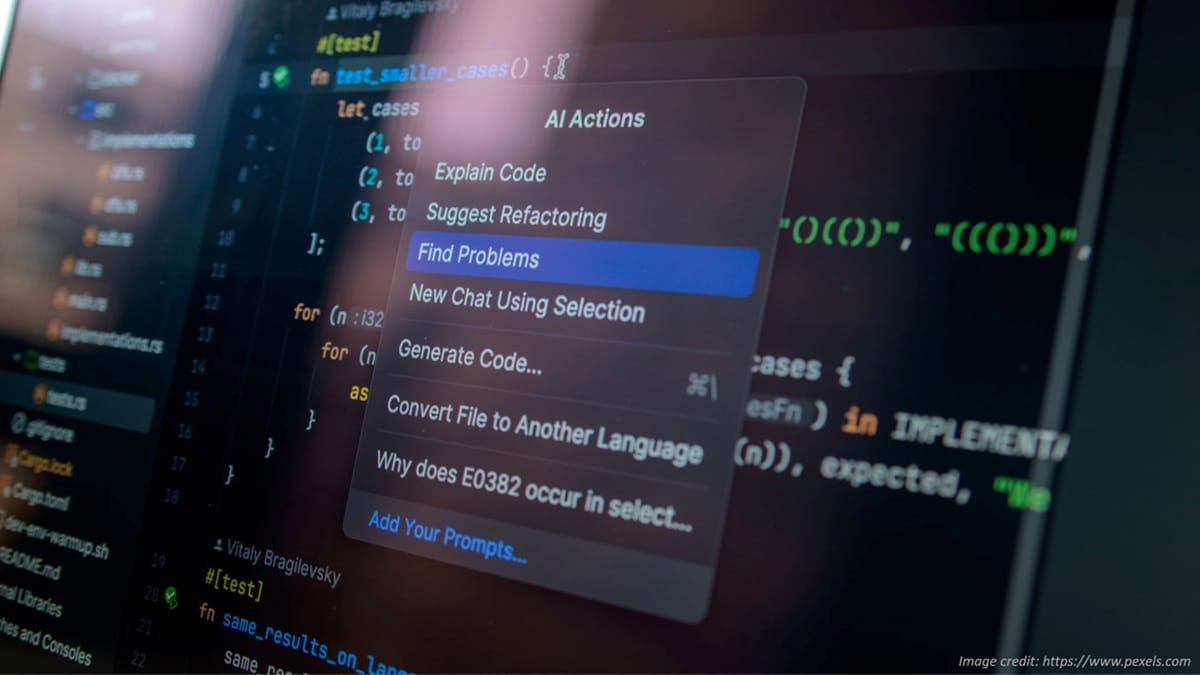
AI governance is a set of rules in an organization that decides how an AI system is going to be built, applied, safeguarded, and supervised. It also involves which data should be used in a system, ensuring security regulations, who is going to have access to it, and who will be reviewing its output and accountable for the consequences of approving its suggestions.
To be straightforward, it is a monitoring system for AI to govern its decisions, outcomes, data usage, and ensure safety, human review, and risk management.
However, AI governance is a way bigger concept than an AI detector, if you are wondering. Though both are related, their purposes and functions are not the same.
While AI governance is a holistic policy for AI applications, AI detection tools simply identify the parts where AI assistance was used. The purpose of AI detection tools is mostly to reduce or edit the AI-generated portions. But the latter one takes its assistance by applying certain regulations and rules.
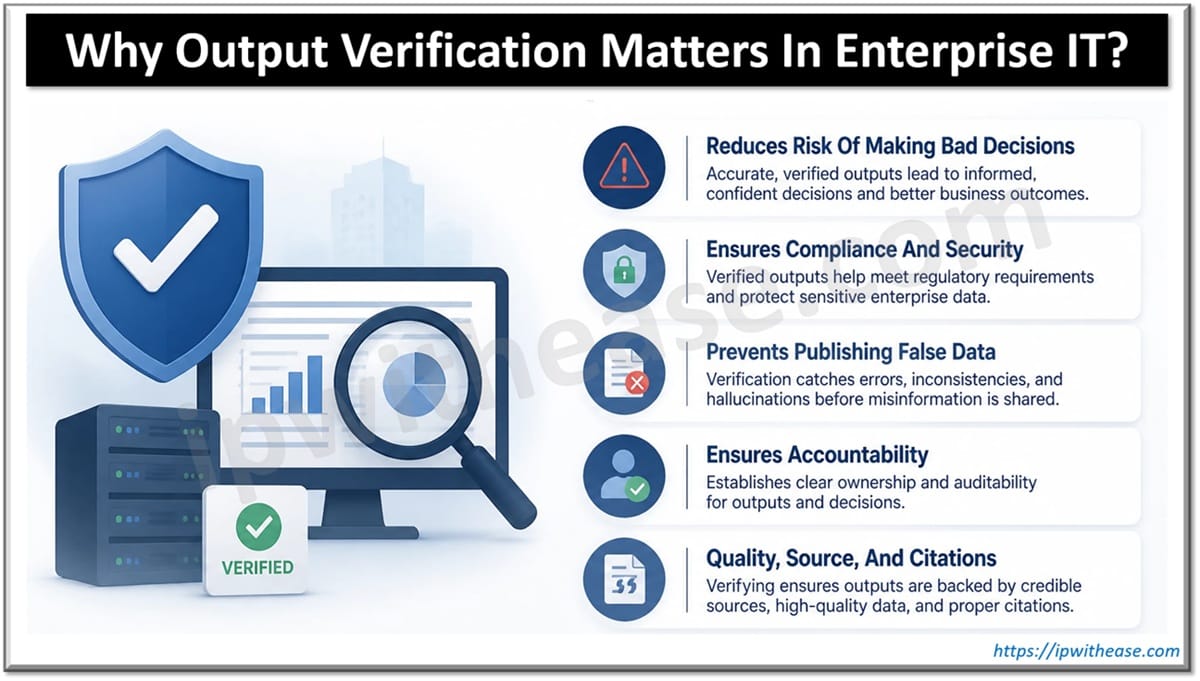
Why Output Verification Matters In Enterprise IT?
In enterprise IT, there are numerous technicalities and decisions to make based on reliable data and solid facts. Undoubtedly, in enterprise IT, trusting AI-suggested solutions and suggestions is pretty suicidal.
Here are five primary reasons why AI output verification is crucial for enterprise IT.
Reduces Risk Of Making Bad Decisions
AI misreads and misunderstands contexts and situations frequently, and, based on guesswork, it provides outputs that do not fit into the context properly and fail to fulfill the purpose of making a decision.
Moreover, to fit into the prompt or please the user’s perspective, AI also gives unfair and biased judgments. As a result, the decisions taken from AI-provided suggestions proved to be partially fruitful for the enterprise.
Recently, Amazon has faced the heavy consequences of trusting AI in major decision-making. Their retail website crashed because they initiated a decision suggested by an AI agent that was based on outdated information.
Amazon’s case clearly showcases how implementing AI output led to a terrible decision, risking profit and sales, especially when there are technical issues like making a website run smoothly.
If there were a verification process in Amazon’s context, the outdated information could be edited or updated; they would have reached a viable decision.
So, a verification process in the loop of an enterprise IT can effectively prevent an enterprise from making bad decisions. Rather, with the help of AI, it can suggest a better and practical decision.
Ensures Compliance And Security
Whenever AI is in the workflow, there is always a risk of data leakage and cyberattack. When you put sensitive or confidential data into an AI system, you are risking it being exposed.
A recent IBM research study has claimed that only 24% of Gen AI projects have security measures right now, which is alarming considering the amount of data being fed to AI every day.
Through cyberattacks, AI tools can be manipulated and steal a person’s identity by using their personal information and photos, and even cloning their voices too.
Imagine how vulnerable your company’s important data is when it is put into an AI system.
So, to ensure security and compliance and prevent confidential data leakage, an enterprise must have a solid data security system.
Enterprises can frequently look for security gaps in the AI environment, carefully utilize and protect AI training data, and assess model vulnerabilities for risk management.
Prevents Publishing False Data
As AI hallucinates with data, it is highly risky to publish information that AI tools are providing. AI most of the time messes up information that it gathers from numerous different sources.
Not only that, it even makes up non-existent facts and claims to fit into a certain prompt. And it does not cross-check the information to ensure its validity.
The case of Deloitte is a perfect example of AI providing inaccurate facts and false data, making the company get into serious trouble and face heavy consequences.
If the output, particularly the data, were verified, they could have been saved from such big trouble and kept their image clean.
So, if any AI output goes through an impactful governance or verification process, false data and made-up facts will be identified and will be removed or edited.
Ensures Accountability
If you come to the Deloitte situation again, you can understand that the gen AI tools that were used in the report writing were never held accountable for the mess that occurred by them. It is only a human who can take responsibility and recover the damage somehow.
A verification process can ensure accountability in the workflow. Also, they can rationalize and justify a suggestion or decision even if it is taken by AI.
If there is any glitch in the measures or decisions taken by AI, a verification process and human oversight can fill the gap or fix the glitch. Also, there should be someone to take responsibility and own the outcome in case something goes wrong in the workflow.
Quality, Source, And Citations
Finally, quality assurance, secondary source verification, and citation check are always essential steps for an enterprise to ensure the best results.
However, AI is notoriously known for providing output that lacks high-standard quality. Also, it does not check the data and information against the sources, and it never checks citations properly to ensure credibility.
AI and a verification process with human intervention ensure these three components to scale up an AI output and bring out the best result.
Final Thought
No matter how efficient and updated an AI tool, software, and workflow pipeline become, the contribution of a real supervisor, governance, and a verification system is fundamental to ensure the effectiveness of the output.
For large enterprise AI, a robust verification system is even more necessary to ensure the best decision-making, quality assurance, accountability, data privacy, and accuracy, and to avoid bigger and more complicated after-effects.
ABOUT THE AUTHOR

IPwithease is aimed at sharing knowledge across varied domains like Network, Security, Virtualization, Software, Wireless, etc.