Table of Contents
An AI POD (Point of Delivery) is a pre-integrated, rack-scale infrastructure unit that bundles GPU compute, high-speed networking, and storage into a single deployable package. It is purpose-built to run AI training and inference workloads at scale with minimal setup time.
In the fast-paced digital landscape of today, businesses are constantly looking for ways to utilize the power of artificial intelligence (AI) to build innovative productions, automate business functions and workflows to improve overall efficiency, reduction in operating costs and gain competitive advantage in the market ahead of its competitors.
But the adoption of AI is a bit slow as there are concerns around its secure usage and that hinders the time to market. AI Pods are taking a lead as a replacement of traditional AI deployments which are modular, scalable and faster means to deploy AI. AI Pod comprises all elements required to run as a single unit to achieve AI functionality and includes computing resources, network infrastructure, data storage, AI models and algorithms and security.
In today’s article we understand about AI POD architecture, its components, benefits and use cases.
What is an AI POD
AI POD is a self-contained unit having components (data storage, AI models and algorithms, compute resources, network infrastructure and security measures) for faster AI deployments and does not require elaborate infrastructure setups and complex integrations to function. The modular nature of AI Pods allows ease of customization and they can be tailored for specific business needs and can be utilized across a range of business applications.
Benefits of AI PODs
- Speed – is the USP of AI PODs as they can be used for quick deployment of AI solutions. No requirement of extensive infra setup or complex configurations requirements are there.
- Modular – they are modular in nature and function so components can be swapped out or specific elements can be taken out without impacting the functioning of the whole system. Their very nature makes them flexible to adopt and align themselves to changing requirements when technology changes occur.
- Scalable – They are easily scaled up or scaled down to adapt workload requirements.
- Cost effective – AI PODs do not require massive infrastructure or complex integration setups hence running costs are lower and modularity helps in paying only for the components being in use.
- Security – AI PODs are highly secure and security is built in their design itself. Risk of data breaches and exposure is less likely as AI POD is a single entity which is secured.
AI POD Architecture and its Components (GPU, Networking, Storage)
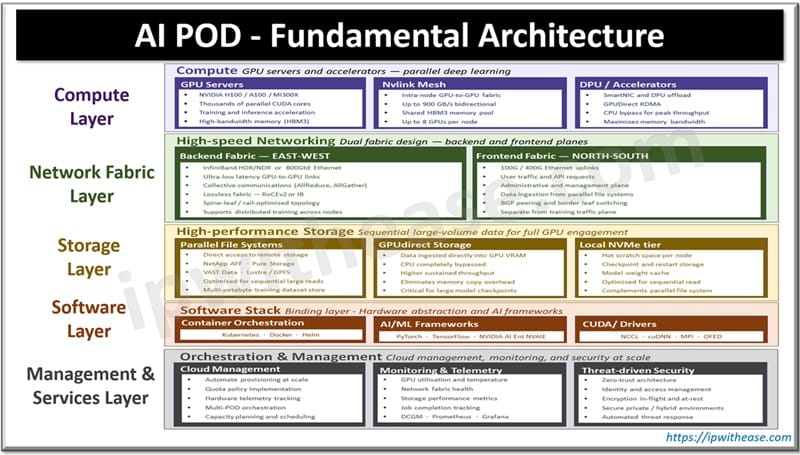
An AI POD is a single piece bundle together all components designed to run and operate artificial intelligence training and inference workloads. The AI PODs operate on a fundamental architecture having a set of components as under.
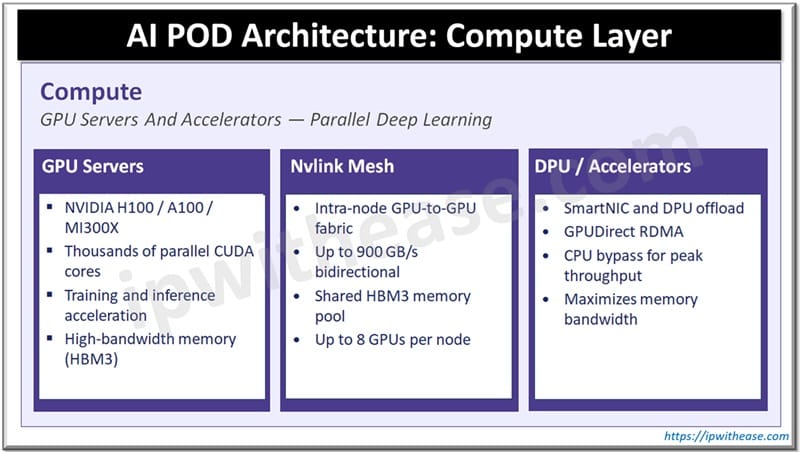
Compute Layer – GPU Servers & Accelerators
Complex mathematical algorithms are used by AI Models for deep learning and that requires specialized hardware with high compute capacities to handle massive processing loads. There are GPUs servers and accelerators which can perform thousands of tasks parallelly and accelerate training and inference workloads.
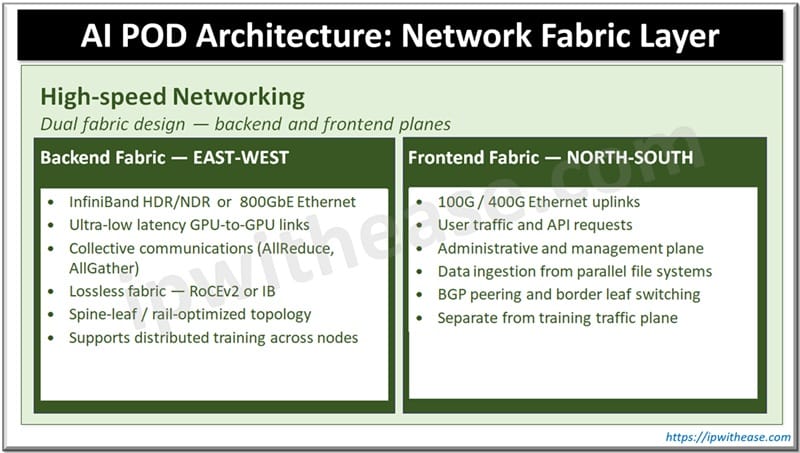
Network Fabric Layer – Dual Fabric Design
AI models process vast amounts of data and need a faster, robust and seamless connection channel between GPUs and servers. AI PODs use dual fabric design – a backend fabric (EAST-WEST) – Infiniband or 800GbE Ethernet switches to ensure ultra-low latencies for GPU-to-GPU sync and data transfers done during AI model training. Frontend fabric (NORTH-SOUTH) is meant to handle user traffic administrative functions and data ingestion directly from storage.
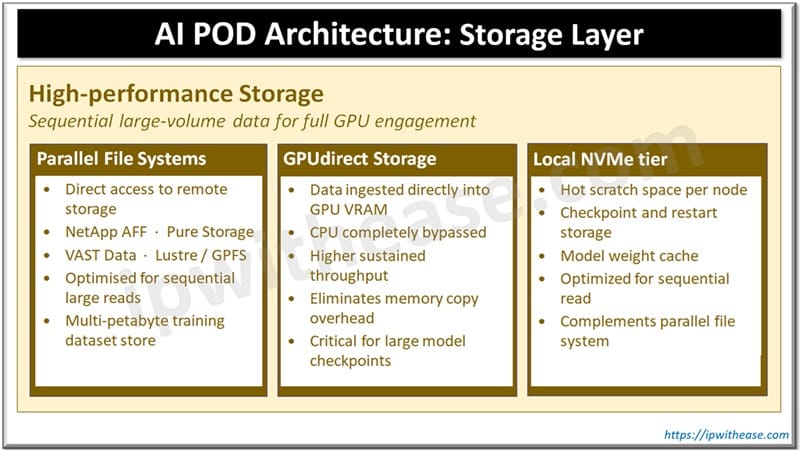
Storage Layer – High Performance Storage
AI model training requires large volumes of data ingestion in sequential manner and AI PODs are ideal candidates for this purpose ensuring full engagement of GPUs and no bottle neck in data receiving. Direct access to remote storage is provided by Parallel file systems some examples are NetAPP AFF, Pure storage and VAST data etc. GPUDirect storage of GDS allows data to be directly ingested into GPU memory by bypassing CPU to improve throughput.
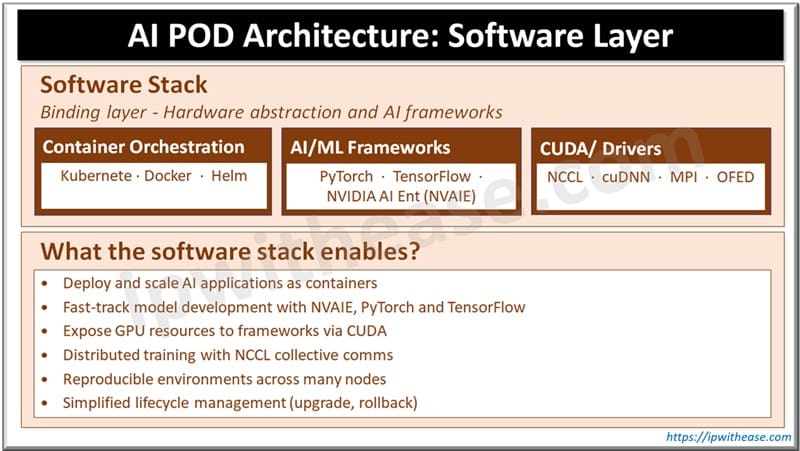
Software Layer – Binding layer
Binding layer for hardware with software. Container orchestration is used to deploy, manage and scale AI applications. AI/ML frameworks fast-track AI model development. Examples NVIDIA AI Enterprise, PyTorch, and TensorFlow.
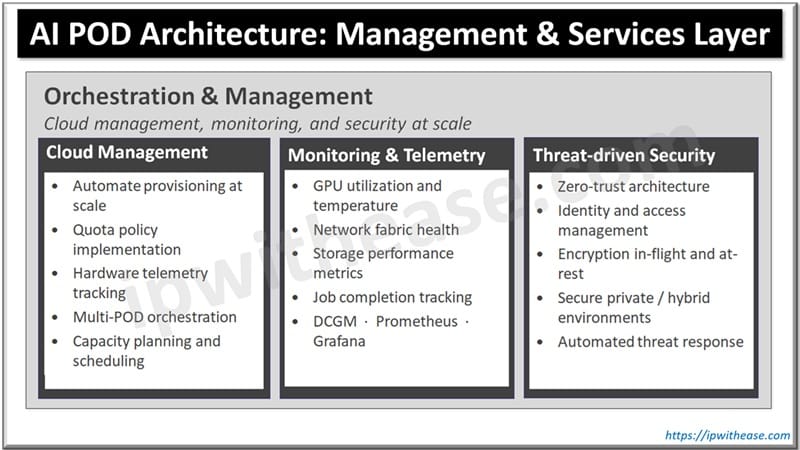
Management & Services Layer – Orchestration & Management
Management of thousands of PODs is achieved with cloud management to automate provisioning, quota policies implementation and tracking hardware telemetry. Monitoring tools and threat driven architecture allows models to scale securely in private and hybrid environments.
AI POD Enterprise Use Cases
- A major financial institution deployed AI PODs to implement fraud detection systems, reduction in losses due to fraudulent transactions by 30% and it is seamlessly integrated with existing infrastructure with minimum disruption.
- A healthcare company using AI PODs for predictive maintenance systems for their medical equipment improve on patient care and reduce un-predictive maintenance on medical equipment. Preventive maintenance is scheduled for a medical device by analyzing data from medical devices and sensors to predict potential device failures.
- A retail enterprise customer used AI PODs for personalized recommendation systems to improve sales by 15%. The AI PODs are used to integrate recommendation systems with their e-commerce system to provide customers tailored suggestions on product purchases based on their web browsing history and purchase pattern.
ABOUT THE AUTHOR

You can learn more about her on her linkedin profile – Rashmi Bhardwaj