Table of Contents
People throw around the phrase “Hugging Face is the GitHub of AI” so often that it’s practically become the platform’s tagline. It’s a useful shorthand, and it’s not wrong exactly — but it also glosses over some real differences that matter if you’re deciding where to host a model, where to version your code, or how to think about the two platforms sitting side by side in your org’s toolchain.
So let’s actually pull them apart.
The comparison people reach for, and why it mostly works
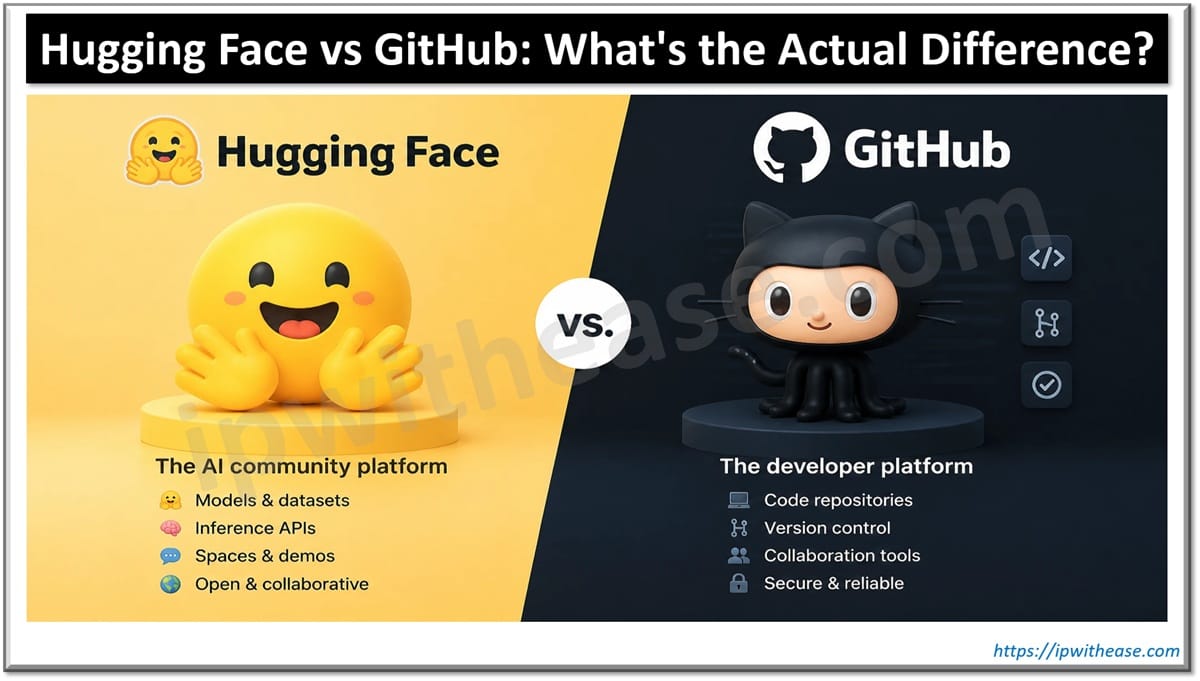
GitHub is where the world keeps its code. Hugging Face is where a huge chunk of the AI world keeps its models. Both are built around version-controlled repositories, both have a social layer of stars, forks, and community contributions, and both have become the default gravitational center for their respective ecosystems. If you’ve used one, the other feels immediately familiar — same mental model, different cargo.
That’s a fair starting point. It’s also where the similarity mostly ends.
Comparison at a glance: Hugging Face vs GitHub
| Parameter | GitHub | Hugging Face |
| Primary purpose | Hosting and collaborating on source code | Hosting and sharing ML models, datasets, and demo apps |
| Core unit | Code repository | Model repo, dataset repo, or Space |
| Underlying tech | Git | Git, plus its own storage layer built for large model weights |
| Typical file size | Small — source files, configs, scripts | Large — often hundreds of MB to hundreds of GB per model |
| Large file handling | Git LFS, added on as a workaround, with its own limits | Built in from the start as a core design requirement |
| Metadata conventions | README, license file — format is up to you | Model cards and dataset cards with standardized fields (intended use, training data, limitations, license) |
| Collaboration tools | Pull requests, issues, branch protection, Actions for CI/CD | Discussions, community pull requests on models, Spaces for live demos |
| Access governance | Mature — orgs, teams, SSO, audit logging | Growing, with enterprise features, but younger in this specific area |
| Typical network footprint | Small — cloning code is cheap | Substantial — pulling model weights can mean serious bandwidth |
| Parent company | Microsoft (since 2018) | NVIDIA (acquisition agreed September 2026, expected to close H1 2027) |
| What it’s genuinely best at | Code review, versioning, and shipping software | Discovering, versioning, and deploying ML models and datasets |
Download the comparison table: Hugging face vs GitHub
What GitHub is actually built for
GitHub is a code hosting platform, full stop. It’s built around Git, the version control system, and everything about it — pull requests, issues, branches, Actions for CI/CD — exists to support the workflow of writing, reviewing, and shipping software collaboratively. It doesn’t care whether your repository holds a web app, a kernel driver, or a machine learning script. Code is code to GitHub, and it’s genuinely excellent at managing it.
It’s also not built to handle large binary files gracefully. Git itself struggles with anything much bigger than a few hundred megabytes, and while GitHub offers Git LFS (Large File Storage) as a workaround, it’s exactly that — a workaround, with its own storage limits and pricing tier. A 40GB set of model weights is not what GitHub was designed to hold, and it shows.
What Hugging Face is actually built for
Hugging Face was built specifically for the opposite problem: hosting the artifacts machine learning work produces, which are frequently enormous. Model weights, tokenizer files, dataset shards — these can run from a few hundred megabytes to hundreds of gigabytes, and Hugging Face’s infrastructure is designed around that reality from the ground up, not bolted on afterward.
It also organizes things differently than GitHub does. Instead of one big repository type, Hugging Face splits things into models, datasets, and Spaces (the demo-app hosting piece), each with its own metadata conventions — model cards, dataset cards, licensing tags, usage examples — that are specific to machine learning work in a way generic code repositories aren’t. A model card tells you the intended use case, training data, and known limitations in a standardized way; a GitHub README does none of that unless someone decides to write it that way themselves.
And Hugging Face repos do use Git underneath the hood, with an extension called Git LFS-like storage of their own, plus a layer specifically for versioning model weights efficiently. So it’s not that the two are unrelated technically — Hugging Face is genuinely built on Git plumbing. It’s that everything above that plumbing was designed around a completely different kind of artifact.
Where the lines blur
Here’s where it gets a little more tangled than the “GitHub for AI” line suggests.
A lot of ML projects live on both platforms simultaneously and for good reason. The training code, the fine-tuning scripts, the inference server — that all tends to live on GitHub, where the code review and CI workflows are mature. The trained model itself, the weights that took days of GPU time to produce, gets pushed to Hugging Face, where it can be pulled down with a couple of lines using the transformers library instead of being cloned as a giant Git repo.
Hugging Face also increasingly does code-adjacent things GitHub is known for. Spaces can host actual running applications, not just static files. Organizations can fork models, open discussions on a model’s page, and submit changes the way you’d open a pull request. The two platforms have been converging toward each other in places, even while their center of gravity stays different.
Why this matters beyond the “which one do I use” question
For anyone on the infrastructure side, the distinction isn’t just academic.
- Access control and governance work differently across the two. GitHub’s permission model — organizations, teams, branch protection rules — is mature and something most enterprises already have wired into SSO and audit logging. Hugging Face has built out enterprise features too, but it’s a younger product in that specific area, and if your org is pulling models directly into production pipelines, it’s worth checking that access governance actually matches what you’d expect from a platform holding code.
- Bandwidth and storage planning look different too. Code repositories are small and git operations are cheap. Model repositories are not — pulling down a large language model’s weights is a meaningfully different network event than cloning a codebase, and if your team is doing that routinely, it belongs in capacity planning conversations the way GitHub traffic usually doesn’t.
- And the supply-chain risk profile isn’t identical. Malicious or compromised packages are a known risk on GitHub (and on package registries that pull from it), but loading a pretrained model from Hugging Face carries its own version of that risk — a model can include code that executes on load, and a poisoned or backdoored model is a different kind of threat than a poisoned npm package, even if the underlying concern (trusting something you didn’t write) is the same.
Worth noting: The two aren’t as separate as they used to be
This distinction is getting blurrier for another reason too — ownership. NVIDIA announced in early September 2026 that it had agreed to acquire Hugging Face for roughly $12.9 billion, a deal expected to close in the first half of 2027, with NVIDIA saying it intends to keep the platform open and hardware-neutral. Meanwhile GitHub has been owned by Microsoft since 2018, and Microsoft has its own deep AI ambitions through OpenAI and Azure AI.
Neither platform is really a neutral, standalone entity anymore — both now sit inside larger companies with a direct stake in how AI infrastructure gets built and where the compute runs. That’s not necessarily a bad thing for either platform’s users, but it’s a reasonable thing to keep in view when you’re deciding how much of your workflow to build around either one.
Final Words
GitHub is where code lives and gets reviewed. Hugging Face is where machine learning artifacts — models, datasets, and the apps built around them — live and get shared. They share a Git-based foundation and increasingly overlap at the edges, but they were built to solve different problems, and treating them as interchangeable is where teams tend to run into friction, whether that’s a model repo clogging up a CI pipeline or a code review workflow trying to make sense of a 20GB binary diff.
Most serious ML shops end up using both, deliberately, for the parts each one actually does well.
Related Video
ABOUT THE AUTHOR

You can learn more about her on her linkedin profile – Rashmi Bhardwaj