Table of Contents
This article focuses on recursive routing (recursive lookup) or recursive next-hop resolution behavior in BGP within enterprise and large-scale routing environments.
This article describes a common network problem where BGP routes appear correct in the BGP table but are missing from the router’s routing table, a situation that is often overlooked or misunderstood. Through practical scenarios, operational behavior analysis, and verification logic, this article explains how recursive next-hop resolution affects BGP route installation and traffic flow in a production environment.
What is Recursive Routing (Recursive lookup)?
Recursive routing is a concept in networking that enables efficient data resolution and packet forwarding. It is used by transitive routers to find the best path to a destination. In this approach, the router performs a lookup via its routing table to get the next-hop IP address and further performs lookup to know the physical interface for reaching the next-hop IP. Such an approach warrants correct routing by resolving dependencies among multiple route entries.
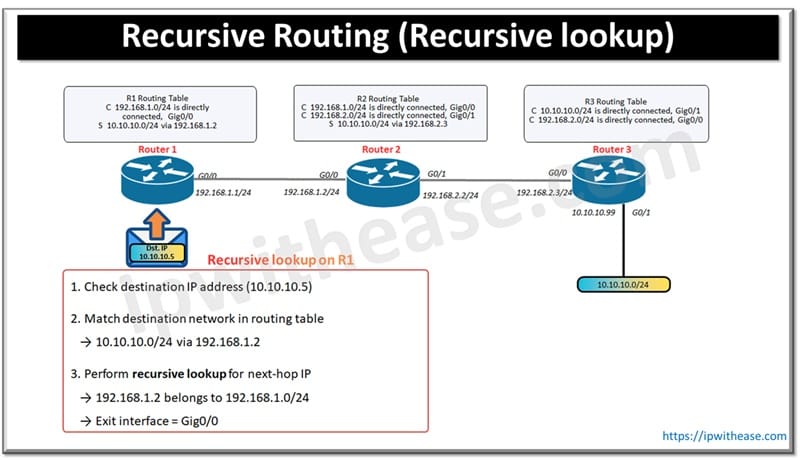
Above diagram illustrates working of recursive routing lookup in a routed network while using three interconnected routers. As per depiction, Router-3is directly connected to the destination network 10.10.10.0/24, while Router-1 doesn’t have any direct connection to the same network. The destination network is learnt by Router-a via a route pointing to its next-hop IP address (192.168.1.2), which belongs to Router-2. When a packet destined for the network 10.10.10.0/24 gets to Router-1, firstly the router checks its routing table to validate a matching destination network.
Once it identifies the route, next step the Router-1 performs is a second route lookup to resolve the next-hop IP address towards the correct outgoing interface. By doing so, it is confirmed that the next-hop IP is reachable through the directly connected network 192.168.1.0/24, therefore making sure that Router-1 can forward the packet via interface Gi0/0. This 2-step process where first destination network is resolved and then the next-hop IP is known as recursive routing lookup. Hence, this the procedural approach on how a packet moves forward on hop-by-hop basis, until the destination network is reached.
How BGP Uses Recursive look up Next-Hop Resolution
In scenario of BGP routing protocol, the route to a destination is advertised along with the next-hop IP address. In order for a router to send traffic to that next-hop IP address, it’s a key ask that it must resolve this next-hop address to a valid route in its IP routing table. The process followed to find the route is BGP recursive lookup.

Stages in BGP Recursive Lookup
BGP Route Advertisement Receival
When a BGP router receives a peer update, the information is about a route to a specific destination in addition to next-hop IP address.
Next-Hop Reachability Validation
Verification of Reachability to the next-hop IP address is required to be performed by the router. In order to achieve this, it performs a recursive lookup to corroborate whether it has the route to the next-hop IP address in the router’s IP routing table.
Recursive Lookup Process
The router performs a lookup of next-hop IP address in its routing table to deduce how to reach it. The approach includes verifying the route to the next-hop address and if that route is reachable.
For reachability to the next-hop IP address, The BGP route/prefix is included in the routing table. In case next hop isn’t reachable, the route is considered invalid and will not be used for routing.
BGP Routing Table Update
Once the recursive lookup validates the next-hop reachability, the BGP route is added to the routing table, henceforth used for routing decisions.
What Is Recursive Routing Failure?
The situation of Recursive routing failure occurs when a BGP route is received, however the router isn’t able to resolve its next-hop address through the routing table. In that case, the route is not Installed in the routing table for traffic forwarding.
This creates a situation where:
- The BGP session is up and stable
- The route is visible in the BGP table
- The route is absent from the routing table
- This is a problematic situation since there is no obvious protocol failure. The control plane appears healthy, but the data plane is affected.
Conceptual View of the Problem

(Figure: Recursive next-hop resolution in BGP. Via BGP, the route is received, however not installed in the routing table due to the reason that the next-hop address cannot be resolved).
Common Causes in Production Networks
Recursive routing failures in BGP networks are rarely caused by the BGP protocol itself. In most cases, they are due to a lack of reachability or a flawed network design.
Missing IGP Reachability
When Loopback interfaces for BGP peering are not advertised into the IGP, this makes next-hop resolution impossible.
Incorrect Next-Hop Handling in iBGP
The fundamental behavior of iBGP is to preserve the next-hop attribute. Till the time the next-hop handling is addressed, the route/prefix cannot be installed in the table.
Static Route Dependencies
Some designs rely on static routes for next-hop reachability. If these routes are missing or removed during maintenance, BGP routes become unusable.
Multi-Hop eBGP Design Issues
For multi-hop eBGP, incorrect routing toward the peer or misaligned TTL settings may also indirectly lead to unresolved next hops.
Impact on Traffic, Services and Applications
The evident impact of recursive routing failure is unpredicted traffic behavior. Based on the type of the network design, traffic may either be dropped or else forwarded via alternate paths.
In scenarios where we have networks with multiple paths, the router may choose a less optimal route, leading to issues like increased latency or asymmetric routing. In case of single-path scenarios, traffic may be blackholed, therefore leading to complete application and service outage.
Because monitoring systems often focus on BGP session health, these issues can persist unnoticed until application teams report problems. This disconnect between control-plane visibility and data-plane reality makes recursive routing failure particularly disruptive in production environments.
Common Misinterpretations During Troubleshooting
Recursive routing failure is frequently misdiagnosed. Engineers may initially assume:
- An application-layer problem
- A firewall or security policy issue
- A performance or capacity bottleneck
These assumptions delay resolution because the underlying issue is not traffic filtering or application behavior, but route usability. Clear comprehension of how BGP rests on on next-hop reachability helps to avoid unnecessary troubleshooting steps.
Troubleshooting Approach
An organized troubleshooting approach is pertinent to quickly identify recursive routing failure.
Key indicators include:
- Routes visible in the BGP table but absent from the routing table
- Stable BGP sessions with no flaps
- Traffic drops or inconsistent reachability
Few of the considerations during the troubleshooting include verifying next-hop reachability, validating the IGP advertisements, and verifying recent network changes. In few of the cases, the issues are immediately resolved when reachability to the next-hop is addressed.
Operational Verification Indicators
Recursive routing failure is most clearly identified not through configuration review, but through verification output. In operational networks, engineers rarely discover this issue while configuring BGP; it is usually detected while validating routing behavior after deployment.
A typical signal is the presence of a BGP-selected best path that does not appear in the forwarding table. This indicates that BGP path selection has completed successfully, but route installation has failed due to unresolved recursion. Another strong indicator is that changes to underlying reachability immediately activate or deactivate BGP routes without any change to BGP configuration itself. This behavior confirms that the failure is dependent on routing resolution rather than BGP policy or session stability.
From a configuration standpoint, this means that resolving recursive routing failure does not require modifying BGP neighbors, timers, or attributes. Instead, the focus must remain on restoring consistent reachability for the next-hop address through the routing table.
This approach is important because it prevents problem like BGP resets, route refreshes, or policy rollbacks during troubleshooting. In a well-refined and optimized network, once next-hop reachability is restored, automatically BGP routes transition to an active state.
Best Practices for Avoiding Recursive Routing Failure
To prevent recursive routing failures in enterprise and service provider networks, the following practices are recommended:
- Ensure all BGP peering loopbacks are reachable via the IGP
- Use consistent routing design principles across the network
- Validate next-hop reachability before deploying BGP policies
- Monitor route installation status, not just BGP session state
- Document routing dependencies between BGP and the IGP
Using the shared practices help to ensure that routing information exchanged by BGP interprets into predictable traffic forwarding behavior.
Key Considerations
BGP route visibility does not guarantee traffic forwarding
- Next-hop reachability is mandatory for route installation
- Recursive routing failure is usually caused by reachability or design issues
- Stable BGP sessions can still result in data-plane traffic loss
ABOUT THE AUTHOR

You can learn more about her on her linkedin profile – Rashmi Bhardwaj