Table of Contents
Introduction
Managing a handful of firewalls with local admin accounts works fine until the team grows, people move on, and nobody is quite sure who still has the root password. Centralised authentication fixes that. With TACACS+, every admin login to the firewall is checked against a central server, privilege levels are controlled in one place, and you get a clear record of who logged in and when.
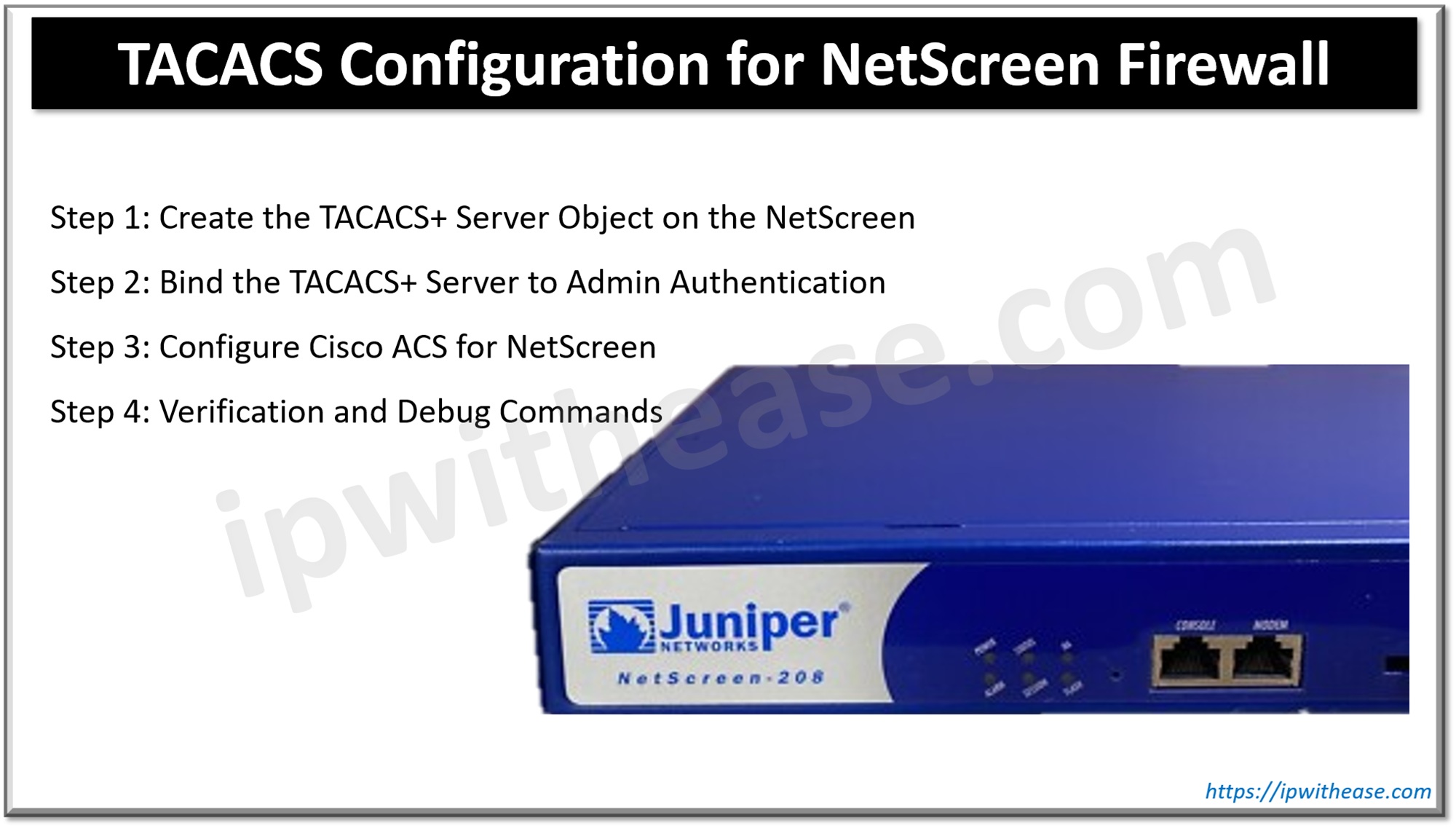
Juniper NetScreen firewalls running ScreenOS can hand off admin authentication to a TACACS+ server such as Cisco ACS. In this post, we walk through the full setup: creating the TACACS+ server object on the firewall, binding it to admin authentication, defining the custom service and attributes on the ACS side, and checking that it all works using the verification and debug commands.
TACACS+ Support in ScreenOS
Beginning with ScreenOS 6.0.0 TACACS+ as an external authentication server for administration purposes is supported.
Step 1: Create the TACACS+ Server Object on the NetScreen
Below is this example scenario of TACACS server object where the TACACS server is called “AUTH“. The CLI commands required for this are as follows:
set auth-server “AUTH” id 1
set auth-server “AUTH” server-name “172.16.0.10”
set auth-server “AUTH” account-type admin
set auth-server “AUTH” type tacacs
set auth-server “AUTH” tacacs secret Screen05
set auth-server “AUTH” tacacs port 49Note:- Here Screen05 is the secret password which will be seen hashed in config file.
Step 2: Bind the TACACS+ Server to Admin Authentication
The AUTH server will be configured as admin auth server as below –
set admin auth server “AUTH”
set admin auth remote root
set admin privilege get-external
Step 3: Configure Cisco ACS for NetScreen
On the ACS server web interface via the ACS Admin application, following steps need to be followed –
1.Click Interface Configuration, and select TACACS+ (Cisco IOS)
2.Add a new service called “netscreen”, and leave the protocol field blank
3.Check both the user and group check box.
4.Click Submit
On the user configuration, scroll down to the bottom and select the netscreen (case sensitive) Custom attributes check boxes. Specify the attributes in the custom attributes field. The attributes that can be specified are as follows:

Related – TACACS VS TACACS+
Limitations of TACACS+ on ScreenOS
TACACS+ is not supported for use as an authentication server for xauth or policy authentication.
Verification and Debug Commands
The verification and debug commands are –
-> get admin auth
-> get admin user login
debug admin all
debug auth all
FAQs
Q.1 Which ScreenOS version supports TACACS+ for admin authentication?
TACACS+ support for administrative logins was added in ScreenOS 6.0.0. If your NetScreen is on an older release, you will need to upgrade first or use RADIUS or local accounts instead.
Q.2 Can TACACS+ be used to authenticate VPN or firewall policy users on ScreenOS?
No. On ScreenOS, TACACS+ is only supported for administrator logins. For XAuth (remote access VPN users) or policy-based user authentication, use RADIUS, LDAP, SecurID or the local user database.
Q.3 What port does TACACS+ use, and does it need to be opened?
TACACS+ runs over TCP port 49, which is why the configuration sets tacacs port 49. Make sure any firewall or ACL between the NetScreen and the ACS server permits TCP 49 in both directions, and that the ACS server has the firewall added as a AAA client with the same shared secret.
Q.4 Why is the shared secret shown hashed in the configuration?
ScreenOS stores the secret in an encrypted form so it does not appear in plain text when someone runs get config or saves a backup. The value still has to match exactly what is configured for this device on the ACS server, otherwise authentication will fail silently.
Q.5 What does set admin privilege get-external do?
It tells the firewall to take the admin’s privilege level from the TACACS+ server rather than assigning it locally. That way, whether someone gets root, read-write or read-only access is decided by the attributes you set in ACS, which keeps role control in one place.
Q.6 Why does the service name “netscreen” have to match exactly?
The firewall looks for attributes under that specific service name, and the match is case sensitive. If the service is created as “NetScreen” or “Netscreen” on ACS, the firewall will not read the attributes and the user may be denied access or given the wrong privilege level.
Q.7 What happens if the TACACS+ server goes down?
Plan for this before rolling out to production. Keep the local root admin account with a strong password stored securely, and test console access, so you can still get into the box if the ACS server or the path to it fails.
Q.8 How can I troubleshoot a failed TACACS+ login?
Start with get admin auth to confirm the right server is bound, then use debug auth all and debug admin all while attempting a login to see the exchange with the server. On the ACS side, check the failed attempts report, as it usually tells you straight away whether the problem is a wrong secret, an unknown user or a missing service attribute. Remember to turn debugs off with undebug all once you are done.
Final Words
Moving NetScreen admin logins to TACACS+ is a small change with a big payoff. You stop sharing local passwords, privilege levels sit in one central policy, and every login is tied to a named user. The configuration itself is short: define the server object, bind it to admin authentication, let the server decide privileges, and set up the “netscreen” service and attributes on ACS.
The details that usually trip people up are the case-sensitive service name, a mismatched shared secret and TCP 49 being blocked somewhere in the path, so check those first if logins fail. And while ScreenOS is now a legacy platform, many networks still run it, and the same centralised AAA approach carries over directly when you migrate to SRX or any other modern firewall.
ABOUT THE AUTHOR

You can learn more about her on her linkedin profile – Rashmi Bhardwaj