Table of Contents
Factories are becoming increasingly networked due to automation, remote monitoring, industrial Internet of Things (IoT), cloud computing, and converged IT-OT networks. Despite their benefits in terms of efficiency and visibility, these systems can also introduce cybersecurity risks.
Traditional enterprise security solutions may not always be sufficient for operational technology environments. OT systems often include legacy equipment, specialized protocols, continuously running processes, and devices that cannot be easily updated or replaced.
Specialized security solutions can help organizations address these challenges by providing capabilities for monitoring, access control, network protection, threat detection, and asset management while supporting the operational requirements of industrial environments.
What Are OT Security Tools?
OT Security Tools are defined as the technologies which assist companies in recognizing, monitoring, securing and managing cybersecurity threats in an OT environment.
They may be used for securing ICS, SCADA systems, PLCs, HMIs, sensors, industrial networks, etc. The area of concern of such solutions can vary depending on the company needs from the area of visibility to network traffic analysis, vulnerability management, secure access, threat detection and incident response.
Instead of using one tool companies apply several solutions creating layers of protection for their industrial environment.
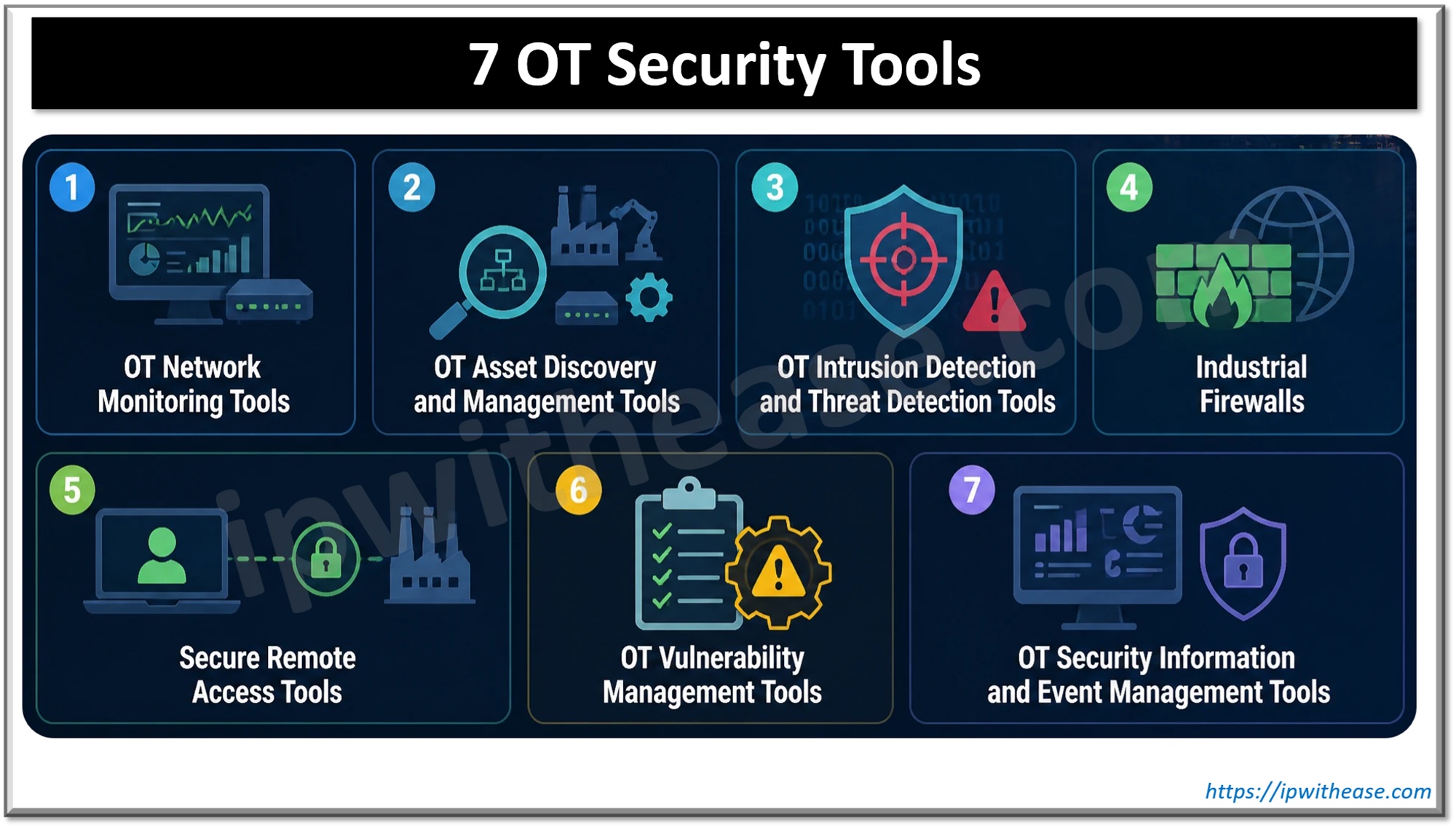
Best 7 OT Security Tools For Industrial Cybersecurity
1. OT Network Monitoring Tools
OT security tools for industrial cybersecurity can provide visibility into communication across industrial environments, helping organizations understand which devices are connected, how systems communicate, and what normal network activity looks like.
These tools can monitor industrial traffic and identify unusual communication patterns that may require investigation.
Key capabilities include:
- Industrial network visibility
- Traffic monitoring
- Device communication analysis
- Protocol awareness
- Anomaly identification
Network monitoring is particularly valuable in complex environments where organizations may not have complete visibility into all connected OT assets.
2. OT Asset Discovery and Management Tools
Knowing what exists within an industrial network is an important part of cybersecurity. Asset discovery tools help organizations identify connected devices and build an inventory of OT assets.
These tools can provide information about industrial controllers, servers, workstations, network devices, and other equipment. Some solutions can also help identify device types, operating systems, communication relationships, and other asset details.
Key capabilities include:
- Automated asset discovery
- Device identification
- Asset inventory
- Network relationship mapping
- Asset classification
Better asset visibility can help organizations identify unknown devices, understand their network environment, and prioritize security efforts.
3. OT Intrusion Detection and Threat Detection Tools
Intrusion detection systems are used for detecting unusual behavior in an industrial network environment. This type of software analyzes the activity on the network or computer to identify unusual behavior that may show signs of any security violation.
Detection systems focused on OT can be designed in a way that recognizes industrial communication protocols and behavior.
Key capabilities include:
- Threat detection
- Anomaly detection
- Industrial protocol analysis
- Suspicious activity alerts
- Security event monitoring
These capabilities can help organizations investigate potential threats before they create a larger operational impact.
4. Industrial Firewalls
Industrial firewalls provide controlled boundaries between different network segments. They inspect and filter traffic based on defined security policies and can help restrict unnecessary communication.
Unlike standard enterprise firewalls, industrial firewall solutions may be designed to operate within environments that use specialized industrial protocols and equipment.
Key capabilities include:
- Traffic filtering
- Network segmentation
- Access control
- Industrial protocol filtering
- Secure network boundaries
Industrial firewalls can be positioned between IT and OT environments or between different OT network zones to reduce unnecessary exposure.
5. Secure Remote Access Tools
Remote access becomes more relevant in modern industry for performing maintenance, troubleshooting, monitoring, and support activities. Nevertheless, unmanaged remote access is another risk for organizations.
Secure remote access tools will allow the company to manage and control remote access to the OT environment. Authentication, authorization, session management, and other features can be provided by such tools.
Key capabilities include:
- Controlled remote access
- Strong authentication
- User authorization
- Session monitoring
- Time-based or role-based access
These tools allow organizations to support legitimate remote operations while maintaining greater control over access to critical systems.
6. OT Vulnerability Management Tools
Vulnerability management tools help organizations identify security weaknesses across industrial assets and determine which issues may require attention.
OT environments can present unique challenges because conventional vulnerability scanning may not always be appropriate for sensitive industrial systems. Aggressive scanning or unplanned changes can potentially affect system availability.
OT-focused vulnerability management approaches can help organizations assess risks while considering the operational characteristics of industrial environments.
Key capabilities include:
- Vulnerability identification
- Risk assessment
- Asset prioritization
- Configuration analysis
- Remediation tracking
Organizations can use these capabilities to prioritize security improvements based on asset importance and potential operational impact.
7. OT Security Information and Event Management Tools
Security Information and Event Management (SIEM) tools can collect and analyze security data from multiple systems. When integrated with OT environments, they can help security teams bring industrial security events into a broader monitoring and response process.
Combining OT data with information from IT systems can provide a more complete view of security activity across an organization’s infrastructure.
Key capabilities include:
- Centralized event collection
- Security alert correlation
- Log analysis
- Incident investigation
- Security reporting
This broader visibility can help organizations coordinate IT and OT security operations more effectively.
Key Factors to Evaluate Before Selecting OT Security Tools
The choice of OT security tools requires an evaluation of their effectiveness in dealing with industrial security needs and integration into operations. There are various things that businesses need to consider when choosing solutions.
Support for Industrial Equipment and Protocols
Organizations need to ensure that the solutions for security are compatible with the infrastructure that exists in their industrial sites.
Effect on Production Operations
The security controls should help mitigate cyber threats without impacting the critical industrial process operations. Companies need to check how well these controls work in practical situations and whether their implementation will impact system availability or production continuity.
Asset and Network Visibility
The right solution must give adequate insights into the interconnectivity of industrial devices, network activities, and interaction among various systems. The above information enables security officers to detect loopholes in security that may need more protection.
Compatibility With Existing Security Infrastructure
OT security tools need to be able to work alongside other security tools already in use by the organization. Good integration could allow for information exchange between systems, make monitoring easier, and provide better threat response capabilities.
Flexibility for Future Expansion
As the industry grows, the organization might include new facilities, devices, and monitoring systems. The security system needs to be able to adapt to the changes made without needing any modifications to the current system.
Deployment and Ongoing Maintenance
Firms need to evaluate what is required for the installation, configuration, operation, and maintenance of each solution. Technologies that complement the existing technical skills and maintenance procedures may ease the task of security management.
Accuracy of Threat Notifications
Security personnel require alerts to be raised for any suspicious actions but not inundated with alerts when there is no need. Evaluation of the efficiency of detection and alert prioritization will assist in identifying real threats rather than wasting time on normal industrial activities.
Conclusion
OT security solutions provide great value to industrial enterprises that need to cope with the cybersecurity problems associated with increased connectivity in their operations. Whether it is the discovery of assets and monitoring of networks, industrial firewalls, threat detection, vulnerabilities management, or centralized event analysis, each of these solutions can be used to solve a certain aspect of the problem. The decision of which solutions to use should be based on current OT infrastructure, business needs, security considerations, and connectivity plans for the future.
FAQs
1. What are OT security tools?
OT security tools are technologies designed to protect operational technology environments by providing capabilities such as asset discovery, network monitoring, access control, threat detection, vulnerability management, and security event analysis.
2. Why are specialized OT security tools needed?
OT environments often include legacy systems, specialized protocols, connected industrial equipment, and continuous operations. Specialized tools can address these characteristics while supporting operational requirements.
3. What is the role of an industrial firewall?
An industrial firewall controls network traffic between different environments or segments. It can help restrict unauthorized communication and establish security boundaries around critical OT systems.
4. Can businesses use multiple OT security tools together?
Yes. Organizations can combine different tools to provide layered protection. Asset visibility, network monitoring, segmentation, threat detection, secure remote access, and centralized security monitoring can work together as part of a broader OT security strategy.
ABOUT THE AUTHOR

IPwithease is aimed at sharing knowledge across varied domains like Network, Security, Virtualization, Software, Wireless, etc.