Table of Contents
Network issues rarely show up with a neat explanation attached. A sales team says the video call froze three times. A warehouse scanner disconnects twice before lunch. Someone in the corner conference room swears the Wi-Fi is worse on Mondays. Meanwhile, the dashboard looks calm enough. The access point is online. The switch is not throwing errors. Nothing is obviously broken.
And still, people cannot work the way they should.
That is the part of networking that burns time. Not every problem is a dramatic outage. More often, it is a trail of small complaints that point in five different directions. The network is technically running, but the experience feels uneven.
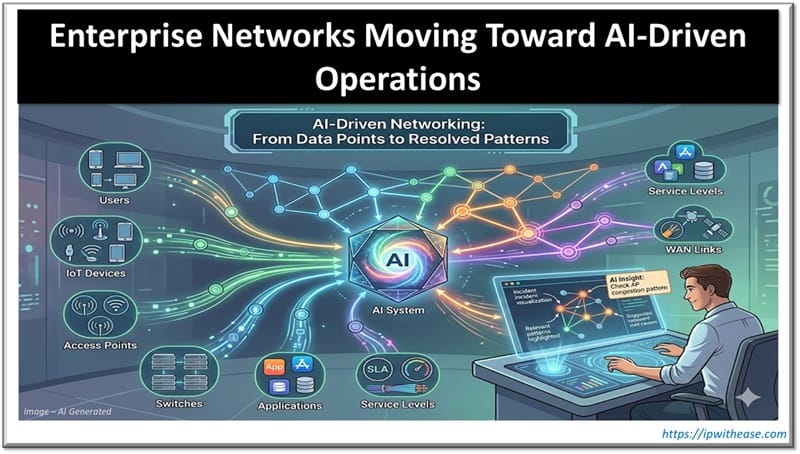
Enterprise networks now carry nearly everything a business depends on: laptops, phones, cloud apps, guest access, IoT devices, cameras, point-of-sale tools, collaboration platforms, security policies, and users moving between offices, homes, branches, and campuses. When something slows down, the cause could be wireless. Or switching. Or WAN. Or DNS. Or DHCP. Or authentication. Or a SaaS app having a bad day. Or a laptop that has not been updated since everyone stopped asking politely.
This is why AI-native networking is getting serious attention. Not because the label is shiny, but because the old manual approach is getting harder to defend at scale.
Juniper Mist fits into that shift. Its real value is not some fantasy where AI runs the network while everyone takes an early lunch. The better, more believable promise is this: help IT teams see user experience more clearly, find patterns faster, and spend less time proving where the problem is not.
What AI-Driven Networking Really Means for Enterprise Networks
Let’s get one thing out of the way: AI-driven networking can sound like marketing filler. Sometimes it is.
But when the term is used properly, it points to a real change in how networks are managed. The network is no longer treated as a collection of devices that are simply up or down. It is treated as a living service that has to support real users, real applications, and real business activity.
A traditional monitoring tool might tell you an access point is online. Useful? Yes. Complete? Not even close.
Users may still be struggling with slow authentication, sticky roaming, weak signal quality, odd device behavior, WAN delay, or application issues that look like network problems from the user’s side. On paper, everything can look healthy while the actual experience is anything but.
AI-driven networking tries to connect those scattered clues. It pulls telemetry from users, devices, access points, switches, applications, service levels, and WAN links. Then it looks for patterns a person could find eventually, but not always quickly. The point is not to replace an engineer’s judgment. The point is to stop making engineers start every investigation from a blank page.
A better operations model asks sharper questions:
- Did the client connect, or did it fail during authentication?
- Is this really wireless, or is the wired side involved?
- Are users roaming poorly between access points?
- Is the problem tied to one site, one app, or one device type?
- Did the issue begin after a configuration change?
This is where AI-driven networking with Juniper Mist becomes more than a phrase on a product sheet. It gives teams a way to link visibility, assurance, and troubleshooting so every ticket does not become a brand-new detective story.
Why Juniper Mist Keeps Coming Up
Juniper Mist gets mentioned often because it focuses on experience-first operations. That phrase can sound polished, but the idea behind it is simple.
Knowing that equipment is online is not the same as knowing that users are having a good day on the network.
A switch can be up. An access point can be reachable. Traffic can pass. Still, someone may be retrying a login, dropping from a Teams call, or waiting too long for a cloud app to respond. Anyone who has worked near an IT queue has seen this gap.
Juniper Mist is built to narrow it.
The platform brings together cloud-native management, machine learning, automation, and assurance across wireless, wired, and WAN environments. Instead of treating every alert as equal, Mist AI is designed to help teams understand which issues are actually affecting experience and where the likely cause sits.
For organizations updating network operations, AI-driven networking with Juniper Mist gives IT teams a cleaner way to improve visibility, reduce manual troubleshooting, and support users across multiple locations.
That matters more once a company has branch offices, hybrid workers, IoT devices, guest networks, and cloud applications in the same environment. At that point, “check the logs and walk the floor” starts to feel like a strategy from a smaller era.
Marvis Gives Engineers a Better First Read
One of the more useful parts of Juniper Mist is Marvis, the virtual network assistant.
The important thing about Marvis is not that it makes engineers unnecessary. That would be a bad reading of what these tools are good for. Good engineers still matter, especially when the fix involves architecture, security, or judgment.
What Marvis can do is give them a better first read.
Think about a typical help desk note: “Wi-Fi is slow in the east wing.” That could mean almost anything.
Maybe the client is clinging to the wrong access point. Maybe authentication is dragging. Maybe the signal is weak near one row of rooms. Maybe the switch uplink is involved. Maybe DNS is slow, and everyone calls it Wi-Fi because that is the part they can name.
Marvis helps narrow the list by using data already inside the Mist environment. It can point teams toward likely causes, show where the user experience is breaking down, and reduce the usual tool-hopping that happens during messy troubleshooting.
That is not flashy. It is useful. There is a difference, and network teams usually care more about the second one.
Assurance Is More Useful Than Another Wall of Charts
Most IT teams are not short on dashboards. They are short on answers.
That is why assurance matters in the Juniper Mist approach. Assurance changes the question from “Is the device alive?” to “Is the service working well for the user?”
Small wording change. Big operational difference.
Juniper Mist applies assurance across Wi-Fi, wired switching, and WAN environments. In practice, that means teams can look at connection success, roaming behavior, authentication timing, service levels, and other experience signals instead of relying only on device health.
Uptime still matters. Of course it does. But uptime can hide a lot.
A school can have access points online while students struggle in a lecture hall. A clinic can have network gear running while staff deal with unreliable device access. A retail store can avoid a formal outage and still have point-of-sale performance that annoys both customers and employees.
That is why AI-driven networking with Juniper Mist often gets framed around user experience. It is less about admiring the infrastructure and more about knowing whether the network is doing the job people need it to do.
The Day-to-Day Payoff for IT Teams
The strongest case for AI-driven networking is not futuristic. It is almost boring, which is exactly why it matters.
It helps with the daily grind.
A team that can identify root causes faster spends less time comparing logs. A team with better service-level data has cleaner conversations with leadership. A team that can troubleshoot a branch remotely avoids sending someone onsite for every awkward issue. A team that catches recurring patterns early has fewer surprise ticket floods.
That is where the business value becomes easier to explain.
- Mean time to resolution improves because engineers are not starting from a blank page.
- Operational overhead drops because fewer hours get burned on repetitive investigation.
- Network reliability improves because small patterns are easier to catch before they become bigger problems.
- Scalability becomes more realistic because cloud-native tools help teams manage more sites with more consistency.
And users, who usually do not care which platform runs the network, simply hit fewer interruptions. That is the part people outside IT actually notice.
When implemented with good planning, AI-driven networking with Juniper Mist can help teams move away from constant reaction and toward more deliberate improvement.
Where Juniper Mist Makes the Most Sense
Juniper Mist can fit many environments, but it is especially useful where connectivity is tied directly to daily work.
On a large campus, the network has to support classrooms, offices, residence halls, libraries, outdoor areas, and events. People move constantly. Device types vary. Expectations are high. Bad Wi-Fi is no longer treated as a small inconvenience.
In healthcare, reliable connectivity supports clinical workflows, connected devices, staff communication, and access to important systems. Even small connection problems can create pressure because the work is time-sensitive.
In retail, the network touches point-of-sale terminals, inventory systems, cameras, guest Wi-Fi, signage, and employee devices. A network issue can become a customer experience issue very quickly.
For companies with many branches, the challenge is different. There may not be a network engineer onsite. Central IT needs enough visibility to troubleshoot from a distance without guessing or sending someone out too often.
These are the environments where AI-assisted operations stop sounding like a nice extra and start looking practical.
Self-Driving Networks Are Coming, But Carefully
The networking industry likes the phrase self-driving network. It is catchy, but it needs grounding.
A self-driving network is not a magic button. It is a gradual move toward systems that observe, analyze, recommend, and eventually automate more routine fixes.
The order matters. First, teams need clean visibility. Then they need enough data to trust the patterns. Then recommendations become useful. Only after that should certain actions be automated, and even then, with controls.
Human judgment is still part of the job. Security, compliance, architecture, change control, and risk decisions should not be handed over blindly. The goal is not to remove IT from the process. The goal is to remove unnecessary guesswork from IT’s day.
Juniper Mist fits this direction because it combines AI-powered troubleshooting, assurance, automation, Marvis, and proactive insights. It gives teams a path toward smarter operations without pretending every network decision should be automatic.
That is a more believable promise, and a more useful one.
Building a Smarter, More Reliable Network Starts with Better Operations
Enterprise networks are too important to manage only through reactive support. Users expect the connection to work. Applications need steady performance. Security expectations keep rising. IT teams are asked to support more systems, more sites, and more devices without getting much more time in the day.
That pressure is why AI-driven networking is becoming part of serious network modernization conversations.
By combining cloud-native management, machine learning, automation, assurance, and intelligent troubleshooting, AI-driven networking with Juniper Mist gives organizations a better way to understand and improve the network experience.
The real benefit is not that the network becomes futuristic. It is that teams get clearer answers, users experience fewer disruptions, and the business spends less time dealing with preventable connectivity problems.
For companies planning a refresh or trying to support distributed infrastructure more effectively, that is the real opportunity: build a network that helps IT get ahead of issues instead of always catching up.
ABOUT THE AUTHOR

IPwithease is aimed at sharing knowledge across varied domains like Network, Security, Virtualization, Software, Wireless, etc.