Table of Contents
The way we handle money has changed so fast that it’s actually hard to keep up. Not long ago, banking meant driving to a physical building, waiting in a long line, and talking to someone behind a glass window. Today, most of us manage our whole financial lives from a device that fits in our pocket. It’s convenient, sure, but it also brings up a very natural question. Is online banking actually safe?
When you can’t see the vault or the person holding your money, it’s easy to feel a little uneasy. We hear about data breaches and identity theft in the news all the time. However, the reality is that digital banking is often more secure than the old paper-based methods we used to trust. Banks invest billions of dollars into security just to keep your assets protected. To feel confident, you just need to understand how the systems work and what your role is in the whole process.
Understanding the Nuances of Online Banking
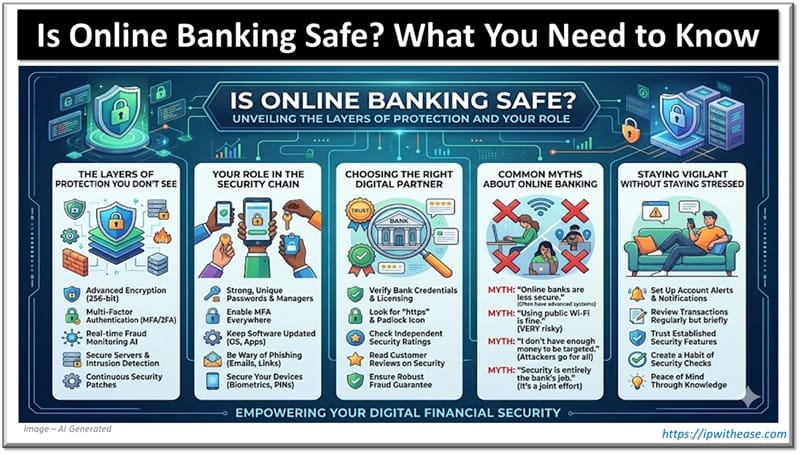
The Layers of Protection You Don’t See
Most people think of a password as their only line of defense, but it’s really just the front door. Behind that door, financial institutions use sophisticated encryption. This technology turns your personal info into a complex code that’s nearly impossible for hackers to read. Even if someone intercepted the data, they’d see nothing but scrambled characters.
Another major layer is multi-factor authentication. You probably know this as the code sent to your phone or email when you try to log in. This simple step is one of the most effective ways to stop unauthorized access. Even if a bad actor manages to guess or steal your password, they can’t get into your account without that physical device in your hand. It adds a physical barrier to a digital world.
Beyond encryption and logins, banks use continuous monitoring. They have systems that look for unusual patterns. If you live in New York and suddenly someone tries to buy a high-priced watch in a different country, the bank will likely flag it and freeze the transaction immediately. This proactive approach catches fraud before it even settles.
Your Role in the Security Chain
While banks do the heavy lifting, the security of your money also depends on your own digital habits. The weakest link in any security system is usually the human element. Using the same password for your bank account as you do for your social media is a big risk. If one site gets hacked, they have the keys to everything else you own.
Public Wi-Fi is another common trap. Logging into your bank while sitting at a coffee shop might seem harmless, but these networks are often unsecured. It’s much safer to wait until you’re on a private, password-protected network at home or just use your mobile data.
Choosing the Right Digital Partner
Safety isn’t just about stopping hackers. It’s also about the stability and reputation of the institution you choose. You want to make sure your money is held by an entity that’s insured. This means that even if the institution faced a crisis, your deposits would be protected up to certain limits by the government.
Many people are moving toward digital-first options because they offer better rates and modern tools. For example, a SoFi high-yield savings account provides the benefit of high interest alongside robust digital security features. When you combine smart tech with traditional protections, you get the best of both worlds.
Common Myths About Online Banking
There’s a misconception that physical banks are safer because you can go there and talk to someone. But paper checks are actually quite easy to forge or steal from a mailbox. Physical bank statements can be taken from your trash. Digital records, on the other hand, don’t leave a physical trail for neighbors or strangers to find.
Another myth is that if your money is stolen online, it’s gone forever. Most reputable financial institutions have a zero-liability policy for unauthorized transactions. As long as you report the suspicious activity quickly, you’re generally not held responsible for the loss. This peace of mind is a standard part of the modern banking experience.
Staying Vigilant Without Staying Stressed
You don’t need to be a tech expert to stay safe. It really comes down to a few basic rules. Update your banking app whenever a new version is released because those updates often include security patches. Check your accounts regularly just to make sure everything looks right. Enable alerts so you get a notification every time a withdrawal is made.
The shift to digital isn’t something to fear. It’s a tool that gives you more control over your financial health than ever before. By understanding the risks and using the tools available, you can enjoy the convenience of modern banking without looking over your shoulder.
ABOUT THE AUTHOR

IPwithease is aimed at sharing knowledge across varied domains like Network, Security, Virtualization, Software, Wireless, etc.