Table of Contents
Software development has always evolved – from punch cards to IDEs, from waterfall to agile, from monoliths to microservices. But nothing has compressed that evolution quite like artificial intelligence. In 2026, AI is no longer a tool developers experiment with. It is the backbone of how software gets built, tested, secured, and shipped.
This post breaks down exactly how AI is Reshaping software development in 2026 – the real changes happening on the ground, backed by data, and what it means for developers and IT professionals alike.
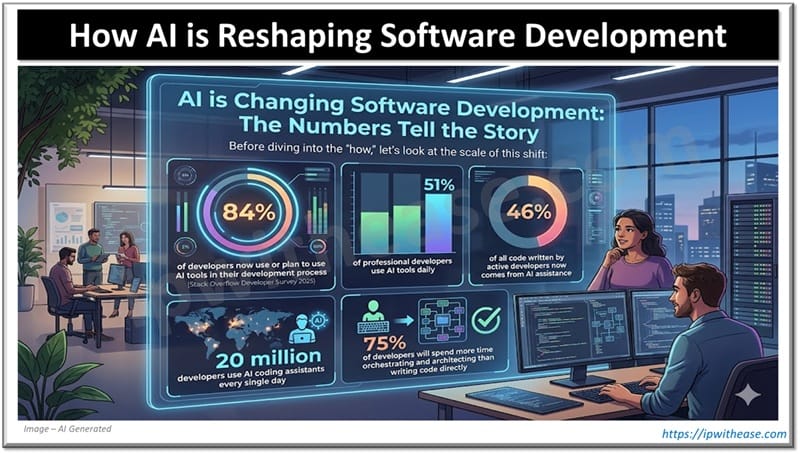
AI is Reshaping Software Development: The Numbers Tell the Story
Before diving into the “how,” let’s look at the scale of this shift:
- 84% of developers now use or plan to use AI tools in their development process (Stack Overflow Developer Survey 2025)
- 51% of professional developers use AI tools daily
- 46% of all code written by active developers now comes from AI assistance
- 20 million developers use AI coding assistants every single day
- 75% of developers will spend more time orchestrating and architecting than writing code directly, as per Gartner
These are not marginal changes. This is a structural transformation of the profession.
Related: How AI Is Disrupting the IT Job Market
From Copilots to Agents: The Biggest Shift in Developer Workflows
If 2024 was the year of AI copilots, tools that suggest the next line of code. 2026 is the year of AI agents.
The difference is significant. A copilot writes a function when asked. An agent refactors an entire module, writes tests, runs them, fixes failures, and opens a pull request autonomously. The developer reviews outcomes, not every individual input.
Gartner reported a staggering 1,445% surge in multi-agent system inquiries between Q1 2024 and Q2 2025. Organizations are building systems where multiple specialized agents coordinate: one handles code generation, another runs tests, a third manages deployment pipelines.
Anthropic’s 2026 Agentic Coding Trends Report documents this shift clearly: average coding agent session length grew from 4 minutes to 23 minutes between Q1 2025 and Q1 2026. The average session now involves 47 tool calls, meaning the agent is reading files, writing code, running commands, and iterating autonomously across dozens of steps.
What this means for developers: The role is shifting from writing code to directing agents, validating results, and making strategic decisions.
AI-Powered Coding Assistants Are Now Standard Equipment
Tools like GitHub Copilot, Claude Code, Cursor, Amazon Q Developer, and JetBrains Junie have moved from novelty to necessity. Context windows have expanded dramatically. Where early tools worked with a few thousand tokens, leading tools now operate with 200,000 to over 1 million tokens. This means an AI assistant can simultaneously consider an entire microservice, its API contracts, database schemas, and test infrastructure when writing a single function.
The productivity gains are real and measurable. Many businesses work with a software development company to implement AI-driven development practices.
- Developers save an average of 3.6 hours per week using AI coding tools
- McKinsey found 33–36% reductions in code-related time at scale in enterprise settings
- Companies like TELUS delivered code 30% faster and saved over 500,000 hours using AI coding tools
- Rakuten used an AI coding tool to add a feature to a 12.5 million line codebase in just seven hours with 99.9% accuracy
However, trust remains a nuanced issue. Only 29% of developers say they fully trust AI-generated code outputs – down from 40% in 2024. The tools are faster, but human review is still essential.
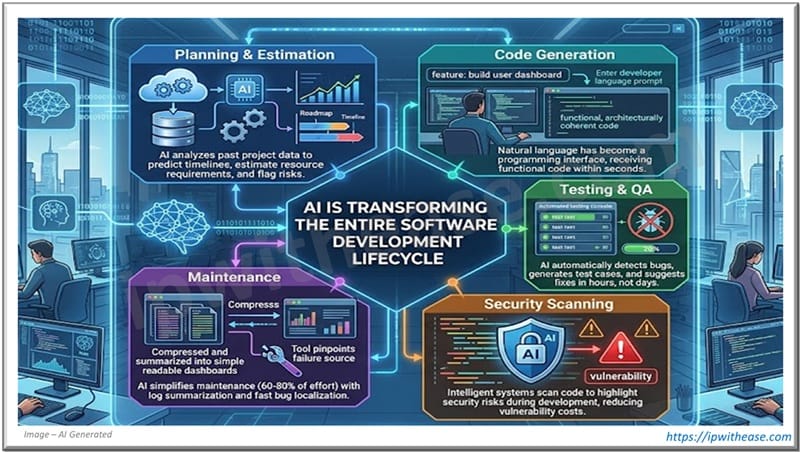
AI is Transforming the Entire Software Development Lifecycle
AI’s impact is not limited to code generation. It is embedded across every phase of the SDLC:
Planning & Estimation
AI analyzes past project data to predict timelines, estimate resource requirements, and flag risks before they become problems. Teams spend less time guessing and more time building.
Code Generation
Developers can now describe a feature in plain English and receive functional, architecturally coherent code within seconds. Natural language has become a legitimate programming interface. For example, a full-stack ai app builder helps users build production ready web applications in quickly.
Testing & QA
AI tools automatically detect bugs, generate test cases from specifications, and suggest fixes. Automated testing that once required days of manual effort can now be completed in hours. This has helped teams release products faster without compromising quality.
Security Scanning
Secure coding practices are now integrated directly into AI-powered workflows. Intelligent systems scan code automatically, highlighting security risks during development rather than after deployment. This proactive approach is significantly reducing the cost of fixing vulnerabilities.
Maintenance
Maintenance accounts for 60–80% of total engineering effort over a product’s lifetime. AI is making early inroads here too, log summarization tools turn walls of error output into readable narratives, and bug localization tools pinpoint failure sources faster than any manual investigation.
The Developer Role is Being Redefined
Perhaps the most significant and debated change is what AI means for the developer’s role itself.
According to the World Economic Forum, 65% of developers expect their role to be redefined in 2026, moving from routine coding toward architecture, integration, and AI-enabled decision-making. Four in ten developers said AI had already expanded their career opportunities as of 2025.
The picture that emerges is nuanced:
- Junior developers who write routine code face structural displacement. Junior developer demand has fallen approximately 40% in companies that have seriously deployed AI tools.
- Senior engineers who design AI-augmented systems, validate agent behavior, and own production reliability are entering a golden era. AI/ML engineer salaries have risen to an average of $206,000 — up $50,000 in a single year.
- New roles are emerging: AI Automation Engineer, AI Agent Developer, Prompt Engineer, MLOps Engineer, and Forward Deployed Engineer are among the fastest-growing titles in tech.
The developers who thrive will be those who treat AI as a powerful collaborator — fast and knowledgeable, but still in need of direction and oversight.
AI-Driven Security in Software Development
As digital threats evolve, AI is becoming a critical defense layer in software development. AI-driven security tools can monitor systems continuously, detect suspicious behavior, and respond to threats faster than traditional methods.
Rather than waiting for a breach, AI helps organizations identify vulnerabilities before they become serious problems, a proactive approach that is strengthening customer trust and helping companies maintain compliance with modern data protection standards.
With 50% of governments expected to enforce AI-in-software regulations by 2026, security and governance are now inseparable from the development process itself. Organizations that build AI governance frameworks now will have a significant advantage.
The Spec-Driven Development Model
One of the most interesting emerging patterns in 2026 is spec-driven development. Rather than writing code directly, developers write detailed specifications and agents implement them.
Cisco has adopted this approach, reducing an eight-person team to three people supported by five digital agents, while tripling output. By the end of 2026, Cisco aims to have six products built entirely with AI assistance.
This mirrors every major abstraction shift in computing history: from assembly to high-level languages, from procedural to object-oriented, from monoliths to microservices. Each abstraction raised productivity by letting developers think at a higher level. Spec-driven, AI-executed development is simply the next rung on that ladder.
The Challenges That Remain
AI in software development is powerful, but it is not without friction:
- Code quality concerns: Higher issue rates in AI-generated pull requests mean review processes need to be sharper, not more relaxed.
- Trust gap: With only 29% of developers fully trusting AI outputs, teams need robust validation workflows.
- Technical debt risk: Organizations that treat AI as automation without guardrails risk accelerating technical debt rather than reducing it.
- Governance overhead: As AI regulations increase globally, compliance frameworks are becoming a significant cost center.
The organizations winning with AI are those that treat it as augmentation with oversight and not as a replacement without accountability.
What Should Developers and IT Professionals Do?
If you work in software development, networking, or IT infrastructure, here is what the 2026 landscape suggests:
- Learn to work with AI agents, not just AI assistants. Understand how to break problems into tasks that agents can execute.
- Invest in review skills. As AI writes more code, the ability to audit, validate, and catch subtle errors becomes more valuable.
- Upskill in AI/ML engineering, DevSecOps, and system design. These areas command significant salary premiums.
- Get familiar with prompt engineering and specification writing. The ability to communicate precisely with AI systems is becoming a core developer skill.
- Start building governance habits now. Track AI-assisted code in your repositories, implement automated security gates, and document your AI usage policies before regulations make it mandatory.
Final Thoughts
The shift AI is bringing to software development in 2026 is not incremental; it is structural. The tools are faster, smarter, and more autonomous than anything the industry has seen before. But the fundamentals of great software engineering i.e. clarity of design, rigorous testing, security-first thinking, and accountability for outcomes have not changed.
AI raises the ceiling on what a skilled developer can build. The engineers and IT professionals who embrace that reality, while maintaining the judgment to guide and validate AI output, are the ones who will define what software development looks like in the years ahead.
ABOUT THE AUTHOR

You can learn more about her on her linkedin profile – Rashmi Bhardwaj