Table of Contents
Spend a week around any machine learning team and you’ll hear the name at least a dozen times. It shows up in job postings, in conference talks, in half the GitHub repos you open. Someone on the data science team will casually ask for GPU quota to “grab a model off Hugging Face,” as if that’s a completely normal sentence. For a company with a name that sounds like a greeting card, it has quietly become load-bearing infrastructure for a huge chunk of modern AI work.
So what is it, actually? And why should people on the infrastructure and networking side — not just the data scientists — bother learning what it does?
The question just got more urgent, too. In early September 2026, NVIDIA announced it had agreed to acquire Hugging Face in a deal worth roughly $12.9 billion, with the transaction expected to close in the first half of 2027. NVIDIA says the plan is to scale Hugging Face’s platform and strengthen its infrastructure while keeping it open to every hardware maker and cloud provider — but when the company that dominates AI training hardware buys the platform millions of developers use to find and share models, it’s worth understanding exactly what’s changing hands.
Hugging Face – The Short Version
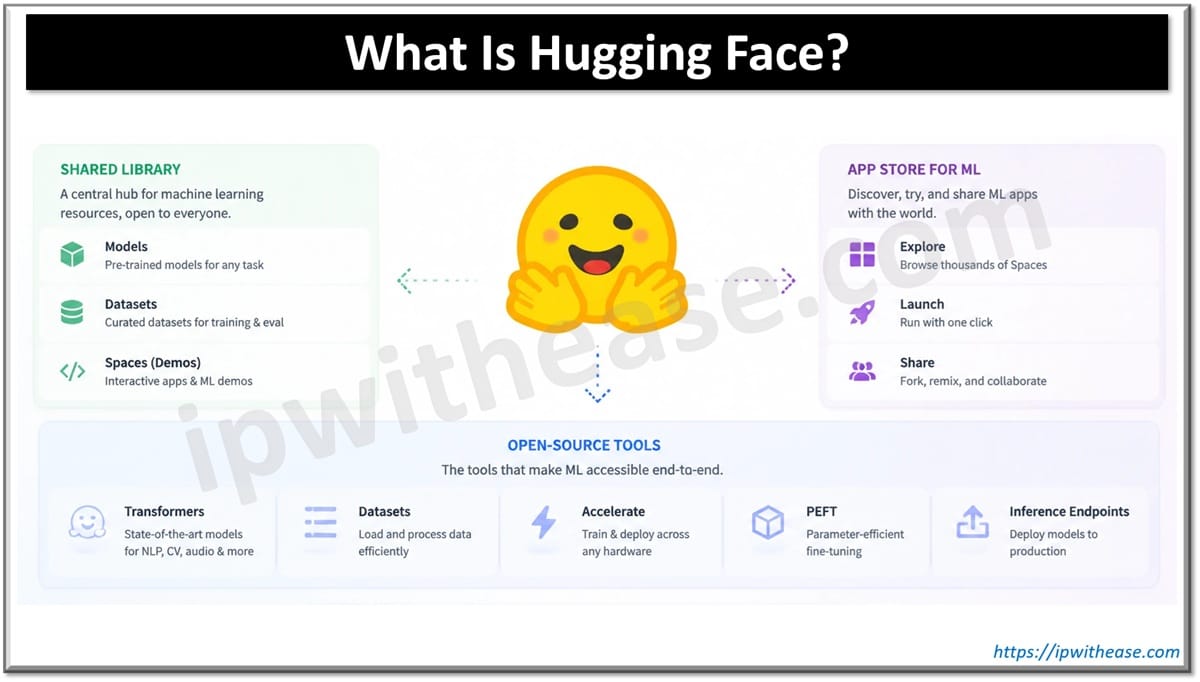
Hugging Face is part platform, part company, and it functions as something close to a shared library for machine learning — plus an app store bolted on for good measure. It hosts pre-trained models, datasets, and demo applications, and it maintains the open-source tools that let people load, tweak, and deploy those models without building everything from the ground up.
Before this existed, using a serious language model or image classifier meant piecing together code from academic papers, tracking down weights files hosted on someone’s personal server, and crossing your fingers that the dependencies still installed correctly. Hugging Face turned that mess into something a lot closer to running pip install and moving on with your day.
Origin
The company started in 2016 as a chatbot app aimed at teenagers, which is not exactly the origin story you’d guess given where it ended up. The turning point came when the founders open-sourced the NLP library sitting underneath that chatbot — a library called Transformers, built to work with the new generation of models based on the transformer architecture. That’s the same family of architecture behind BERT, GPT, and basically every large language model that came after.
That release hit at exactly the right moment. Researchers were sick of rebuilding the same architectures from scratch every time a new paper dropped, and suddenly there was a well-maintained, shared toolkit instead. Adoption took off from there and never really slowed down.
Models, Datasets, and Spaces – The three things worth knowing
Most of what makes Hugging Face useful comes down to three pieces.
Model Hub
The Model Hub holds a few hundred thousand pre-trained models, uploaded by everyone from solo researchers to Google, Meta, Microsoft, and Mistral. Instead of training something from zero — which can eat weeks of time and a serious compute budget — teams can pull down a model that’s already trained and adapt it to whatever they’re actually trying to solve. That’s transfer learning in practice, and it’s the reason a fifteen-person startup can ship a working AI feature without owning a data center full of GPUs.
Datasets
Datasets do the same job for training data. Curated, versioned collections for text, images, audio, and mixed formats save teams from the genuinely tedious work of scraping and cleaning their own.
Spaces
Spaces is where people deploy small, shareable demo apps, usually built with something like Gradio or Streamlit, without needing to spin up their own server. It’s turned into the default way a researcher shows off a new model — post a link, let people poke at it in the browser.
Wrapped around all of this are the open-source libraries — Transformers, Diffusers, Tokenizers, Accelerate — that give everyone a common, standardized way to load and run these models, rather than each team reinventing that wheel.
Why this should be on Infrastructure and Networking radar
This is the part that tends to get skipped in the typical “what is Hugging Face” explainer, and it’s the part that actually matters if you’re the one keeping systems running.
- Model weights are big, and they move across your network. A modern model can range from a few hundred megabytes up into hundreds of gigabytes, and once a team gets into the habit of routinely pulling models — often several times over, as they experiment — that traffic becomes worth paying attention to, especially anywhere bandwidth is constrained or closely monitored. Plenty of organizations end up mirroring the models they use most instead of hitting the public hub every time.
- It’s also a new flavor of third-party dependency, and not always a well-vetted one. Every model, dataset, and sample script on the hub was uploaded by someone, and not all of it gets serious scrutiny. Loading a model can mean executing code, not just reading data — Hugging Face has added protections here over the years, but it’s still a supply-chain risk that belongs in the same conversation as npm packages or PyPI dependencies, not off to the side as a data science concern.
- Deployment is, at the end of the day, an infrastructure decision. Once a model is fine-tuned, it has to actually run somewhere: on-prem GPUs, a cloud instance, an edge device, a managed inference endpoint. Hugging Face has its own hosted inference options, but a lot of organizations pull the model down and serve it through their own stack — which means capacity planning, GPU provisioning, and network design all inherit whatever got decided on a data scientist’s laptop three weeks earlier.
- And it changes how AI workloads sit inside the rest of the environment. As more internal tools get built on these models — chatbots, document classifiers, summarizers — those workloads need to slot into existing identity, access, and segmentation policies, the same as any other application handling data that might be sensitive.
Put plainly: even a team that never writes a line of Python will probably see Hugging Face show up somewhere — in traffic logs, in egress policy discussions, in a GPU budget request that lands on someone’s desk with no context.
Why it stuck around instead of fading like most AI trends
A few things explain why this became the default rather than just another tool that had its moment.
It’s genuinely open. Most of the core tooling is open source, and a large share of the hosted models can be downloaded for free, which lowered the barrier to entry for smaller teams and solo developers who couldn’t otherwise compete.
It became the common format. Models packaged the Hugging Face way are now recognized across most major ML frameworks and cloud AI services, which cut down the friction of moving something from a research notebook into an actual product.
And the community effect keeps compounding. More models bring more users, more users contribute more fine-tuned variants and datasets, and the whole thing keeps getting more useful — not unlike what happened with GitHub becoming the default home for code.
Final Words
Hugging Face isn’t just a website where researchers park their models. It’s turned into plumbing — the kind of infrastructure that a huge amount of AI development now quietly depends on. Between the bandwidth it pulls, the supply-chain questions it raises, and the deployment decisions it forces downstream, it’s earned a spot on the same radar as any other platform your organization already takes seriously.
ABOUT THE AUTHOR

You can learn more about her on her linkedin profile – Rashmi Bhardwaj