Table of Contents
A cloud incident review often starts with a deceptively simple question: who owned the failed control? The answer can take hours. One team believed the provider monitored privileged access, another assumed application logs flowed into the SOC, and nobody had tested whether an exposed storage service would trigger an alert.
That confusion sits at the centre of many Cloud Computing Security failures. Moving infrastructure, platforms, or applications to the cloud transfers certain operational duties, but it doesn’t transfer accountability for business risk.
Security leaders still need to know which controls remain theirs, which sit with the provider, and where the handoffs create gaps.
The Shared Responsibility Model Is a Control Map
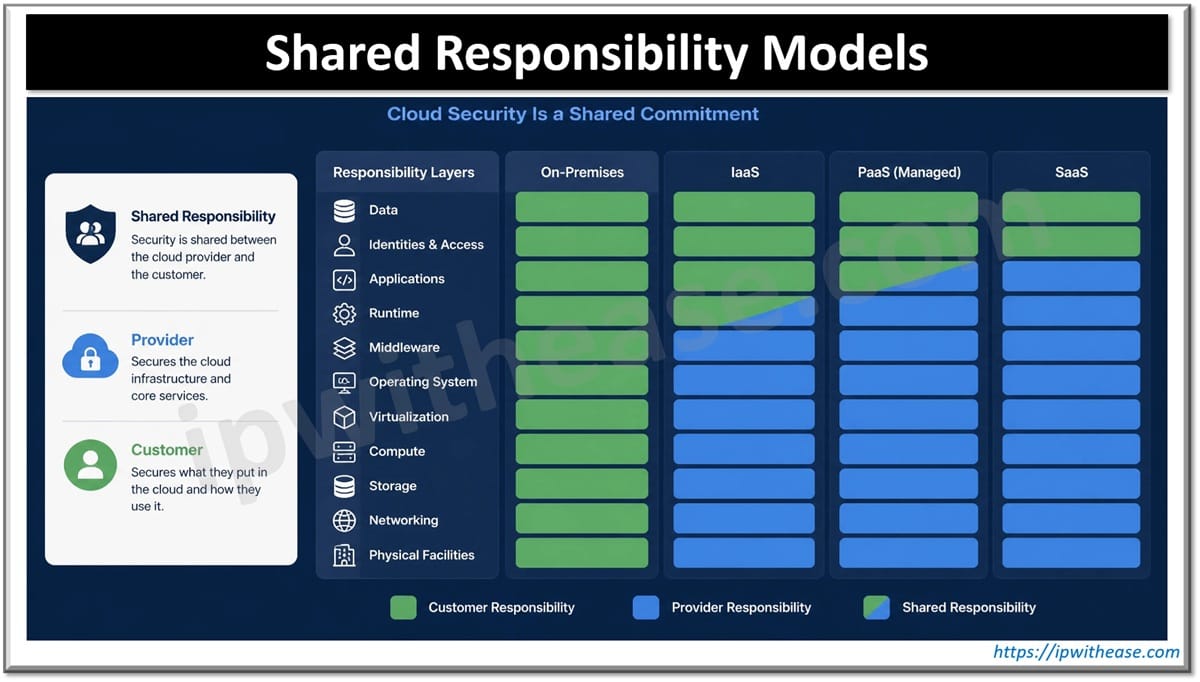
The shared responsibility model divides security duties between the cloud service provider and the customer. Providers generally protect the physical facilities, underlying infrastructure, and core service components.
Customers typically retain responsibility for identities, access policies, data, configurations, endpoints, and the way cloud services are connected to business processes. That sounds tidy. But in reality, it’s far from tidy.
Responsibilities shift according to the service model, contract, configuration options, and managed features selected. A control owned by the customer in an infrastructure-as-a-service environment might move partly to the provider under a managed platform. Yet data classification and access decisions usually stay with the customer.
Security teams assessing the architectural foundations of cloud computing security should therefore treat the model as a working control map, not a diagram shown once during cloud onboarding.
In an infrastructure-as-a-service deployment, the provider manages physical hardware, storage, networking foundations, and virtualization. The customer commonly handles guest operating systems, workloads, network rules, credentials, encryption choices, and application security.
IaaS Leaves More Work With the Customer
That boundary matters during incident response. If an attacker exploits an unpatched operating system or an overly permissive administrative port, the provider’s infrastructure can remain fully operational while the customer’s workload is compromised.
Secure infrastructure doesn’t automatically mean a secure tenant.
PaaS Changes the Boundary, Not the Accountability
Platform-as-a-service offerings remove much of the operating system and runtime maintenance burden. Development teams can move faster because patching and platform upkeep sit largely with the provider.
The customer still controls application code, secrets, identities, data permissions, and deployment settings. A vulnerable API, exposed credential, or careless access policy won’t become the provider’s problem merely because the application runs on a managed platform.
PaaS can reduce the number of controls an enterprise operates directly. It can also make overlooked controls harder to spot because infrastructure details are less visible.
SaaS Narrows Technical Control
With software as a service, the provider operates almost the entire application stack. Customers still decide who receives access, how authentication is configured, what data enters the service, and how information is shared or retained.
This is where identity becomes the practical security perimeter. A compromised administrator account can bypass many protections without exploiting the service itself.
Session theft, weak multifactor authentication settings, dormant accounts, and excessive privileges deserve the same attention once reserved for vulnerable servers.
Where Cloud Responsibility Usually Breaks Down
Most failures don’t come from a total absence of security. They come from mismatched assumptions between architecture, operations, development, and the SOC.
Configuration Ownership Isn’t Explicit
A mid-size financial services firm migrating to hybrid cloud may document that the network team owns firewall policy. But who reviews cloud-native security groups created through deployment pipelines? Who removes temporary rules after testing? If nobody can answer quickly, the control isn’t truly owned.
Every configurable control needs a named owner, a review interval, and a record of approved exceptions. “The cloud team” is too vague.
Visibility Stops at Service Boundaries
Security operations teams can’t investigate what they can’t see. Authentication logs may be available but not collected. Application telemetry may use a different format. Managed services may expose audit records through an API that the SIEM hasn’t been configured to query.
The cloud IDS and IPS challenges discussed here show why distributed traffic, encryption, east-west communication, and hybrid systems complicate conventional monitoring. The operational lesson is blunt: log availability and log ingestion aren’t the same thing.
Compliance Is Mistaken for Provider Certification
A provider’s certification can support an enterprise compliance programme, but it doesn’t certify the customer’s workload. Auditors will still care about access reviews, retention settings, encryption decisions, evidence collection, and incident procedures inside the tenant.
Contracts also need scrutiny. Log retention periods, forensic access, breach notification timelines, data-location commitments, and support escalation paths can shape the outcome of a real incident.
Turn the Model Into an Operating Practice
A responsibility matrix shouldn’t die in an architecture folder. It needs to influence engineering tickets, SOC playbooks, supplier reviews, and budget decisions.
Start with a control register covering:
- Identity administration and privileged access
- Data classification, encryption, and key custody
- Workload and application patching
- Network segmentation and exposure management
- Logging, alerting, and evidence retention
- Backup integrity and recovery testing
- Vulnerability management
- Incident investigation and notification
- Regulatory reporting and contractual obligations
For each control, record who operates it, who verifies it, what evidence proves it worked, and what happens when it fails. Some controls will have split ownership. Write down the split.
The US National Security Agency’s guidance on upholding the cloud shared responsibility model warns that customers can incorrectly assume providers manage safeguards that actually remain inside the customer boundary. Its guidance also points to customer responsibilities for data, endpoints, accounts, and access policies across common service models.
Ask the Uncomfortable Incident Question
Here’s a useful test: if a privileged cloud credential were stolen tonight, could the SOC trace its activity across every relevant account and service?
A confident “yes” needs evidence. The team should know where identity events are stored, how quickly they arrive, which actions trigger alerts, who can revoke access, and whether emergency procedures have been rehearsed.
Run tabletop exercises around ordinary failure modes, not only catastrophic breaches. Test a public storage exposure, a leaked deployment secret, a disabled audit trail, or a compromised contractor account. These scenarios reveal ownership gaps faster than another policy review.
Cloud computing security depends on controls spanning cloud workloads, applications, networks, and security operations. Still, technology can’t resolve unclear accountability. Enterprises need to define control ownership and escalation routes before any platform can apply security policies consistently.
Shared Responsibility Must Reach the Boardroom
Cloud spending decisions are often separated from security ownership. Business units procure services, engineering teams deploy them, and security teams inherit monitoring obligations later. That sequence creates hidden cost and uncertain risk.
Cloud Computing Security improves when responsibility is treated as an operating discipline rather than a contractual footnote. Leaders should expect a current control map, measurable evidence, tested response paths, and clear funding for the duties that remain inside the enterprise. The cloud may change who operates the infrastructure, but it doesn’t change who answers when critical data, customer trust, or business continuity is put at risk.
ABOUT THE AUTHOR
IPwithease is aimed at sharing knowledge across varied domains like Network, Security, Virtualization, Software, Wireless, etc.