Table of Contents
Developed by Internet engineering task force (IEEE) RFC 2544 standard defines a set of tests which are used to evaluate the performance of network equipment including its throughput, latency, data frame loss, capability to handle spikes or bursts of traffic and recovery mechanism.
Networks are the backbone of digital landscape and life-line for organizations to run their operations smoothly and consistently. As networks are becoming more and more complex, faster it becomes very critical to understand how network equipment performs under real-world conditions which are more dynamic and critical in nature.
A network equipment specifications available paper holds good as a sales point but when actual world traffic hits how a network switch or router behaves that is the real testimony. Network teams constantly look for a means to measure the performance, identify potential limitations, and ensure that network equipment is meeting the expected service requirements.
Request for comments or RFC 2544 testing standard provides a means to establish a standard for testing or benchmarking performance of network devices – routers and switches.
In today’s article we will understand about standard RFC 2544, the details of tests involved under this standard and how it works?
About RFC 2544
Request for comments or RFC 2544 is a defacto standard released by Internet engineering task force (IEEE) to establish a benchmark for network equipment performance with some standard tests which analyse the latency, throughput, packet loss, spikes or burst handling and recovery capabilities of network equipment such as switches and routers.
RFC 2544 is used for product validation, performance benchmarking, continuous performance evaluations, managing service level agreements, troubleshooting, network capacity planning and optimization.
How RFC 2544 Testing works
RFC has a set of tests to determine Ethernet and IP network devices performance using a set of defined testing procedures. The set of procedures are followed by network engineers for consistent results across network devices. RFC 2544 benchmarks network equipment so tests are undertaken in a controlled environment so that dynamic network conditions and outside world traffic do not cause distortion in results. It also enables organizations to compare two different vendors’ network equipment and validate their performance.
When network devices are required to handle too much traffic that sometimes requirement have trouble keeping up with RFC 2544 tests organizations can analyse performance of equipment and flow of information. Both positive and negative trends are recorded and that becomes the key performance indicator (KPI) to enable organizations to choose the right network equipment for their environment.
RFC 2544 Test Types
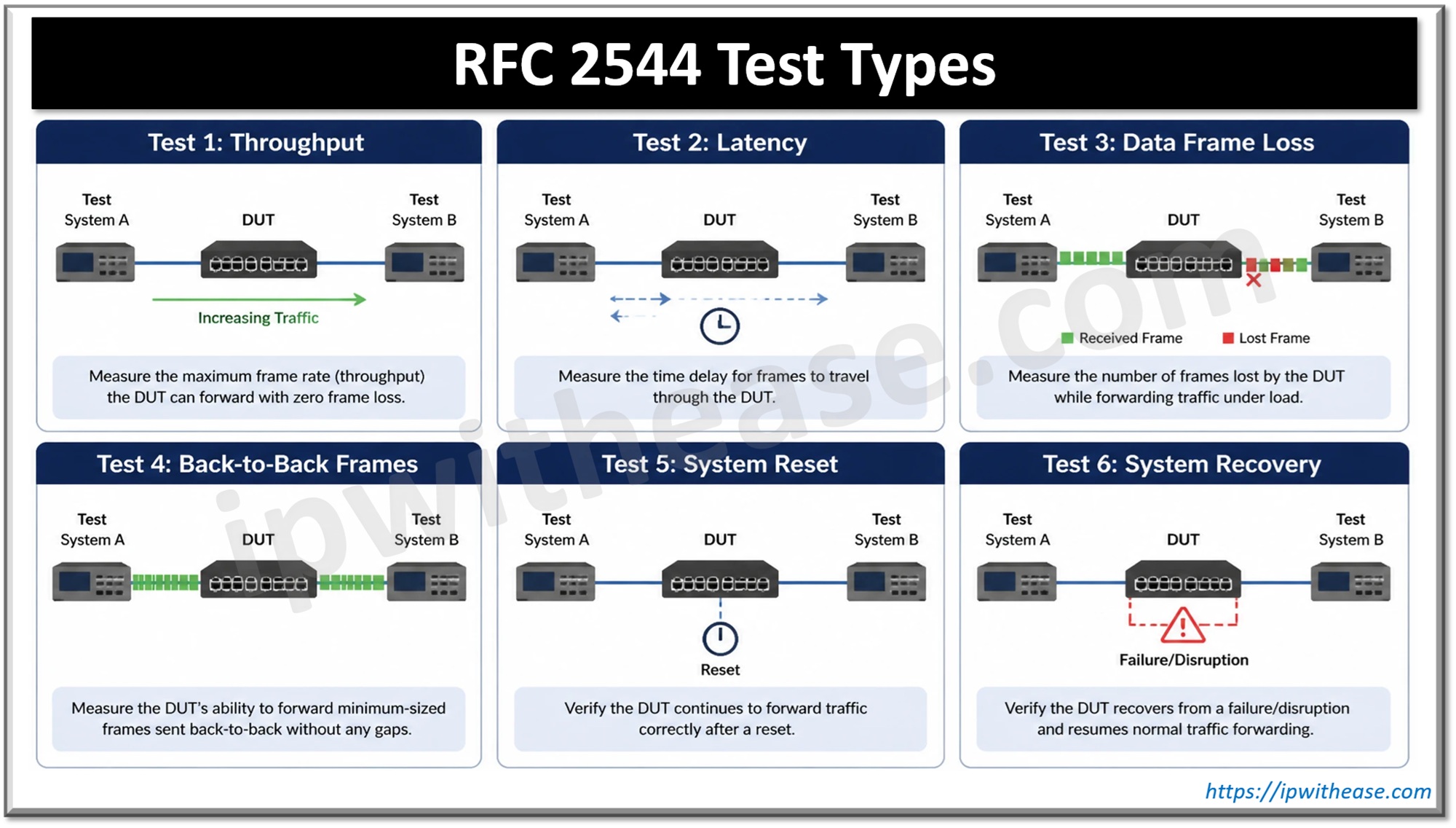
The RFC 2544 defines six tests – Throughput, latency, data frame loss, back to back frames, system reset and system recovery.
Test 1: Throughput
How much data transfer can be done from one location to another location within a specific time period without errors and in other words the available bandwidth. The usage of bandwidth will change dynamically during the time period when users are accessing the network, transmitting information and signing-off. The internal networks peak times are usually start of the day or end of day. Required throughput needs to be available during peak usage window.
Test 2: Latency
Latency is the amount of time taken by a data frame to travel from its sender to its receiver in the destination network and sending acknowledgement back to the receiver. It is the total of processing required at each stage and delays occurred during this transit. The latency is measured by sending a test frame to check when the frame is received. Slow networks could result in application problems.
Test 3: Data Frame Loss
Percentage of frames which started from its source but not all reached final destination due to various issues and to ascertain that large volume of traffic is generated and sent as a burst or spike. The system monitoring checks how much information received at destination. Data frame loss could occur due to lack of resources and tacking this helps to determine the buffering capacity requirements.
Test 4: Back-to-Back Frames
Back to back frame or sudden bursts tests measure the maximum number of frames reached the receiver at full rate before being lost. This shows how well the network supports simultaneous stream of high volume transmissions and this also aids in capability planning.
Test 5: System Reset
System reset is used to recognize issues and fix them automatically instead of depending on the network person to fix it by making necessary adjustments. System resets help in determining how soon a device can recover from a hardware or software failure or overload. A continuous stream of frames is sent and output is monitored to check when frames begin to be forwarded.
Test 6: System Recovery
System recovery checks the speed at which device recovers from an overload and to test this stream of frames sent to higher rate at recorded throughout and delay is measured to recalibrate. The system recovery helps in building a full proof network disaster recovery plan.
ABOUT THE AUTHOR

You can learn more about her on her linkedin profile – Rashmi Bhardwaj