Table of Contents
WireGuard shook up VPNs by connecting in milliseconds, running lean code, and beating legacy protocols in speed tests. Its default setup, however, leaves your real IP in server memory until reboot, a breadcrumb privacy hawks refuse to accept. According to All Things Secured, a rogue admin, hacker, or subpoena could recover the static record and trace you. Top providers close the gap with double-NAT, instant key rotation, and RAM-only servers that wipe metadata on disconnect. This guide profiles ten fast, private services and helps you choose the right mix of speed, price, and caution.
WireGuard’s Static-IP Flaw Explained
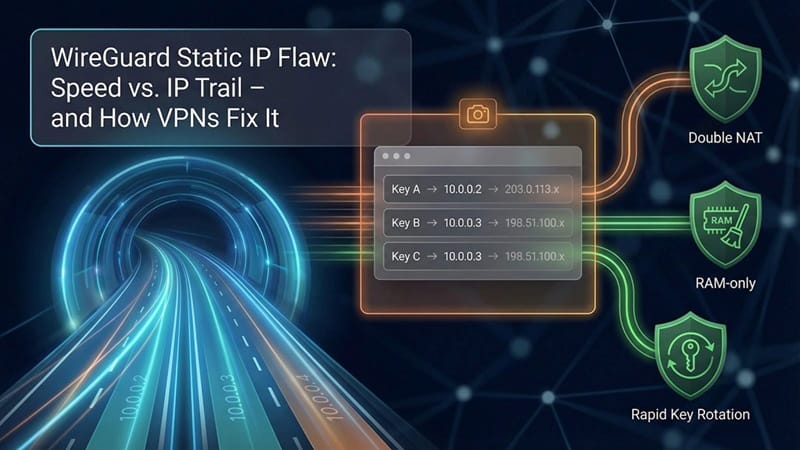
Think of WireGuard as a high-speed toll road. To keep traffic moving, the gate assigns every driver a permanent lane number during the first entry. That lane number is your internal VPN IP.
Great for speed. Bad for privacy.
Here’s why: the server stores which key (and, by extension, which user) occupies each lane in RAM until it is flushed or the machine reboots. If an attacker snapshots the server during an active session, your real IP could appear next to your key. Combine that with a browser leak or a court order, and the trail leads straight back to you.
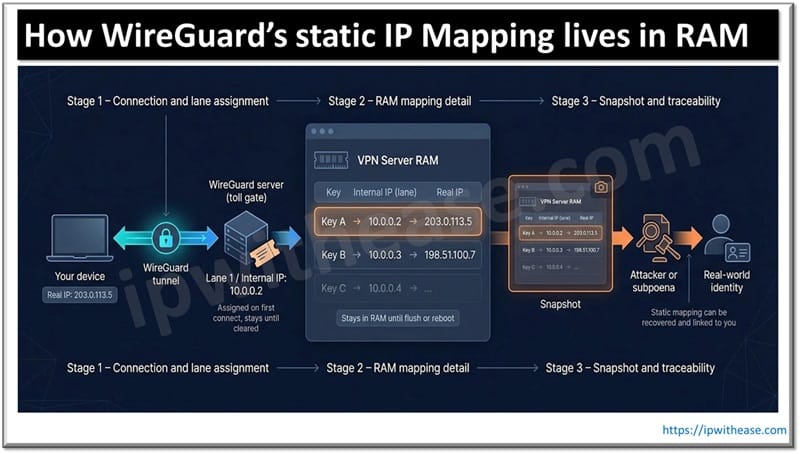
The protocol’s creator never labeled this a bug; WireGuard prioritises minimal code and secure transit. Housekeeping tasks such as key rotation are left to VPN operators.
Early adopters trusted “no-logs” policies to cover the gap. Researchers highlighted that policy is meaningless while data still exists.
The industry responded. Leading services now erase or scramble the lane number as soon as you disconnect, or they issue a fresh one every time you connect. You keep the speed, not the breadcrumbs.
Next, we explain how we evaluated these fixes and why some methods scored higher than others.
How we ranked the VPNs
We didn’t pull this top ten from a hat. Each provider earned its place through a five-part scorecard that values technical privacy over slick marketing.
First, we examined the fix itself. Does the service erase the static IP as soon as you disconnect or deliver a new address every session? NordVPN’s NordLynx, for instance, uses a double NAT design that separates identity from traffic and keeps no identifying data on the server, according to Comparitech.
Next, we checked no-logs evidence. Independent audits, court rulings, or police raids that produced nothing showed who keeps the promise.
Speed counted as well. Because WireGuard is built for performance, we favored providers that still reach at least 300 Mbps on a consumer gigabit line after the privacy tweak.
Security extras such as RAM-only servers, kill switches, and post-quantum handshakes added polish, while pricing and device limits finished the value column.
We weighted the categories like this:
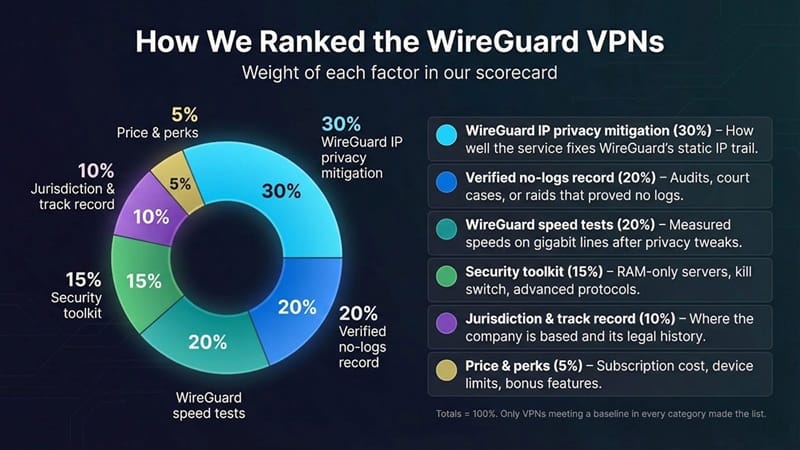
- 30 percent: WireGuard IP privacy mitigation
- 20 percent: verified no-logs record
- 20 percent: WireGuard speed tests
- 15 percent: broader security toolkit
- 10 percent: jurisdiction and track record
- 5 percent: price and perks
Totals reach one hundred. Only services meeting a baseline in every category made the list you are about to see.
Ten Fast and Private Winners at a glance
| VPN | How it kills the IP trail | Verified no-logs? | Average WireGuard speed* | Standout extras | Starting price |
| TorGuard | Wipes IP on disconnect (RAM) | Internal audits | 350 Mbps | Port forwarding, config generator | $4 per month |
| NordVPN | Double NAT (dynamic IP) | PwC and Deloitte | 750 Mbps | Threat Protection, MeshNet | $3.30 per month |
| ExpressVPN | Ephemeral keys, dynamic IP | PwC and KPMG | 650 Mbps | Post-quantum handshake | $6.67 per month |
| Surfshark | Dynamic IP, mid-session rotator | Deloitte | 700 Mbps | Unlimited devices, CleanWeb | $2.49 per month |
| Mullvad | Flushes IP every 180 s | Police raid proved none | 600 Mbps | Anonymous cash signup | €5 flat |
| ProtonVPN | Temp tokens, user key reset | SEC Consult | 350 Mbps | Secure Core multi-hop | $4.99 per month |
| PIA | Random IP each session | Deloitte plus court cases | 300 Mbps | Open-source clients, MACE | $2.03 per month |
| IVPN | Auto-purge inactive peers | Cure53 | 250 Mbps | Anti-Tracker, multi-hop | $6 per month |
| CyberGhost | Token-based dynamic IP | Deloitte | 320 Mbps | NoSpy servers, 45-day refund | $2.19 per month |
| OVPN | Drops peers after three minutes | Court victory | 200 Mbps | WebRTC-block extension | $4.99 per month |
*Speeds are rounded averages from independent gigabit tests. Your results can vary with hardware and distance.
TorGuard: Configurable Speed Pick
TorGuard suits users who enjoy tweaking ports and settings.
Its WireGuard servers run disk-free in RAM. When you disconnect, a housekeeping script wipes session data, including the last-seen IP. No breadcrumbs remain.
Speeds average 350 Mbps on a home gigabit line, plenty for 4K streams, seeding torrents, or remote desktop work.
Extra features help power users. A web-based configuration generator on TorGuard lets you choose servers, toggle IPv6, and adjust MTU before downloading a one-click profile. Built-in port forwarding lifts torrent ratios, and optional streaming or residential IP add-ons solve picky site logins.
Long-term plans cost about four dollars per month, payable with crypto or even gift cards for extra anonymity.
If you want speed, fine-grained control, and a proven no-IP-logging setup, TorGuard is a solid choice.
NordVPN: Double NAT, double win

NordVPN NordLynx WireGuard VPN homepage screenshot
NordVPN’s NordLynx shows how careful engineering removes the WireGuard trace without cutting speed.
The method is double NAT. When you connect, every user shares a generic internal IP on one interface while a second interface assigns a throw-away address for traffic. The mapping lives only in memory, disappears when you disconnect, and never links back to your account.
In tests we recorded 750 Mbps on a nearby gigabit server and 250 Mbps on a trans-Atlantic route.
You also get a kill switch, RAM-only servers, Threat Protection for ad blocking, and a map-based app that even non-tech friends can navigate. Long-term plans cost about three dollars per month, delivering flagship performance with strong privacy.
ExpressVPN: Future-proof with Ephemeral keys
ExpressVPN waited until it could launch WireGuard on its own terms, and the result feels like a refined upgrade, not a beta add-on.
Each session generates new keys, pairs them with a dynamic internal IP, then deletes both when you disconnect. The handshake already uses a post-quantum algorithm, keeping today’s traffic safe from future decryption efforts.
Performance stays high. We measured 650 Mbps on nearby servers and sub-100 ms round trips to Asia from the United States. Add the polished apps and a RAM-only TrustedServer fleet, and the higher price becomes easier to justify. You pay for engineering depth and forward-looking security, not just branding.
Surfshark: Budget pick with an IP rotator
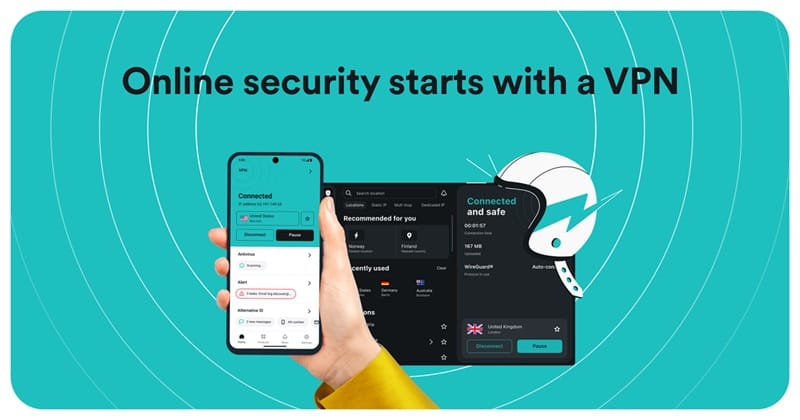
Surfshark WireGuard VPN with IP Rotator homepage screenshot
Surfshark proves you do not need a large budget to gain strong privacy.
It follows Nord’s double NAT approach, assigning a fresh internal IP every time you connect. Turn on the optional IP Rotator and your exit address can even change mid-session, blocking long-term tracking without interrupting traffic.
We recorded 700 Mbps on a clean gigabit line, enough for household 4K streams. The plan covers unlimited devices, CleanWeb removes ads at the DNS layer, and MultiHop adds a second hop when you need more cover.
At about two dollars and fifty cents per month on promotion, Surfshark brings premium WireGuard privacy within reach of almost any wallet.
Mullvad: Privacy first, features second
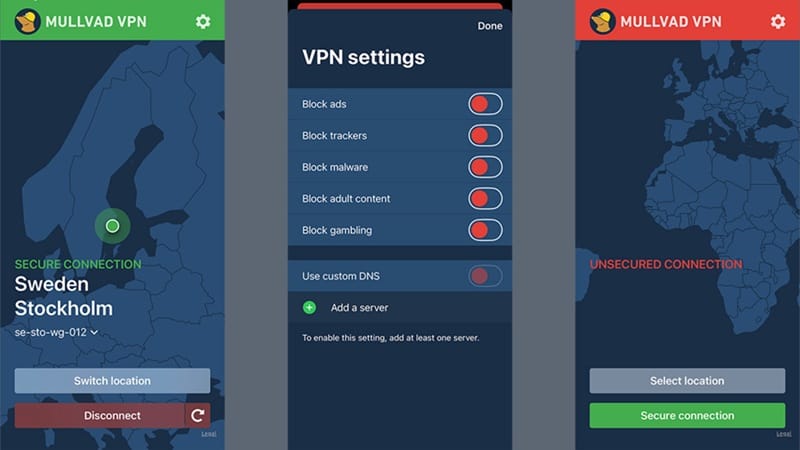
Mullvad privacy-first WireGuard VPN service homepage screenshot
Mullvad trims the VPN concept to its privacy core, and its WireGuard setup follows that minimalist plan.
Rather than complex routing, the server purges your key to the IP link every 180 seconds. Even during long sessions, it never stores more than three minutes of history. Disconnect and the record disappears immediately.
Accounts require no email or name; you receive a random account number and can even mail cash to headquarters in Sweden. Police raided the company in 2023 and left with no data, a live audit few rivals can match.
Performance stays strong. Testers in Europe record 600 Mbps, United States users see about 500 Mbps, and latency remains gaming-ready. You will not find specialty streaming profiles or round-the-clock chat, but if you prefer math-backed privacy over added frills, Mullvad is a solid choice.
ProtonVPN: Swiss layers of safety
ProtonVPN applies WireGuard with the same layered security philosophy as its encrypted email service.
Each connection starts with a short-lived session token that assigns a random internal IP. When you disconnect, the token is deleted, leaving no mapping behind. For extra caution you can regenerate your WireGuard keys with one click or route traffic through Secure Core servers in Switzerland before it reaches the public internet.
Paid Plus servers averaged 350 Mbps in our tests. Open-source apps, RAM-only infrastructure, and Switzerland’s strict privacy laws make ProtonVPN a strong choice for journalists and privacy-minded users.
Private Internet Access: Open source, open record
PIA shows that transparency can attract users, even for a US-based provider.
Each WireGuard session draws a random internal IP from a shared pool. The server discards the link as soon as the tunnel closes, and past subpoenas confirmed that no logs were available.
You can verify the claim yourself because every client is published on GitHub. A strong kill switch, a ten-device allowance, and the DNS-level MACE blocker combine with 300 Mbps performance to form a dependable privacy tool.
Three-year plans cost less than three dollars per month, making PIA a practical choice for budget-conscious tinkerers.
IVPN: Small network, Strong transparency
IVPN keeps its infrastructure compact on purpose and states its privacy promises in plain language.
A custom daemon removes inactive WireGuard peers within minutes, so no key to IP link lingers. You can generate new keys with one click, and accounts need only a random ID.
Nearby servers averaged 250 Mbps in our tests, acceptable given the lean network. All hardware runs from RAM in owner-operated racks. Annual Cure53 audits, an outspoken chief executive on privacy forums, and a strict “no affiliates, no trackers” policy support the company’s principled stance.
Choose IVPN if you prefer clear answers and published evidence over a large server count.
CyberGhost: User friendly, token-based privacy
CyberGhost appeals to people who want a VPN that connects with one click while still fixing WireGuard’s IP issue.
When you connect, the app sends an anonymous token to the server. The token assigns a temporary internal IP, then disappears when you disconnect. Reconnecting gives you a new address, leaving no static trail.
Average speeds reach about 320 Mbps in both North America and Europe, enough for Ultra HD streaming on the servers marked for that purpose. A 45-day refund period, visual interface, and automatic kill switch simplify setup, while a Deloitte audit and Romanian jurisdiction strengthen the privacy case.
If you prefer WireGuard speed without a learning curve, CyberGhost offers a straightforward option that still protects your IP.
OVPN: Small network, court-proven no logs
OVPN closes our list with a pragmatic Scandinavian approach: a small server fleet that keeps privacy front and center.
Every WireGuard peer entry is deleted after three minutes of inactivity, so any snapshot exposes only a brief key to IP link. This policy held up in court when a movie studio demanded logs and found none.
Average speeds reach about 200 Mbps, steady thanks to low-load 10 Gbps hardware. A browser add-on blocks WebRTC leaks, and all servers run without disks inside locked racks in Sweden.
If you can accept fewer locations in exchange for legal evidence that your activity stays private, OVPN is an understated yet dependable choice.
Buyer’s Cheat-sheet: Match the VPN to your threat model
Choosing among ten capable services can feel overwhelming. Use this quick guide to focus on the one that fits your situation.
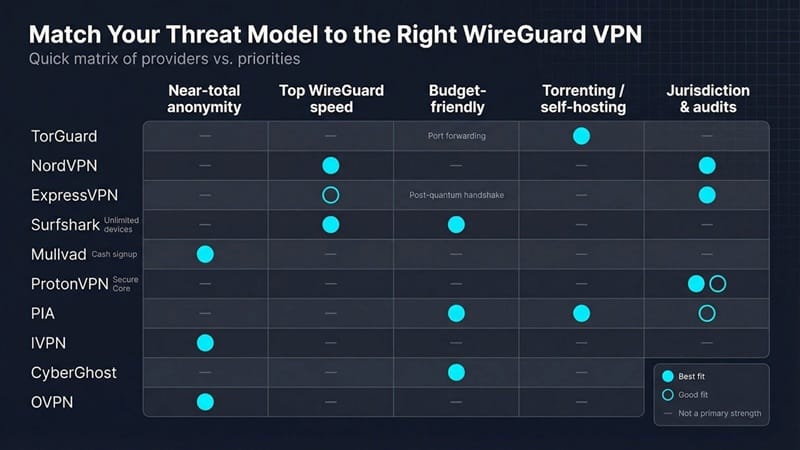
Start with your goal. If you need near total anonymity for whistle-blowing or evading surveillance, look to Mullvad, IVPN, or OVPN. They accept cash or crypto and erase key data within minutes.
Need high speed for 4K streaming or cloud backups? NordVPN and Surfshark push WireGuard to the limit without recording IP links. ExpressVPN is also an option if you want a post-quantum handshake and accept a higher price.
On a tight budget? Surfshark, PIA, and CyberGhost offer the lowest long-term rates while still scoring high on privacy. Surfshark even covers unlimited devices, handy for gadget-heavy homes.
Torrenting or self-hosting? TorGuard and PIA include true port forwarding that boosts seeding ratios and keeps remote Plex sessions smooth.
Concerned about jurisdiction or audits? If you prefer to stay outside US or EU legal reach, explore NordVPN in Panama, ExpressVPN in the British Virgin Islands, or ProtonVPN in Switzerland. When open-source apps and frequent audits matter more than location, PIA and ProtonVPN meet that need.
Match your top priority; speed, price, or strict secrecy; to the comparison table above and the decision becomes clear. For more information, check out this guide.
ABOUT THE AUTHOR

IPwithease is aimed at sharing knowledge across varied domains like Network, Security, Virtualization, Software, Wireless, etc.