Table of Contents
Border Gateway Protocol (BGP) is the exterior gateway protocol that autonomous systems use to exchange reachability information across the internet. Every network operator depends on it, yet many routing investigations still begin with periodic snapshots: a show ip bgp here, a public looking-glass query there, a cron job that polls a route collector every few minutes.
The problem is that routing does not wait for your next poll. A prefix can be withdrawn, re-originated from a different AS, and restored again inside a single monitoring interval. When that happens, a snapshot tool shows you the before and the after, but not the event itself. This blog explains where snapshot monitoring falls short, how the BGP Monitoring Protocol (BMP) closes the gap, and why operators are consolidating routing data into a single self-hosted view.
Why snapshot BGP monitoring leaves blind spots
Polling-based monitoring has three practical limits.
- Timing. If you poll every five minutes, any change that starts and ends inside that window is invisible to you. Route flaps and short-lived hijacks are exactly the events that live in those gaps.
- Scale. The global IPv4 table has passed 1.06 million prefixes, with roughly 247,000 more in IPv6. Repeatedly scraping full RIBs at that size is expensive on the router control plane and slow to parse.
- Context. A raw route entry tells you the current best path. It does not tell you whether the origin AS is authorized, whether the announcement is RPKI valid, or how that prefix has behaved over the past month.
That third gap is the one that costs engineers the most time. Routing visibility is rarely the hard part. Routing context is.
What BMP changes
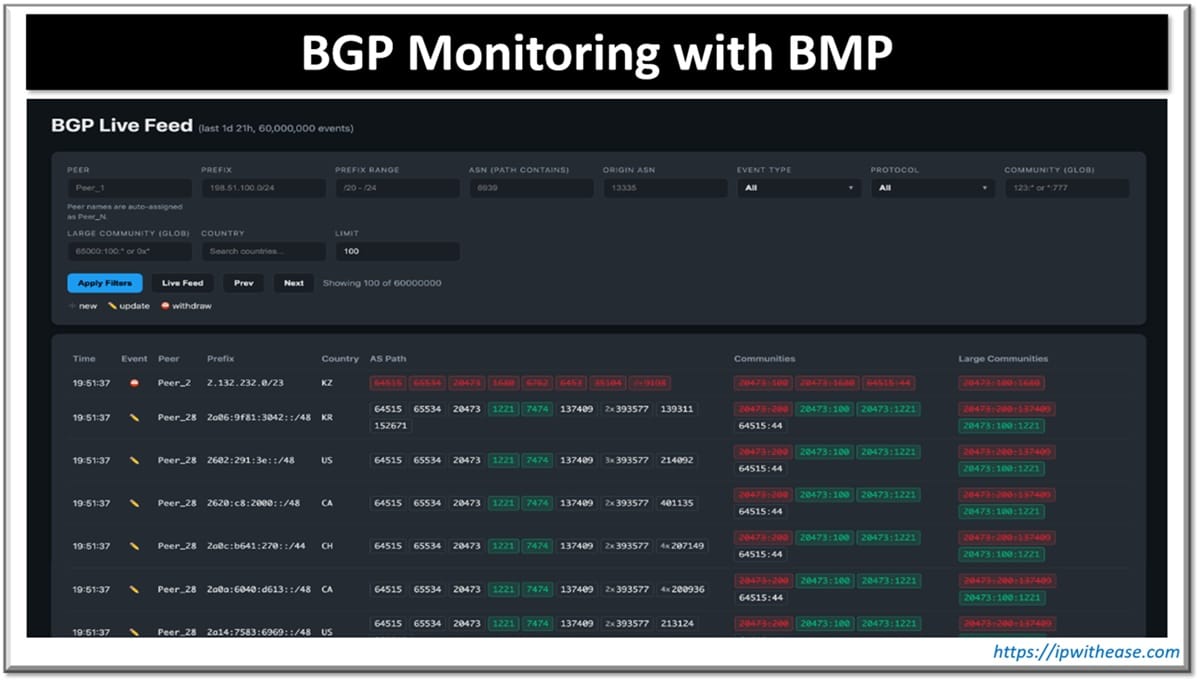
BMP, standardized as RFC 7854 in 2016, was designed to provide a standardized way for routers to export BGP state and events to monitoring systems without relying on CLI polling or screen scraping. Instead of asking the router for its state on a schedule, the router continuously streams routing information—including Adj-RIB-In and, with later extensions, other RIB views—to a monitoring station as changes occur.
In operational terms, this means a few things. You observe prefix origin changes as they occur, not after the fact. You can watch AS-path evolution during an incident instead of reconstructing it from logs afterward. And you get a per-peer view of what each neighbor actually sent you, before your own inbound policy touched it.
For a NOC, that shift from post-event analysis to live understanding is the difference between explaining an outage and catching it while it is still unfolding.
The other half: validation and ownership data
Seeing a change in real time only helps if you can immediately judge whether it is legitimate. That judgement needs data that lives outside the BGP feed.
The Resource Public Key Infrastructure (RPKI), defined in RFC 6480, together with Route Origin Validation (ROV), specified in RFC 6811, allows routers to determine whether the originating AS is authorized to announce a prefix. Deployment has grown rapidly, with more than half of globally visible IPv4 routes now covered by valid Route Origin Authorizations (ROAs), and adoption continues to increase. IRR, WHOIS and RIR registry data provide ownership and routing-policy context that helps operators investigate unexpected announcements. Routing history then shows whether the observed origin or AS path is normal for that prefix or represents a first-time event.
The catch is that these datasets normally sit in separate tools. An engineer investigating one incident ends up jumping between a looking glass, an RPKI validator, an IRR query, a WHOIS lookup, and an internal historical collector, then stitching the answers together by hand while the clock runs.
Bringing it into one self-hosted view
This is the gap that consolidated, self-hosted routing intelligence is designed to close. One example of this approach is a self-hosted BGP routing intelligence platform that ingests live BMP feeds and combines them with routing history, ASN and prefix ownership, RIR and WHOIS data, IRR records, geofeed information, RPKI validation, and ASPA status inside a single queryable model.
According to its documentation, it targets ISPs, IXPs, cloud providers, and enterprises running large IP networks. Think of it as your own private BGPView.io running inside your network—but with live BMP ingestion, routing history, APIs, Prometheus metrics, and AI-assisted querying.
Two design choices matter most for working engineers.
The first is that it runs inside your own infrastructure. There are no external API dependencies, no third-party rate limits, and no routing data leaving the network. For teams that currently lean on public lookup services, that removes both a privacy concern and a reliability dependency in one move.
The second is that it is built for automation. Routing intelligence is exposed through REST APIs, bulk lookup interfaces, Prometheus metrics, and Model Context Protocol (MCP) support, so your own tooling and AI assistants can query live routing data directly rather than through a browser.
The broader rationale behind tools like this is straightforward: internet routing has become critical operational infrastructure, yet many organisations still depend on multiple external services to understand what is happening in their own networks. Keeping routing intelligence in-house can make it easier to troubleshoot incidents, automate workflows, and improve routing security.
Where this fits in a monitoring stack
None of this replaces your existing BGP configuration discipline or your IGP monitoring. It sits alongside them as the routing-context layer. A practical setup looks like this.
Your routers stream BMP to the platform for live state. RPKI, IRR and registry data are joined in automatically, so every prefix arrives with ownership and validity already attached. Prometheus then scrapes the metrics you care about, such as invalid announcements seen, Multi-Origin AS (MOAS) events, or unexpected origin changes, into whatever alerting you already run.
The payoff is simple. When a prefix flaps or a new origin appears, the engineer on shift sees the event, the history, and the validation status in one place instead of five, and can decide whether it is a customer change, a misconfiguration, or something worth escalating.
Summary
Snapshot monitoring will always miss what happens between polls, and raw BGP data will always lack the ownership and validation context needed to act on it. BMP solves the timing problem by streaming changes live. Consolidating BMP with RPKI, registry, and historical data solves the context problem. For a network engineer, that combination turns routing from something you audit after an outage into something you can actually watch as it happens.
ABOUT THE AUTHOR

IPwithease is aimed at sharing knowledge across varied domains like Network, Security, Virtualization, Software, Wireless, etc.