Table of Contents
When selecting passive infrastructure for home and office networking, CAT5 and CAT5e are usually the first two cabling standards that come to mind. They share the same connector, look almost identical on the reel, and differ in name by a single letter. Yet that letter matters more than most people realise.
With the arrival of high-performance networking devices, CAT5e has steadily taken over from CAT5. If you are not sure whether to order CAT5 or CAT5e, the recommendation is simple: order CAT5e. CAT5e supports speeds of up to 1 Gbps, whereas CAT5 is rated for up to 100 Mbps. CAT5e is also fully backward compatible with CAT5, and the cost difference between the two is not substantial.
In this article, we look at what CAT5 and CAT5e have in common, where they differ, and how to decide which one belongs in your network.
What is CAT5?
Category 5 (CAT5) is a twisted-pair copper cable standard introduced under TIA/EIA-568-A in the mid-1990s. It was designed primarily for Fast Ethernet (100BASE-TX), which needs only two of the cable’s four twisted pairs: one pair to transmit and one to receive.
CAT5 was a huge step forward in its day and became the default choice for office LANs for several years. However, it was built and tested with 100 Mbps in mind, which became a limitation once Gigabit Ethernet entered the picture.
What is CAT5e?
The “e” in CAT5e stands for “Enhanced.” CAT5e was formalised under TIA/EIA-568-B in 2001, and in that same revision plain CAT5 was dropped as a recognised category for new installations.
Gigabit Ethernet (1000BASE-T) achieves 1 Gbps by sending data over all four pairs in both directions at the same time. That makes the cable far more sensitive to crosstalk (signal leaking from one pair into another) and to signal reflections. CAT5e tightened the specifications and added new performance tests so that gigabit speeds could be delivered reliably over a full 100-metre run.
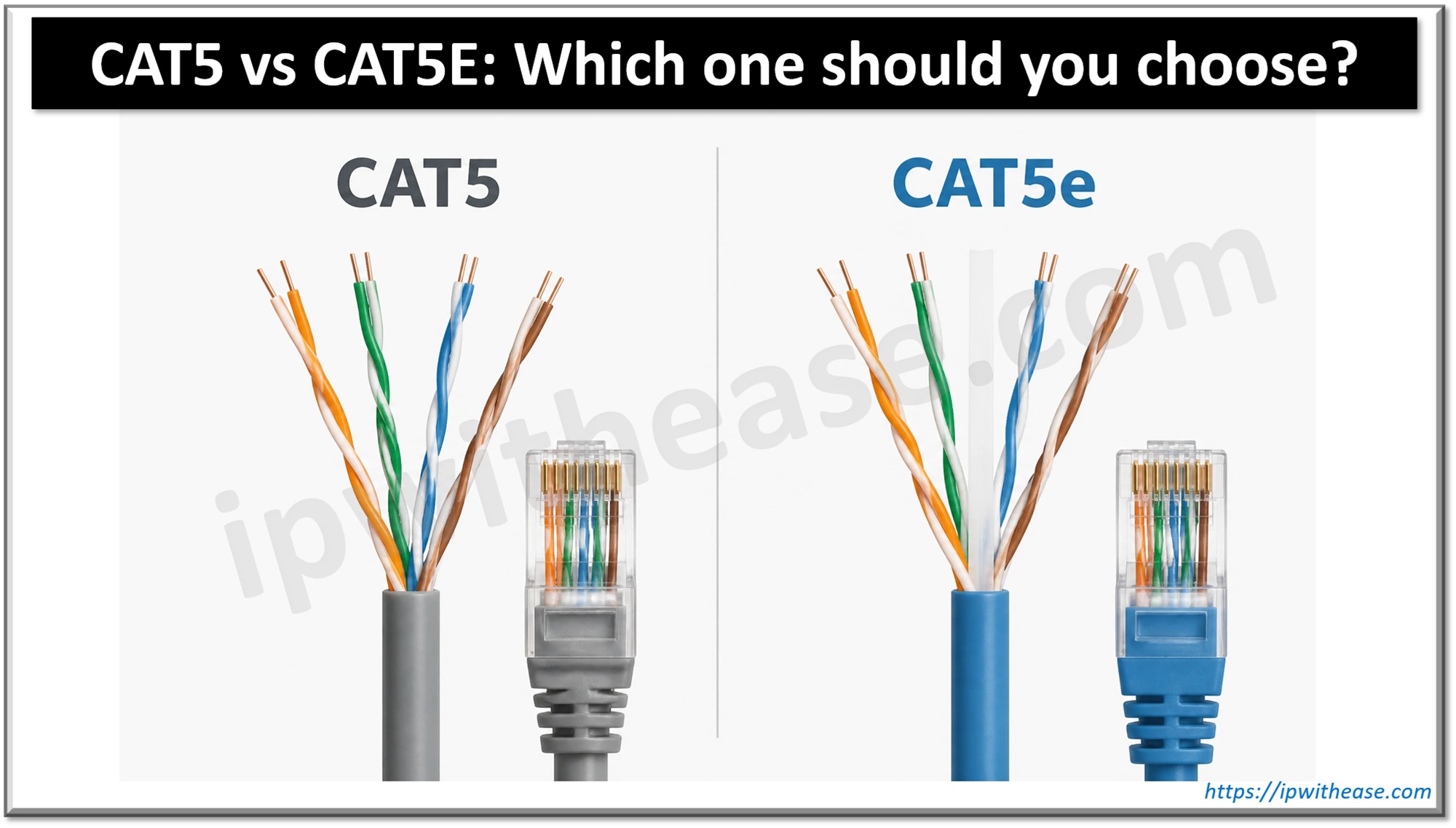
Physically, there is little visible difference between CAT5 and CAT5e cables. The improvement lies mainly in manufacturing quality: tighter and more consistent twist rates and stricter tolerances that keep noise between pairs under control. Many CAT5e cables also come with better-quality jackets, which can add to durability, although jacket design varies by manufacturer rather than being a requirement of the standard.
Similarities between CAT5 and CAT5e
Because CAT5e evolved directly from CAT5, the two standards share a great deal:
- Cable construction: Both are made of four twisted pairs of copper wire.
- Conductor size: Both typically use 24 AWG conductors.
- Shielding: Both are most commonly unshielded twisted pair (UTP), with shielded (STP) variants available for noisy environments.
- Connector: Both terminate with the same RJ45 (8P8C) connector.
- Wiring standard: Both follow the T568A and T568B pinout schemes.
- Bandwidth: Both are rated for frequencies of up to 100 MHz.
- Impedance: Both have a characteristic impedance of 100 ohms.
- Maximum length: Both support a maximum channel length of 100 metres, typically 90 metres of permanent cabling plus up to 10 metres of patch cords.
- Power over Ethernet: Both can carry PoE to devices such as IP phones, cameras and access points.
- Typical use: Both are used for LAN cabling in homes and offices.
In practice, this means the two cables are fully interoperable. You can plug a CAT5e patch cord into a CAT5 wall jack or punch CAT5e down on an older patch panel without any issues. The only catch is that a mixed link will perform to the level of its weakest component.
Differences between CAT5 and CAT5e
Now that we understand the similarities between the two cabling standards, let’s look at how CAT5 is different from CAT5e across various parameters.
1. Speed
This is the difference most people care about. CAT5 is rated for 10/100 Mbps. CAT5e is rated for 1 Gbps (1000 Mbps) over the full 100-metre distance. Under the IEEE 802.3bz standard, CAT5e also supports 2.5GBASE-T at full length, and 5GBASE-T often works on shorter, clean CAT5e runs, although 5 Gbps was formally targeted at CAT6.
Gigabit Ethernet may work over good-quality CAT5, but the standard does not guarantee it.
2. Crosstalk performance
Crosstalk is the main reason CAT5 struggles at gigabit speeds. CAT5 was tested mainly for near-end crosstalk (NEXT) between individual pairs. CAT5e tightened the NEXT limits and introduced additional tests:
- PSNEXT (Power Sum NEXT): the combined crosstalk from all three neighbouring pairs on a single pair, which is exactly what happens when all four pairs carry data at once.
- ELFEXT and PSELFEXT: crosstalk measured at the far end of the cable.
- Return loss: the amount of signal reflected back towards the transmitter because of impedance mismatches.
3. Use of wire pairs
At its top rated speed, CAT5 (100BASE-TX) uses two pairs. CAT5e at gigabit speed uses all four pairs simultaneously in both directions.
4. Build quality and durability
Both cables look the same, but CAT5e is manufactured to tighter tolerances, with more consistent twisting of each pair. Better-quality jackets on many CAT5e products also make them more durable in day-to-day handling.
5. Standards status
CAT5 is now obsolete for new installations and is no longer recognised in current TIA-568 standards. CAT5e is still a recognised category and remains widely deployed.
6. Cost and availability
Brand new CAT5 is hard to find from reputable suppliers today. CAT5e is inexpensive and readily available, and the price difference between the two was never large to begin with.
CAT5 vs CAT5e: Comparison Table
| Parameter | CAT5 | CAT5e |
|---|---|---|
| Full form | Category 5 | Category 5 Enhanced |
| Standard | TIA/EIA-568-A | TIA/EIA-568-B and later |
| Maximum speed | 100 Mbps | 1 Gbps (2.5 Gbps under 802.3bz) |
| Bandwidth | 100 MHz | 100 MHz |
| Pairs used at top speed | 2 | 4 |
| Crosstalk testing | NEXT only | NEXT, PSNEXT, ELFEXT, PSELFEXT, return loss |
| Noise and interference | Higher | Lower |
| Build quality | Basic | Tighter twists, stricter tolerances |
| Backward compatibility | N/A | Fully compatible with CAT5 |
| Current status | Obsolete | Recognised and widely used |
| Cost | Slightly lower (where still available) | Low and widely available |
| Recommended for new installs | No | Yes |
How to identify CAT5 and CAT5e cables
Since both cables look nearly the same, the easiest way to tell them apart is to check the printing on the jacket. Reputable manufacturers print the category (“CAT5E”, “Category 5e”) along with the conductor gauge and fire rating every metre or so.
If a cable has no markings, treat it as unknown. For installed cabling, a cable certifier settles the question by testing NEXT, PSNEXT, return loss and length against the standard’s limits.
Which one should you choose?
For any new installation, choose CAT5e at a minimum. It handles gigabit desktops, IP phones, CCTV cameras, home networks and most access-layer connections comfortably, and gives you headroom for 2.5 Gbps.
If you are cabling a building that needs to last a decade or serve Wi-Fi 6E and Wi-Fi 7 access points, consider CAT6 or CAT6A instead, since multi-gigabit speeds are becoming the norm.
If you already have CAT5 in place, it is not automatically useless. Many CAT5 runs will pass gigabit traffic without trouble. Test them first and replace only the links that fail.
FAQs
What does the “e” in CAT5e mean?
It stands for “Enhanced.” CAT5e is an improved version of CAT5 with tighter performance specifications.
Can CAT5 support Gigabit Ethernet?
Sometimes, particularly on short, well-terminated runs. However, gigabit is not guaranteed on CAT5, and marginal links may drop to 100 Mbps or show errors.
Is CAT5e backward compatible with CAT5?
Yes. Both use the same RJ45 connectors and pinouts, so they can be mixed. The link will then perform at CAT5 levels.
Is there a physical difference between CAT5 and CAT5e?
Not one you can easily see. The differences are in twist rates, manufacturing tolerances and tested performance. The jacket marking is the most reliable way to tell them apart.
Is CAT5e still good enough today?
For most homes and standard office desks, yes. For multi-gigabit access points or 10 Gbps links, CAT6A is the better choice.
Do CAT5 and CAT5e both support PoE?
Yes. Both can carry Power over Ethernet, since power is delivered over the same pairs used for data.
Related Video
ABOUT THE AUTHOR

You can learn more about her on her linkedin profile – Rashmi Bhardwaj