Table of Contents
A network engineer gets a routine request: bring up BGP for a new branch site, two ISP uplinks, standard route filtering. Not long ago that meant an hour of copying from the last branch template, editing prefixes and double-checking the route-maps.
This time the AI assistant produces the full config in about thirty seconds. It looks clean. It even has comments.
The engineer then spends the rest of the afternoon checking it. One prefix-list allows a /24 it shouldn’t. A route-map uses syntax from a different OS version. The local-preference values would quietly send all traffic out the backup link. None of these would have shown up in a lab with one uplink.
That afternoon is a good picture of where engineering is heading. AI didn’t remove the work. It moved it, from typing to thinking, checking and owning the result. In this post we look at how AI deployment is changing what engineers actually do day to day, which skills are gaining value, and how to stay ahead of the shift.
Why AI Deployment is Changing the Engineer’s Role
There’s a big difference between trying AI and deploying it. A pilot is a few engineers using a chatbot on the side. Deployment means AI is part of the production workflow: generating configs, drafting change tickets, triaging alerts, and in some teams taking actions through agents.
Once that happens, three things change at the same time:
- First drafts become almost free. Configs, scripts, runbooks and LLDs can be generated in seconds.
- Verification becomes the expensive part. Every output still has to be checked by someone who understands the network.
- Accountability doesn’t move. When a change causes an outage, “the AI wrote it” is not an acceptable RCA. The engineer who approved it still owns it.
Put those together and the job shifts. Less of your day goes on producing, and more goes on specifying, reviewing, integrating and governing.
From Writing Configs to Reviewing Them
The most visible change is that engineers now read far more than they write. Reviewing AI output is also a different skill from reviewing a colleague’s work. A colleague’s mistakes follow patterns you learn over time. A model’s mistakes are confident, neatly formatted and easy to miss.
Common errors to watch for in AI-generated network configs:
- Wrong platform syntax. Commands from a different OS, vendor or software version that look right but fail or behave differently.
- Overly permissive rules. ACLs, security groups or prefix-lists that allow slightly more than intended, often with an “any” that slipped in.
- Invented values. Made-up IP addresses, VLAN IDs, AS numbers or interface names that don’t exist in your environment.
- Missing failure handling. Configs that work when everything is up but were never designed for link, device or site failure.
- Deprecated features. Older commands or protocols that the model saw often in its training data.
This is why deep fundamentals matter more now, not less. You can’t catch a subtle routing mistake if you don’t understand routing. The engineer’s role is starting to look like a cross between an editor and an auditor: know the domain well, and never approve something just because it parsed.
Specification is The New Bottleneck
When generating a config costs nothing, the expensive part is explaining what you actually want. Vague intent gives you vague output, just faster.
Here’s how vague and specific requests compare:
| Vague request | Specific request |
| “Write a BGP config for a branch.” | “eBGP to two ISPs, private AS 65010, advertise only 10.20.0.0/22, ISP-A primary via local-pref 200, accept default route only.” |
| “Create a firewall policy for the app.” | “Allow HTTPS from the DMZ web tier to app servers on TCP 8443 only, deny all else, log denies.” |
| “Design a VPC for production.” | “Three AZs, no public IPs on app or DB subnets, egress via NAT, must survive one AZ failure.” |
| “Write a MOP for the upgrade.” | “MOP for a core switch upgrade in a 2-hour window, with pre-checks, rollback trigger and post-validation commands.” |
The engineers getting the most from AI tools are the ones who write clear requirements. They state constraints up front, provide context like naming standards and current topology, and break big problems into pieces small enough to verify.
If that sounds like architecture work, it is. Turning business needs into precise technical intent used to be a senior engineer’s job. Now every engineer does it daily just to use their tools well. If you’re already good at writing HLDs and LLDs, you have a head start.
What Changes for Infrastructure and Network Engineers
For a while AI looked like a story for software developers and data scientists. Deployment changed that. Once a model leaves the notebook and goes into production, it becomes an infrastructure problem.
| Area | What’s changed | What engineers now own |
| Compute placement | Inference can run on-prem, in a hyperscaler, on a GPU cloud or at the edge | Choosing placement based on latency, data residency and cost |
| Data center network | Training clusters need high-bandwidth, low-latency east-west fabrics | Designing for RDMA, RoCE, lossless Ethernet or InfiniBand |
| Cloud cost | Token usage, GPU hours and egress charges grow quietly | Budgets, quotas, tagging and cost dashboards |
| Observability | “Service is up” no longer means “service is working” | Monitoring latency, token throughput, error rates and model drift |
| Connectivity | AI apps call external APIs and pull from many data sources | Secure egress, private endpoints and API gateways |
Engineers who understand both the AI workload and the plumbing underneath it are still rare. That makes them some of the most valuable people in any organization running AI at scale.
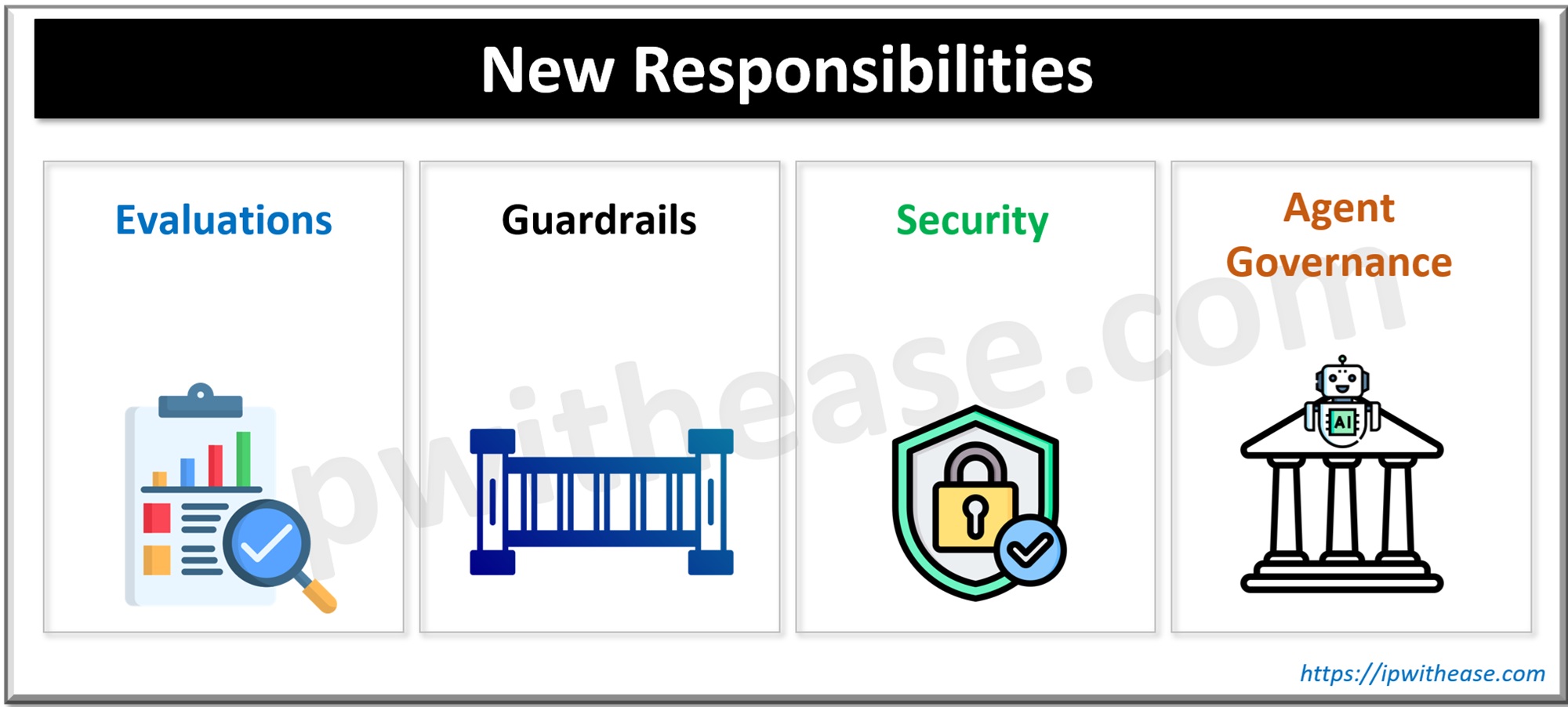
New Responsibilities: Evals, Guardrails, Security and Agent Governance
Deploying AI responsibly creates work that didn’t exist as an engineering discipline a few years ago. Much of it lands on engineers simply because nobody else owns it.
- Evaluations (evals). Traditional tests pass or fail. AI needs evals: curated inputs with expected behaviour that show whether a new model, prompt or data source made things better or worse. Building them is real engineering, and they need constant upkeep.
- Guardrails. Input filtering, output validation, rate limits and fallbacks for when the model times out or returns something it shouldn’t. These are design decisions with failure modes, like any other part of the system.
- AI security. Prompt injection, data leaking through retrieval pipelines, over-permissioned service accounts and shadow AI tools signed up for on a corporate card. The attack surface has grown, and security teams need engineers who understand how these systems really behave.
- Agent governance. When an AI agent can open tickets, change configs or call APIs on its own, someone has to define what it may do, log every action and decide where a human must approve. Treat it like a new privileged user on the network: least privilege, full audit trail, and a clear kill switch.
Agent governance is the newest of these, and probably the most important. It’s a policy and architecture problem first, and a tooling problem second.
Skills Losing Value vs Skills Gaining Value
It’s worth being honest here. Some skills that used to set engineers apart are turning into commodities.
| Skill area | Losing value | Gaining value |
| Syntax and commands | Memorising CLI syntax and config formats | Knowing why a design works and where it breaks |
| Automation | Writing boilerplate scripts from scratch | Breaking problems into verifiable pieces |
| Documentation | Producing first drafts of LLDs and MOPs | Judging whether output is accurate and safe |
| Expertise | Deep knowledge of a single tool or vendor | Systems thinking across network, cloud, security and data |
| Collaboration | Working alone on implementation | Explaining intent clearly to people and to models |
The common thread: anything that’s mostly recall or repetition is getting cheaper. Anything that needs judgement, context or accountability is getting more valuable.
What this means for Junior Engineers
This is the uncomfortable part. Much of the work that used to train junior engineers, the repetitive VLAN changes, the small scripts, the first-draft documentation, is exactly what AI now handles well. If juniors never do that work, how do they build the judgement needed to review it?
Keeping juniors away from AI tools isn’t the answer. Being deliberate about how they learn is. A few practices that help:
- Ask juniors to explain every line of AI-generated output before it goes into a change request.
- Give them real troubleshooting problems to reason through, not just configs to deploy.
- Pair them with senior engineers during reviews so they see what “good” looks like.
- Rotate them through lab work where they build things by hand first, then compare with what the AI produces.
The apprenticeship model isn’t dead. It just has to be redesigned on purpose.
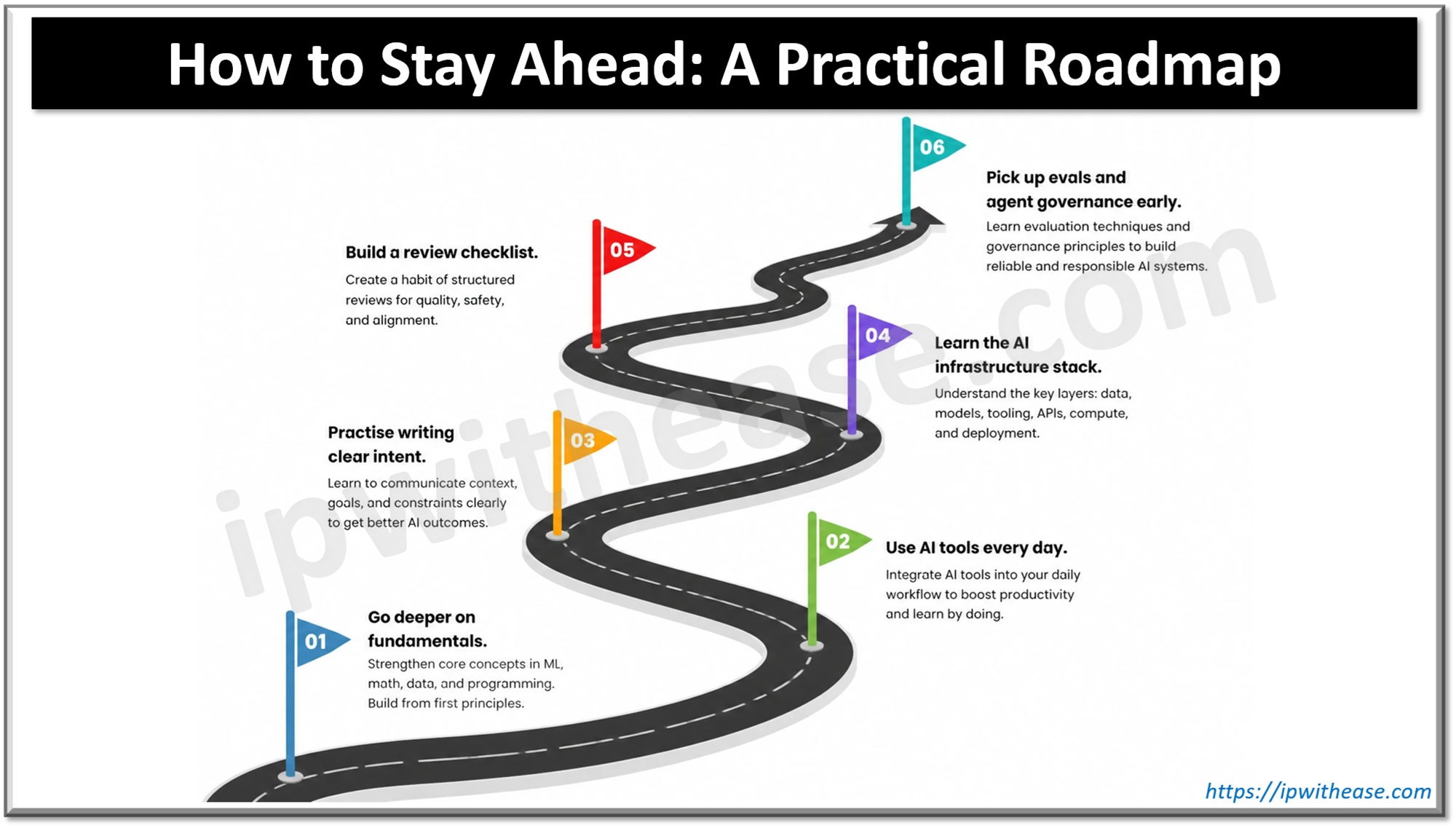
How to Stay Ahead: A Practical Roadmap
If you’re wondering where to put your energy, here’s a simple plan:
- Go deeper on fundamentals. Routing, switching, distributed systems, security models and failure domains. This is what lets you catch the mistake a model makes with total confidence.
- Use AI tools every day. You can’t learn to supervise AI from blog posts, including this one. Use assistants on real tasks and note where they fail.
- Practise writing clear intent. Treat every prompt like a mini design document: context, constraints and expected outcome.
- Learn the AI infrastructure stack. GPUs, inference serving, vector databases, and the networking that ties them together.
- Build a review checklist. Platform syntax, addressing, security rules, failure behaviour and rollback. Run every AI output through it.
- Pick up evals and agent governance early. Few people want to own these areas today, which makes them a great way to become indispensable.
AI deployment isn’t replacing engineers. It’s changing what the job rewards: less typing, more thinking, and more responsibility for making sure things were done right. Start small this week. Take one task you’d normally do by hand, let an AI assistant draft it, and review it as if a new hire wrote it. You’ll learn quickly where the tools help and where your experience still matters most.
ABOUT THE AUTHOR

IPwithease is aimed at sharing knowledge across varied domains like Network, Security, Virtualization, Software, Wireless, etc.