Table of Contents
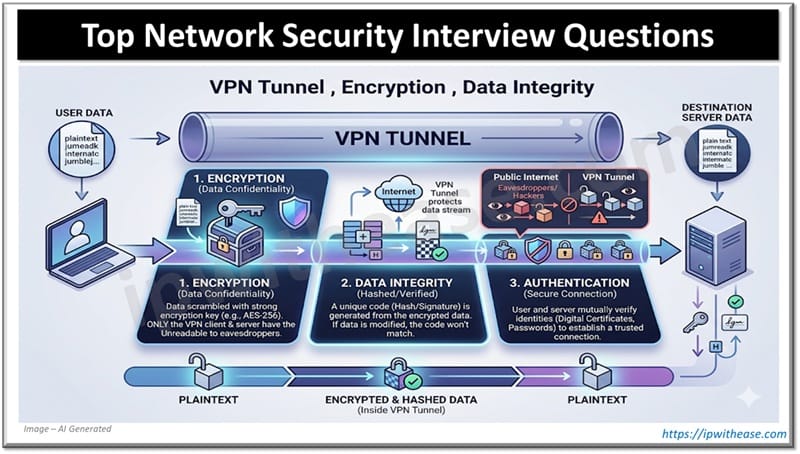
The most effective approach to answering network security interview questions is to explain the technology, where it might fail, and how you would test the technology in a real network. In this topic, the ideal answer will typically consist of three pieces about how the VPN tunnels carry traffic securely, how the encryption protects the data, and how the integrity checks show that the data was not altered during transit. A modern candidate should also know how Kill Switch and Split Tunneling features work as they impact real VPN behaviour when outages occur, when reconnecting and when routing mixed traffic.
During the interview, it’s very important to explain how you would test these features in a production environment, rather than just reading about them in a textbook. You can describe a real-world scenario in which you compare standard tunneling with a deliberate failure of the Kill Switch feature and custom split-tunneling routes. Using a specific tool for practice, such as a good VPN service, will help reinforce the theory, correlate diagrams on the board with real-world configurations, and demonstrate your understanding of how this technology works.
What interviewers expect from network security interview questions
Most network security interview questions are not memory tests. They are scenario tests. A junior candidate may be asked to define a VPN, but a stronger answer explains the path of a packet, the protection applied to it, and the weak point that could expose traffic.
NIST defines a VPN as a virtual network built on top of existing physical networks that can provide secure communication for data transmitted between networks or nodes. That makes VPNs useful for remote work, branch offices, and safer access over untrusted networks.
Top 10 Network Security Interview Questions and Short Answers
1. What is VPN Tunnel?
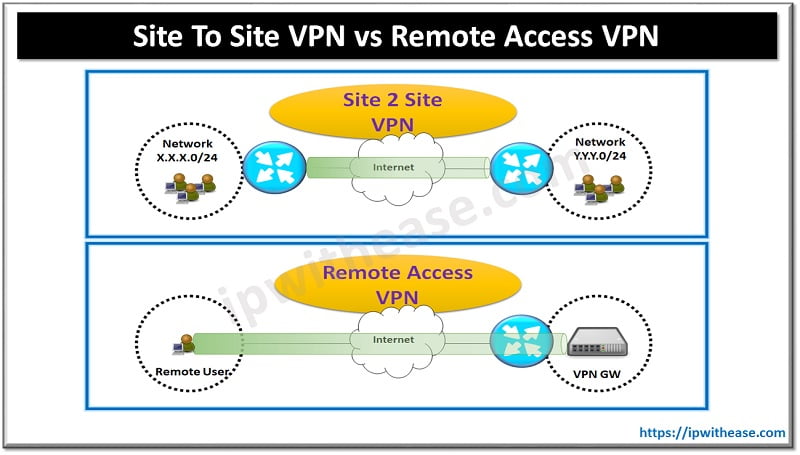
Virtual private network (VPN), or remote access VPN, is a link between a user device and a private network. Site-to-site VPN is one of the VPN where two networks (such as a branch office and headquarters) are connected with each other.
2. What is the difference between remote access VPN and site-to-site VPN?
A remote access VPN allows a user to use a VPN to connect to a private network while working from another location. Site-to-site VPN is a VPN connection made to link two networks together, like a branch office and headquarters.
3. What is the role of encryption in protecting the VPN traffic?
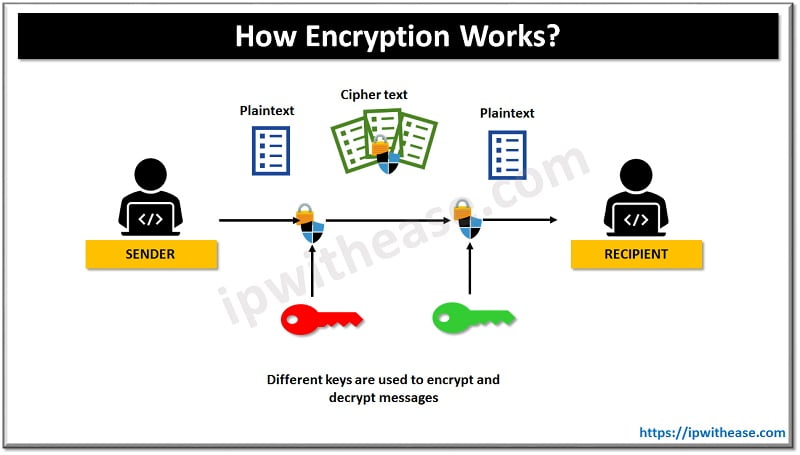
Encryption converts data into something that is not readable, or ciphertext. It can only be recovered by the appropriate cryptographic material.
4. What is Symmetric Encryption?
Symmetric Encryption: The key for encrypting is same as the key for decrypting. AES is provided as an example by NIST.
5. Explain asymmetric encryption?
A public-private key pair is used by asymmetric encryption. One of these encrypts, the other decrypts.
6. Why is it that VPNs employ both symmetric and asymmetric techniques?
Identity and key exchange are done by way of asymmetric cryptography. Symmetric cryptography is used for rapid bulk data protection.
7. Data Integrity is what in network security?
Data integrity is when the receiver can determine if the data has been altered during transmission. Popular tools include hashes, MACs, and digital signatures.
8. What is HMAC?
The HMAC is one of the important methods for message authentication that uses keys. A way to find out if the sender had the shared secret, and if there has been any unauthorized alteration.
9. What is a VPN Kill Switch and why is it important?
A Kill Switch prevents IP or traffic leaks when the VPN connection is lost, to protect your privacy in case of failures. Proton VPN says it’s “defending against the IP address in the event of an unexpected VPN disconnection.
10. What is the purpose of Split Tunneling?
Split Tunneling routes selected traffic and leaves other traffic on the regular Internet connection. This is a way described by Microsoft to route specific traffic from Microsoft 365 devices out of the VPN to lighten the load and enhance performance.
VPN Tunnel Interview Questions: What to Explain Clearly
Good VPN tunnel interview questions often begin with a simple prompt: “Explain what happens when a user connects to a VPN.” A strong answer should move in order:
- The client contacts the VPN gateway.
- The server and client authenticate each other.
- They agree on cryptographic settings.
- A tunnel is created.
- Traffic is encrypted and routed through that tunnel.
- Integrity checks help detect tampering.
- The session ends, reconnects, or fails based on policy.
One of the problems is when people say, “the internet is secure if you use a VPN.” That is too broad. A better answer is a VPN is only one part of the security puzzle; there are still other components to consider, such as configuration and endpoint trust, handling the DNS, and application behavior.
Remote Access VPN Interview Questions
Remote access VPN interview questions usually focus on employees, contractors, or administrators connecting from outside the office. The main risk is that the user device becomes the new edge of the network.
| Interview angle | Strong answer |
| User access | Use MFA, device checks, and least privilege |
| Traffic path | Confirm whether all traffic or only private traffic uses the tunnel |
| Failure case | Test what happens when Wi-Fi drops or the VPN reconnects |
Site to Site VPN Interview Questions
Site to site VPN interview questions focus on network-to-network traffic. The candidate should talk about routing, subnets, firewall rules, and tunnel monitoring.
| Area | What can go wrong |
| Routing | Traffic goes outside the tunnel because of a wrong route |
| Subnets | Overlapping private ranges break communication |
| Firewall rules | Tunnel is up, but allowed traffic is blocked |
| Monitoring | The team sees the outage only after users report it |
A useful interview phrase: “Tunnel up does not always mean traffic flows. I would check phase status, routing table, firewall policy, and packet counters.”
Encryption Questions: Symmetric vs Asymmetric Encryption
Encryption questions test whether the candidate knows the difference between speed, trust, and identity. Symmetric encryption is efficient for large amounts of traffic. Asymmetric encryption is useful when two sides need to establish trust without already sharing the same secret.
| Type | How it works | Common interview point |
| Symmetric encryption | Same secret key protects and restores data | Fast for VPN traffic |
| Asymmetric encryption | Public-private key pair | Useful for identity, certificates, and key exchange |
NIST notes that asymmetric cryptography uses two separate keys, while symmetric cryptography uses the same secret key for its operation.
Data Integrity Interview Questions: Hashes, MACs, and Signatures
Data integrity interview questions check whether a candidate can separate privacy from trust. Encryption hides content. Integrity checks help prove the content was not changed.
A useful mini-test for interviews:
- Send message A.
- Calculate a hash or authentication tag.
- Change one character in message A.
- Calculate again.
- Compare the result.
If the result changes, the receiver knows the message is no longer the same. A MAC adds a shared secret to this process, so it can provide integrity and authenticity. NIST describes a message authentication code as a cryptographic checksum designed to reveal accidental or intentional modification of data.
Plain interview answer: “Confidentiality hides the data. Integrity shows whether the data changed. Authentication helps confirm who sent it.”
Kill Switch and Split Tunneling in Network Security Interview Questions
Kill Switch and Split Tunneling features are useful because they show how security works during imperfect conditions.
A Kill Switch answers this question: “What happens when the VPN fails?”
If the tunnel drops, the Kill Switch blocks traffic instead of letting the device fall back to the open internet.
Split Tunneling answers another question: “Does all traffic need to go through the VPN?”
Sometimes the answer is no. For example, video meetings or cloud apps may use a direct route, while internal systems stay inside the tunnel. Fortinet describes VPN Split Tunneling as routing some traffic through an encrypted VPN while other traffic has direct internet access.
The risk is misrouting. If sensitive traffic is placed outside the tunnel by mistake, Split Tunneling can weaken the setup. A good candidate should say: “I would define allowed split routes carefully, test DNS behavior, and confirm that private resources never bypass the tunnel.”
Network Security Questions for Junior Roles: A Practical Checklist
For network security interview questions, junior candidates should avoid long theoretical answers. The interviewer wants clean thinking.
Before the interview, prepare short answers for:
- VPN tunnel setup and failure behavior.
- Remote access VPN versus site-to-site VPN.
- Symmetric versus asymmetric encryption.
- Confidentiality versus integrity.
- Hash versus HMAC versus digital signature.
- Kill Switch behavior during reconnects.
- Split Tunneling risks and routing checks.
A practical interview habit: draw the path. Put “user,” “VPN client,” “VPN gateway,” “internal app,” and “public internet” on paper. Then show which traffic is encrypted, which route is trusted, and where integrity checks apply.
Data Integrity Explained
Strong answers to network security interview questions connect theory with behavior in critical situations. VPN tunnels protect traffic paths. Encryption protects content. Integrity checks detect changes. Kill Switch and Split Tunneling features show whether the candidate can think beyond definitions and explain how real VPN connections behave when networks fail, reconnect, or route traffic in different ways.
ABOUT THE AUTHOR

IPwithease is aimed at sharing knowledge across varied domains like Network, Security, Virtualization, Software, Wireless, etc.