Table of Contents
If you’ve spent any time on tech Twitter or LinkedIn in the last couple of years, you’ve probably seen the term “Forward Deployed Engineer” thrown around — often with a mix of curiosity and confusion. Palantir popularized the role, and now a growing number of AI and enterprise software companies are hiring for it. But what does a Forward Deployed Engineer actually do, and how is the role different from a regular software engineer, solutions architect, or consultant?
This post breaks down what the role really involves, why companies are increasingly betting on it, and what it takes to succeed in it.
Forward Deployed Engineer
A Forward Deployed Engineer (FDE) is a hybrid engineer-consultant who works directly at or with a customer’s site to build, customize, and deploy software solutions that solve that customer’s specific problems; often writing production code on the fly, rather than shipping a generic product and walking away.
The word “forward deployed” is borrowed from military language, where forward-deployed units operate close to the front lines rather than at a distant headquarters. Applied to engineering, it means the engineer works close to the actual problem — inside the customer’s environment, workflows, and data — instead of sitting back at company HQ building features based on secondhand requirements.
What an FDE Actually Does Day to Day
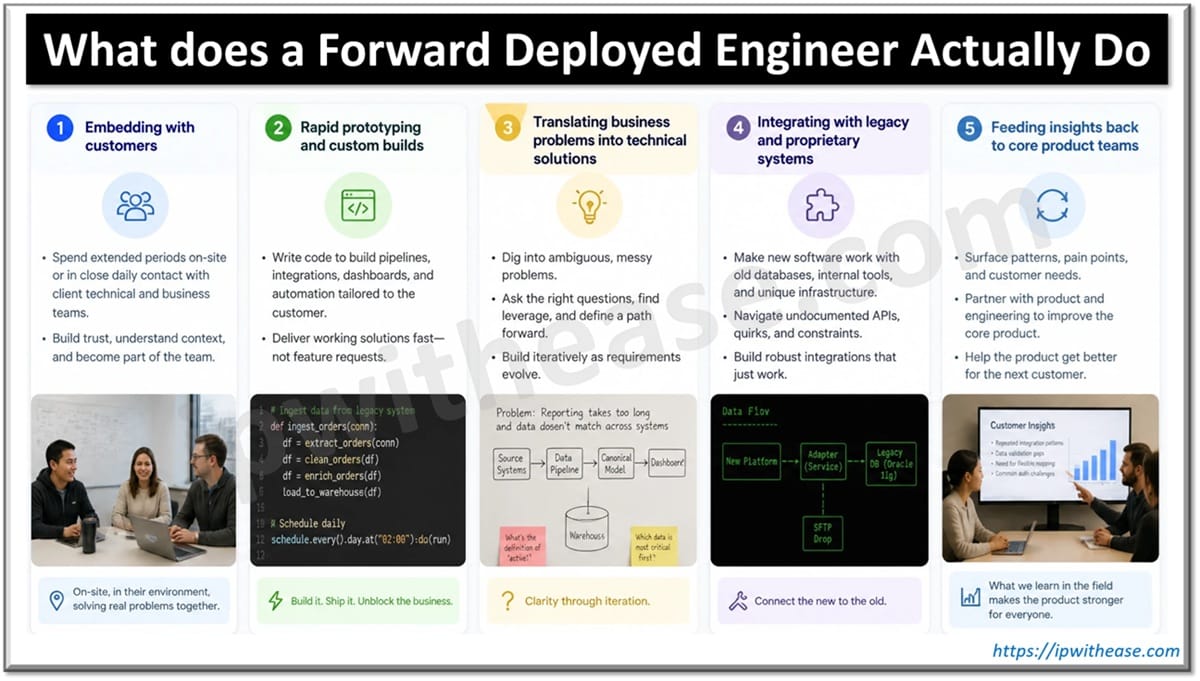
An FDE’s work typically spans several overlapping responsibilities:
- Embedding with customers: FDEs often spend extended periods on-site or in close daily contact with a client’s technical and business teams, sometimes for weeks or months on a single engagement.
- Rapid prototyping and custom builds: Instead of filing a feature request back to a product team, an FDE writes code — pipelines, integrations, dashboards, automation scripts — tailored to that specific customer’s data and systems.
- Translating business problems into technical solutions: A large part of the job is understanding messy, ambiguous business problems and turning them into a working technical implementation, often before the requirements are fully clear.
- Integrating with legacy and proprietary systems: Enterprise customers rarely have clean, modern tech stacks. FDEs frequently have to make new software work with old databases, internal tools, and idiosyncratic infrastructure.
- Feeding insights back to core product teams: Patterns and pain points discovered in the field often get routed back to central engineering, which uses them to improve the core product for future customers.
FDE vs. Solutions Architect vs. Consultant vs. Software Engineer
The role sits at an intersection, which is part of why it confuses people. Here’s a rough comparison:
| Role | Primary Focus | Writes Production Code? | Customer-Facing? |
| Software Engineer | Building the core product | Yes | Rarely |
| Solutions Architect | Designing technical solutions, advising | Sometimes | Yes |
| Management Consultant | Business strategy and process | No | Yes |
| Forward Deployed Engineer | Building custom solutions on customer turf | Yes | Yes, heavily |
The key differentiator is that an FDE combines the technical depth of an engineer with the client-facing, problem-diagnosis skills of a consultant — and unlike a consultant, they’re expected to actually ship working software, not just a slide deck of recommendations.
Why Companies Are Hiring for This Role Now
A few forces are driving demand for FDEs, especially in AI infrastructure and enterprise software:
- Enterprise AI deployments are messy. Off-the-shelf AI tools rarely work out of the box against a large enterprise’s actual data, security constraints, and legacy systems. Someone has to bridge that gap, and it’s usually an engineer who can work directly with the customer’s environment.
- Faster time-to-value matters. Enterprise sales cycles are long, and the gap between “signed contract” and “customer actually sees value” can kill a deal. FDEs compress that gap by building working solutions during the engagement itself, rather than waiting on a generic product roadmap.
- Product-market fit for complex software is discovered, not designed. For sophisticated platforms — data integration, AI infrastructure, government and defense tech — the real requirements often only surface once an engineer is inside the customer’s actual workflow. FDEs act as a feedback loop between the field and the product org.
Skills That Matter for an FDE
Because the role blends engineering and client work, the skill set looks a little different from a typical engineering hire:
- Strong, versatile coding ability — often full-stack, since you don’t know in advance what a given customer’s problem will require
- Comfort with ambiguity and rapidly changing requirements
- Systems thinking, especially around integrating with unfamiliar or legacy infrastructure
- Communication skills strong enough to run a room of non-technical stakeholders
- A degree of resilience and travel tolerance, since on-site work is common
- Business and domain fluency — understanding not just the technology but the customer’s industry and incentives
Is the FDE Role Right for You?
The FDE path tends to suit engineers who get bored with narrow, well-scoped tickets and want more ownership over outcomes, not just code. It also suits people who like variety — no two engagements look alike — and who don’t mind the ambiguity of walking into a customer’s environment without a fixed spec.
It’s less suited to engineers who prefer deep, focused work on a single codebase, or who strongly prefer to avoid client interaction. The travel and always-on-call-for-the-client nature of the role is also a real trade-off worth weighing.
Final Thoughts
The Forward Deployed Engineer role reflects a broader shift in how complex enterprise and AI software actually gets adopted: not through generic products alone, but through engineers who are willing to go where the problem is and build the solution in place. As enterprise AI adoption accelerates, expect the FDE title — or roles that look a lot like it — to keep showing up in job postings across the industry.
Related Video
ABOUT THE AUTHOR

You can learn more about her on her linkedin profile – Rashmi Bhardwaj