Table of Contents
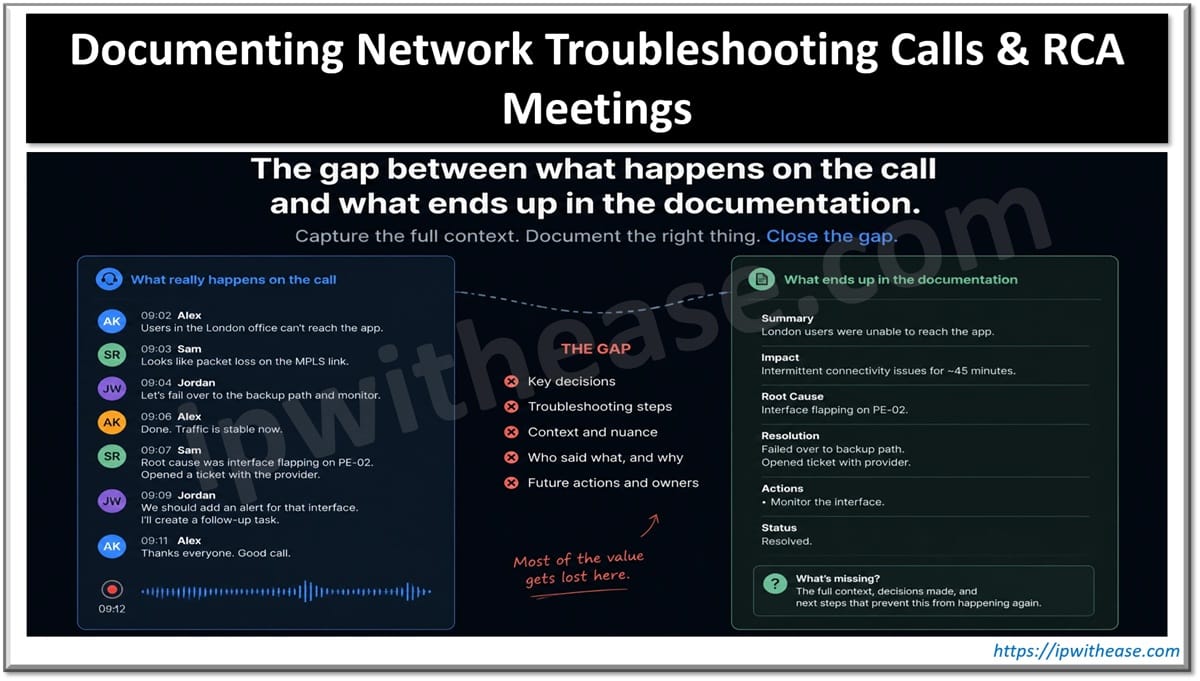
Anyone who has sat through a two-hour bridge call during a P1 outage knows the drill. The war room fills up, engineers start throwing out hypotheses, someone from the vendor side joins in, half the conversation is technical shorthand, and by the time the issue is resolved, nobody quite remembers who said what or when the real breakthrough happened. Somebody eventually writes up a summary from memory, and that summary becomes the official record — even though it rarely captures the actual sequence of troubleshooting steps that got the network back up.
This gap between what happens on a call and what ends up in the documentation is one of the most underrated problems in network operations. And it’s why more infrastructure teams are quietly adding transcription into their incident response and change management workflows.
Network troubleshooting Documentation Problem Nobody Talks About
Network troubleshooting is a verbal, real-time process. Engineers talk through packet captures, argue about whether a BGP flap is the cause or the symptom, reference runbooks out loud, and make decisions on the fly. None of that reasoning typically makes it into the post-incident report. What survives is usually a sanitized timeline: “Issue detected at 14:02. Root cause identified at 14:47. Resolved at 15:10.” The actual diagnostic path — the dead ends, the vendor escalation calls, the exact command outputs that pointed to the real problem — gets lost.
This matters more than it seems. When a similar issue resurfaces six months later, the team doesn’t have access to the reasoning that solved it the first time, only the conclusion. New engineers onboarding onto a team lose out on some of the best learning material available: real troubleshooting conversations between senior architects. And during formal RCA (root cause analysis) reviews, teams often end up reconstructing events from memory and fragmented chat logs instead of an accurate record of the call itself.
Where Call Recordings Already Exist, But Go Unused
Most enterprise IT environments already record calls in some form. Vendor support lines record for quality assurance. Internal bridge calls run through platforms like Zoom, Teams, or WebEx, most of which support recording. NOC shift handovers are sometimes recorded for compliance. The raw audio is often sitting there, untouched, in a recordings folder that nobody revisits unless there’s a dispute to settle.
The reason these recordings go unused isn’t a lack of value — it’s friction. Nobody wants to sit through 90 minutes of a troubleshooting call to extract five useful minutes of insight. Video and audio are inherently linear and slow to search. You can’t Ctrl+F your way through a recording. That’s the exact problem transcription solves.
From Recording to Searchable Documentation
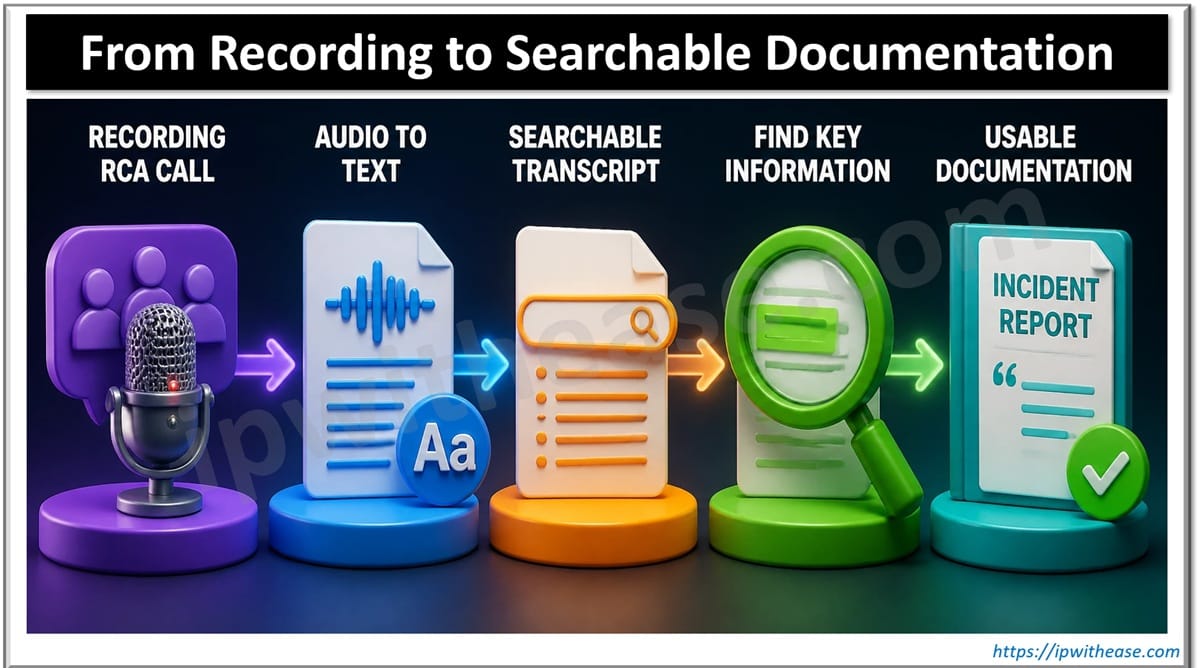
Once a call is converted into text, it stops being a passive artifact and becomes usable documentation. A transcribed RCA call can be scanned in minutes instead of replayed in full. Keywords like interface names, error codes, or device hostnames become searchable. Teams can pull direct quotes into their incident reports instead of paraphrasing from memory, which matters when precision counts — a vendor engineer saying “we saw the same flap on the upstream router” is a very different claim than “the vendor confirmed the issue was on their end.”
For teams handling this at scale, a straightforward audio file to text conversion step turns a folder of recorded bridge calls into a searchable archive almost automatically. It doesn’t replace a proper incident management system, but it fills the gap between “we recorded the call” and “we can actually do something useful with the recording.”
Practical Use Cases in Network Operations
A few places where this fits naturally into existing workflows:
- Vendor escalation calls. When you’re three hours into a call with a vendor’s TAC team, having a transcript afterward means you don’t have to rely on someone’s hurried notes to capture what was actually promised or diagnosed.
- Change management approvals. CAB (Change Advisory Board) calls often include verbal justifications and risk discussions that never make it into the change ticket. A transcript preserves the actual reasoning behind an approval or rejection.
- Post-incident reviews and blameless postmortems. RCA meetings benefit enormously from an accurate record, especially when the goal is to understand process failures rather than assign blame. A transcript keeps the conversation honest and specific.
- Knowledge transfer and onboarding. New network engineers learn a lot from watching how senior engineers troubleshoot. A searchable archive of past incident calls, converted to text, becomes an informal but genuinely useful training resource.
Getting Accuracy Right for Technical Content
One caveat worth flagging: transcription tools weren’t built with networking jargon in mind. Acronyms, device names, and protocol terms (think OSPF, VRRP, or vendor-specific hostnames) can trip up automatic transcription. It’s worth a quick manual pass over anything going into a formal RCA document, particularly around technical terms and proper nouns. For internal reference material where perfect accuracy matters less, the raw transcript is usually good enough as-is.
The Bigger Picture
None of this is about replacing incident management tools or formal documentation processes. It’s about closing a specific, persistent gap: the difference between what actually happens on a troubleshooting call and what gets written down afterward. As network environments grow more complex and distributed teams handle more incidents across time zones, having an accurate, searchable record of these conversations isn’t a nice-to-have anymore — it’s becoming part of how mature IT ops teams operate.
The next time your team wraps up a long RCA call, it might be worth asking: are we actually capturing what just happened, or just what we remember of it?
ABOUT THE AUTHOR

IPwithease is aimed at sharing knowledge across varied domains like Network, Security, Virtualization, Software, Wireless, etc.