Table of Contents
Architecture as Code is like writing down the “blueprint” of your software system in a simple text file, just like how you’d write a recipe. So that anyone (including computers) can read, check, and update it automatically, instead of drawing complicated diagrams that quickly become outdated.
Network architecture deals in planning, designing and implementing computer networks. Maintaining secure, scalable and efficient networks are required to meet business and customer requirements.
Data flow in a network and its communication with other components and their interconnectivity is defined by its Network architecture. Effective designing of network architecture ensures reliable and secure data communication and supports scalability to adapt to changing business needs.
Network architecture covers both physical layout of network hardware and logical data communication including communication protocols, ports, routing techniques which facilitate data movement in efficient, reliable and secure manner.
In today’s article we will understand architecture as a code, its features, components and benefits.
Understanding Architecture as Code (AaC)
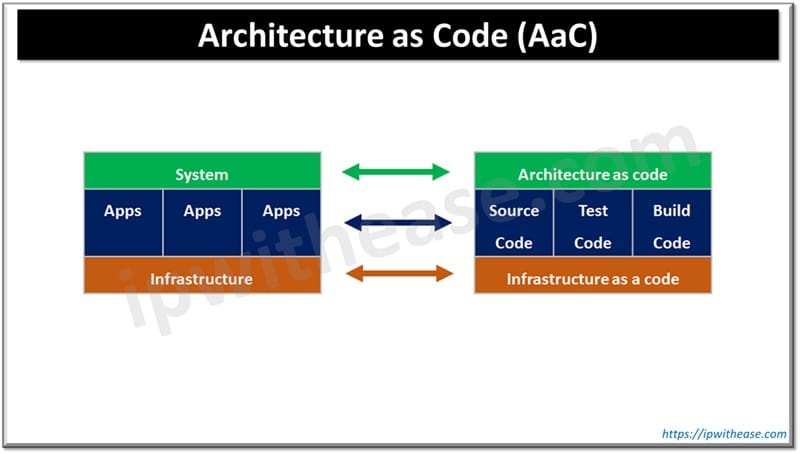
Architecture as Code is an extension of Infrastructure as a code (IaC) which focuses on automatic provisioning of infrastructure. Whereas AaC includes architecture designing for the entire system. It defines systems architecture overall and not just focuses on servers and networks but also on application architectures, configurations and interdependencies managed via code.
Traditional approach in software architecture is represented in diagrams, figures, flowcharts and textual representations. The real-time state of implementation is not captured by this traditional static approach where it is crucial for the network to adapt to dynamic business needs. Architecture as code approach defines architecture as executable code so as to ensure architecture is aligned with the current system state.
Key Features
- Governance – Architecture rules can be enforced with code to ensure logical structure is aligned to design and does not cause deviation.
- Automation and Integration – Continuous checks are achieved via automation to adapt to evolving needs of business. Architecture models are validated with CI/CD pipelines to ensure dependencies on system and API contracts remain unchanged as code evolves.
- Integration with Modern Development – architecture definition is stored in code repositories to enable tracking of versions to ensure architecture evolves along with the codebase.
- Leveraging AI and Models – tools like Structurizr or ArchiMate allow export in XML format of architecture models.
- Single Foundation of Truth – Architecture is stored in GitHub and any changes in architecture automatic Updation happens in generated diagrams
Core Components of AaC
In this section we will cover more in detail about core components and their needs.
- Modelling language – traditional static architecture of diagrams is replaced with machine-readable text files such as JSAON, YAML and specialized domain languages such as Structurizr or ArchiMate. The dynamic nature of architecture allows version control which can be modified and reviewed just like an application code.
- Architectural fitness functions – architecture characteristics such as cohesion, coupling and scalability are maintained with automated tests. Architectural baseline functions provide insight to developers if there are any structural changes in design which violates them.
- Diagram as code or visual documentation – automatic generation of diagrams and documentation using textual models can be achieved. Some popular tools in this space are Structurizr, ArchiMate and Mermaid. Visual documentation is always in sync with implemented architecture
- CI/CD integration for automation – Architecture blueprint is integrated with CI/CD pipelines for automated testing of architecture rules on every commit so as to ensure compliance and contain architecture decay
- Network component dependencies mapping – components such as containers, interfaces etc. are defined explicitly along with their interdependencies to ensure APIs and data flows are established as per clear demarcation of operating boundaries.
Benefits of AaC
- Up-to-Date: Since the architecture lives alongside the actual code, it gets updated together, no more outdated diagrams that no one trusts.
- Automation: Computers can read and act on the architecture automatically — spinning up servers, enforcing rules, or generating diagrams without human intervention.
- Consistency: The same architecture can be replicated across multiple environments (dev, testing, production) without errors caused by manual setup.
- Collaboration: Teams can work on architecture the same way they collaborate on code — using pull requests, reviews, and comments.
- Early Error Detection: Since architecture is written in structured formats, tools can automatically catch mistakes before they reach production.
- Cost Savings: Automation and fewer manual errors mean less time fixing problems, which directly saves money.
- Security & Compliance: Security rules written as code are automatically enforced everywhere, reducing the risk of human oversight.
- Faster Onboarding: New team members can simply read the architecture files to understand the entire system quickly, instead of hunting for outdated documents.
FAQs
Q.1 How does AaC differ from Infrastructure as Code (IaC)?
IaC focuses on provisioning infrastructure resources (VMs, networks, storage). AaC captures higher-level architectural intent, patterns, constraints, and interactions across systems, often referencing IaC for implementation.
Q.2 What are common use cases for AaC?
Enforcing architectural guardrails, documenting system topology, automated compliance checks, environment generation for testing, platform onboarding, and reproducible reference architectures.
Q.3 What formats/approaches are used to express AaC?
Declarative YAML/JSON/DSLs, architectural models (C4, UML) as code, policy-as-code languages (Rego), graph/metadata representations, and custom domain-specific languages.
Q.4 Which tools support AaC?
Tools vary by scope: policy engines (OPA/Rego), model-driven tools (Structurizr DSL), configuration platforms (Terraform + modules for architecture patterns), graph/datamodel tools (Neo4j, GraphQL schemas), and proprietary platform engineering solutions.
Q.5 How is AaC integrated with CI/CD?
Architectures are validated in pipelines via static checks, policy tests, automated model verification, environment provisioning for integration tests, and gated merges that enforce architectural rules.
Q.6 What are common organizational practices for AaC adoption?
Start with high-value patterns, create reusable modules/templates, enforce automated checks in CI, establish architecture owners, and provide training and documentation.
Q.7 What are the challenges and risks?
Overcomplication of models, tool fragmentation, maintaining model accuracy, cultural resistance, and balancing flexibility vs. guardrails.
ABOUT THE AUTHOR

You can learn more about her on her linkedin profile – Rashmi Bhardwaj